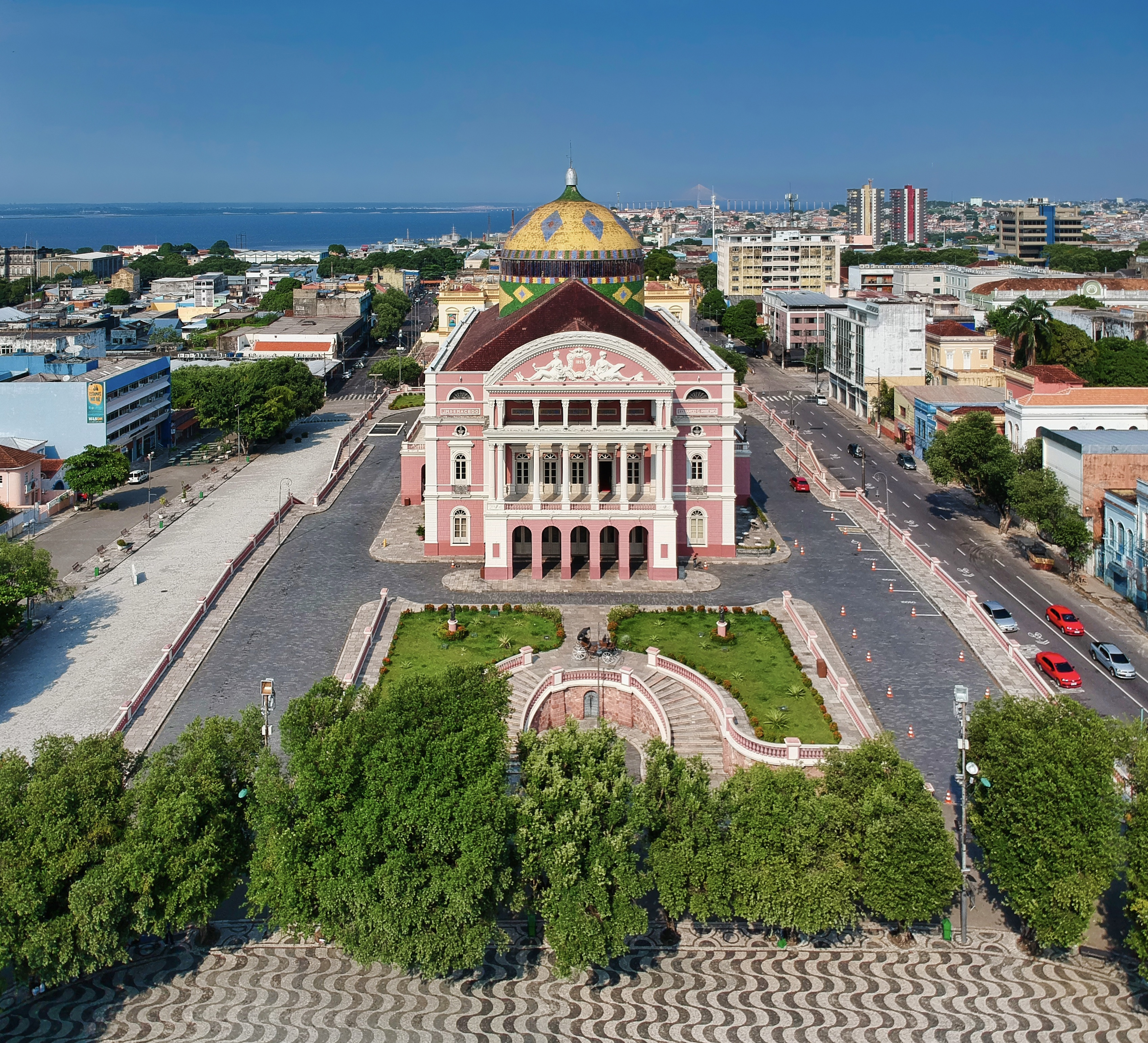
Amazon Theatre
The opera house sits in the heart of the Amazon rainforest. Its dome holds 36,000 ceramic tiles painted yellow, green, and blue in the colors of the Brazilian flag - tiles imported from France because, in 1896, no one in Manaus could make them. The interior is furnished in the Louis Quinze style, also imported from France. The Carrara marble of the staircase came from Italy. The steel beams came from Glasgow. The roofing slates came from Alsace. One hundred and ninety-eight chandeliers hang over the seats, thirty-two of them hand-blown Murano glass. The curtain was painted in Paris and shows the Meeting of the Waters, where the Rio Negro and the Solimões merge without mixing outside Manaus. This opera house was built with rubber money, and the people who tapped the rubber never sat in it.
The Commodity That Built a City
In the second half of the nineteenth century, the industrial world discovered rubber. Bicycles and carriages and electrical cables and, soon, automobiles all demanded it. The only source was the Hevea brasiliensis tree, which grew wild in the Amazon basin. Manaus - a small river port where the Rio Negro joins the Solimões - became, almost overnight, the center of a global commodity market. Rubber merchants made fortunes. They wanted a city to match their wealth. They paved the streets with European stone, strung electric lights before Boston had them, laid tramway tracks, and sent their shirts to Lisbon to be laundered because no local laundry could meet their standards. They decided they needed an opera house. Construction of what became the Teatro Amazonas was first proposed in 1881 by a member of the local House of Representatives, Antonio Jose Fernandes Júnior, who wanted a jewel in the heart of the Amazon rainforest.
The Long Construction
In 1882, the president of the Province of Amazonas, José Lustosa Paranaguá, approved a larger budget and ran a design competition. A Lisbon firm - the Gabinete Português de Engenharia e Arquitectura - won. The Italian architect Celestial Sacardim took over construction on site. Work began in 1884 and stopped and started over the next fifteen years. By 1895, the masonry was finished and the installation of the interior began. The theatre opened on December 31, 1896. The first full performance came a week later on January 7, 1897, with Amilcare Ponchielli's La Gioconda - an Italian opera, sung by an Italian company, in a Renaissance Revival building in the middle of the Amazon rainforest. The merchants who paid for it all sat in the first and second tier boxes. The auditorium could seat 701 people.
Who Was Not in the Audience
The rubber that made Manaus rich was tapped by seringueiros - rubber tappers - who worked deep in the forest under a system that sometimes approached debt bondage. Many were migrants from drought-stricken northeastern Brazil, lured west by labor recruiters who promised wages and delivered credit accounts at company stores that could never be paid off. Many more were indigenous people - Bare, Tukano, Baniwa, Marubo, and others - forced or coerced into rubber work through a combination of violence, displacement, and dependency. Some rubber estates used outright enslavement. The Putumayo scandal, documented by the Irish diplomat Roger Casement in 1910, exposed Peruvian Amazon rubber operations that had killed tens of thousands of indigenous workers through starvation, forced labor, and murder. Conditions in the Brazilian Amazon were often better but rarely good. The seringueiros who hauled the latex that built the Teatro Amazonas were not invited to its opening.
The Building, in Detail
The architectural style is Renaissance Revival. Domenico de Angelis the Younger, an Italian painter, did the ceiling panels of the auditorium and the audience chamber. Crispim do Amaral created the stage curtain in Paris - its image of the Meeting of the Waters is the most specifically Amazonian detail in a building otherwise composed entirely of European imports. The dome's 36,000 ceramic tiles, painted in the colors of the national flag, give the Teatro its distinctive silhouette on the Manaus skyline. The boxes fan out in four tiers. The orchestra pit is modest. The main stage is functional rather than spectacular. But the building is still one of the most beautiful opera houses in the world - Vogue magazine listed it among the fifteen most beautiful in 2019 - and it still hosts the annual Festival Amazonas de Ópera, the Amazonas Opera Festival, which draws singers and conductors from around the world.
Herzog, Pavarotti, Caruso
In 1982, Werner Herzog made Fitzcarraldo - the story of an opera-obsessed rubber baron in turn-of-the-century Iquitos who drags a steamship over a mountain to reach a rubber concession. The film opens at the Teatro Amazonas, where Fitzcarraldo and his partner Molly paddle a boat to hear Enrico Caruso sing Verdi's Ernani. Caruso never actually sang at the Teatro, though the legend that he did has circulated in Manaus for a century. But in 1995, Luciano Pavarotti did travel to the Teatro and perform there, partly to replicate the Caruso myth - the visit forms the opening sequence of the 2019 documentary Pavarotti. Eva Ibbotson set two novels partly in the theatre: Journey to the River Sea, a children's book, and A Company of Swans, a young-adult romance. Ann Patchett set her 2011 novel State of Wonder in Manaus and the forest. The Teatro Amazonas is now what it always threatened to become: a symbol. It was built to declare that rainforest wealth could buy culture equal to Paris or Milan. Today it stands as a reminder of what that wealth cost - and still plays the operas it was built for.
From the Air
Located at 3.13 degrees south, 60.02 degrees west in the center of Manaus, Amazonas state, Brazil. The theatre sits in the historic center of the city, a few blocks from the Rio Negro waterfront. Nearest airport is Eduardo Gomes International (SBEG), about 13 km north. From cruising altitude, Manaus is unmistakable as a large gray urban patch on the north bank of the Rio Negro, surrounded by unbroken rainforest. The Meeting of the Waters - where the black Rio Negro meets the brown Solimões - is visible as a distinct line about 10 km east of downtown. The theatre itself is not visible from cruising altitude, but the pink dome is a landmark in any low-altitude view of central Manaus.