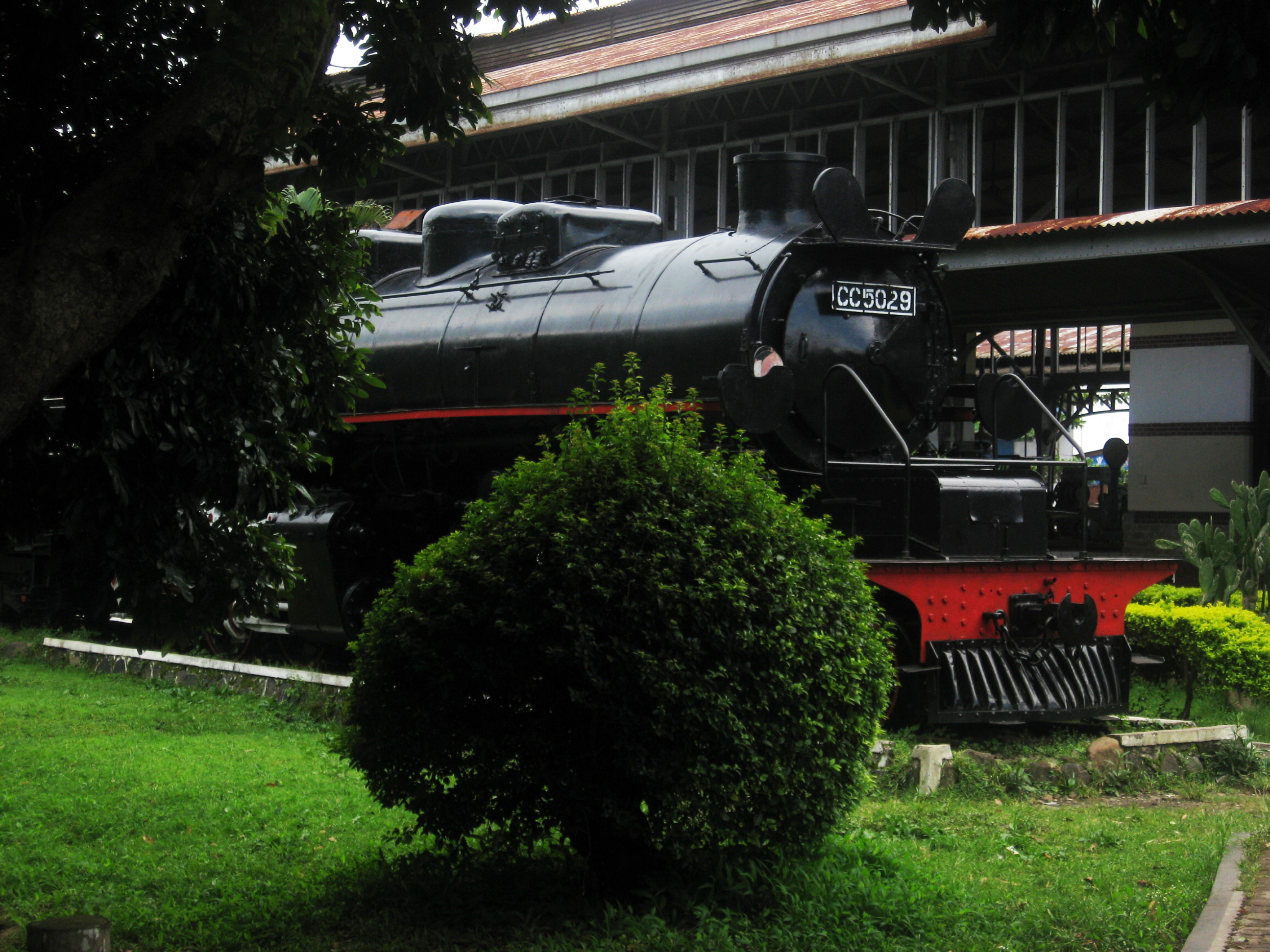
Ambarawa Railway Museum
Two German-built locomotives, numbered B25 02 and B25 03, have been pulling themselves up the same Javanese hillside for more than a hundred years. They are rack engines, fitted with toothed wheels that grip a third rail laid between the running tracks, and they were designed for a single purpose: to haul trains up a 6.5-percent gradient between Jambu and Secang that no ordinary locomotive could manage. That gradient still exists. So do the locomotives. Both live at the Ambarawa Railway Museum in Central Java, where the station they once served has been preserved as Indonesia's foremost railway heritage site.
A Fort's Railway
The station's origins are military. In the 1860s, Ambarawa was a garrison town anchored by Fort Willem I -- known locally as Benteng Pendem -- which the Dutch colonial government used to project control across the Central Javanese highlands. Governor-General Sloet van de Beele ordered a railway to connect the fort with Semarang on the coast, enabling the rapid mobilization of Royal Netherlands East Indies Army troops. The Nederlandsch-Indische Spoorweg Maatschappij completed the line on 21 May 1873, and with it came Ambarawa station, built on a sprawling 127,500-square-meter plot named for King William I of the Netherlands. The station was designed as a transshipment point between two different gauges: a four-foot-gauge branch arriving from Kedungjati to the northeast, and a three-foot-gauge line heading south toward Yogyakarta via Magelang. Walk through the station today and you can still see it -- the two sides of the building were built at different heights to accommodate different-sized trains.
The Rack Line That Climbed the Mountains
South of Ambarawa, the terrain rises sharply into volcanic highlands. Ordinary adhesion railways could not manage the slopes, so the NIS built a rack railway -- the only one in all of Java -- reaching Secang by 1 February 1905. The line connected the military stronghold at Magelang with Fort Willem I, threading through steep contours and difficult topography along the way. At its most dramatic, the rack section climbed a gradient of 6.5 percent, the kind of incline where a loose railcar would simply slide away. The mountain railway operated for decades, but its decline was gradual and almost inevitable. Buses on the parallel road stole most passenger traffic long before an earthquake in the early 1970s damaged sections of track beyond repair. The eastern line to Semarang lingered into the mid-1970s, though by then it carried almost nothing. Roads were faster, more direct, and cheaper to maintain. When the last services ended, the station fell quiet.
Iron Survivors
The museum's collection includes 26 steam locomotives gathered from railway companies across the former Dutch East Indies. Four remain operational. The stars are those two Esslingen-built B25-class rack engines, B25 02 and B25 03, originally numbered NIS 232 and 233. They were part of an original fleet of five delivered to the line over a century ago; a third, B25 01, stands on static display in a park in town. Among the other machines is CC5029, a massive 2-6-6-0 Mallet articulated locomotive once known as the Bergkoningin -- Queen of the Mountains -- for its service on steep lines in West Java. Locals later renamed it Si Gombar, meaning roughly "the Monster," on account of its sheer size. Beyond the locomotives, the museum preserves Morse telegraph equipment, antique signal bells, old telephones, and period furniture, artifacts of an era when the railway was the nervous system of colonial administration.
Riding the Heritage Line
Ambarawa is not merely a place to look at old trains behind velvet ropes. The museum operates tourist excursions hauled by its working steam engines, running along the surviving stretch of the original three-foot-gauge line. The experience is deliberately unhurried: the locomotives hiss and clank at walking pace, and the narrow gauge keeps the carriages close enough to the passing rice paddies and kampung houses that you could almost reach out and touch them. A Krupp diesel-hydraulic D301 also works the line for regular excursion duties, and a General Electric CC 200 15 diesel-electric -- the first generation of diesel-electric engine used in Indonesia -- is preserved on site by the Indonesian Railway Preservation Society. The station building itself, with its twin waiting rooms and stationmaster's office, has the solid proportions of Dutch colonial architecture. It was built to last, and it has.
What the Gauges Remember
The Ambarawa Railway Museum matters because it preserves something more than rolling stock. It preserves a system: the logic of colonial transportation, the engineering compromises forced by Java's volcanic terrain, and the economic choices that made narrow gauge cheaper to build but ultimately impossible to sustain. The two different platform heights at the station are a physical record of the gauge-break problem that shaped railway operations across the Dutch East Indies. Passengers and freight had to be transferred between trains here -- an inconvenience that meant through traffic from Semarang to Yogyakarta was never practical. That limitation, built into the very foundations of the station, helps explain why the line eventually lost to roads. Today, the museum draws visitors who come for the novelty of a working steam train, and many leave understanding something larger about how infrastructure shapes the life of a place -- and how its absence reshapes it again.
From the Air
Located at 7.27S, 110.40E in the Central Javanese highlands south of Semarang. The station sits near Fort Willem I (Benteng Pendem), visible as a large rectangular compound. The surrounding terrain rises toward volcanic peaks to the south. Nearest major airport is Ahmad Yani International Airport (ICAO: WAHS) in Semarang, approximately 35 km to the north. Adisumarmo International Airport (ICAO: WAHQ) near Solo is about 60 km to the southeast. Best viewed at 3,000-5,000 feet AGL following the old railway corridor south from the Semarang lowlands into the highlands.