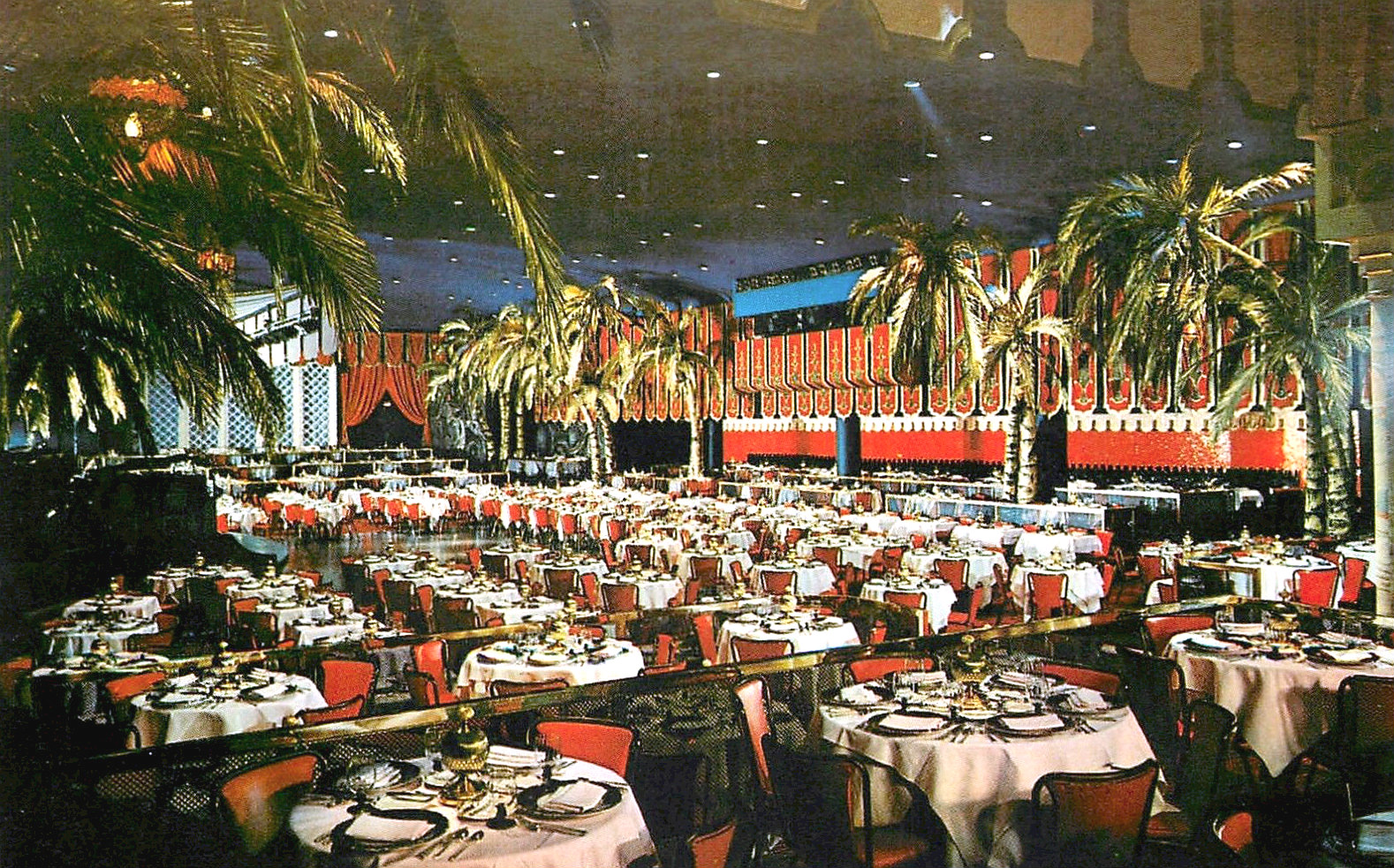
Ambassador Hotel, Los Angeles
On the evening of April 21, 1921, three months after the Ambassador Hotel opened its doors on Wilshire Boulevard, a new nightclub debuted inside: the Cocoanut Grove. Palm trees from the set of Rudolph Valentino's recent film The Sheik lined the walls. Within a decade, the Cocoanut Grove would be the most famous nightclub in America, and the Ambassador Hotel would be the address that defined what it meant to be someone in Hollywood. It would remain that way for 47 years, until the night of June 5, 1968.
The Building That Defined Wilshire
Architect Myron Hunt designed the Ambassador, which opened on New Year's Day 1921 at 3400 Wilshire Boulevard. Later, architect Paul Williams — one of the first major Black architects in the United States — contributed to the hotel's evolving design. The property sprawled across 24 acres with bungalows, gardens, and tennis courts that felt, by the standards of early Los Angeles, almost rural. Six Academy Award ceremonies were held in the Cocoanut Grove between 1930 and 1943, a period when the hotel was as close to the center of the film industry as any building in the city. Carole Lombard, waiting in the Cocoanut Grove one evening, was discovered by a talent scout there.
The Night the Cocoanut Grove Went Dark
Robert F. Kennedy won the California presidential primary on June 4, 1968. Just after midnight, he addressed supporters in the Ambassador's Embassy Ballroom, exited through the hotel kitchen — a route chosen to avoid the crowd — and was shot by 24-year-old Sirhan Sirhan. Kennedy died the following day at Good Samaritan Hospital. He was 42. The Cocoanut Grove never fully recovered from the weight of that association. The hotel closed in 1989 after decades of declining business and a building that no longer matched the city that had grown up around it. It sat vacant on Wilshire Boulevard for 16 years.
The Long Argument About the Building
After the hotel closed, a debate consumed Los Angeles over whether to preserve it or tear it down. Preservationists argued that the Ambassador was irreplaceable — one of the last grand early-century hotels on the Miracle Mile, layered with a century of the city's history. The Los Angeles Unified School District, which eventually acquired the property, argued that the neighborhood desperately needed a new school. The preservationists lost. Demolition began in 2005. By 2006, the Ambassador Hotel was gone. The Robert F. Kennedy Community Schools — a sprawling campus serving thousands of students — were built on the site and opened in 2010.
What Remains
The school complex that replaced the Ambassador incorporates some visual nods to the original building. The kitchen where the assassination occurred, where Juan Romero cradled Kennedy's head and placed a rosary in his hand, no longer exists in any physical form. What exists instead is a school named for the man who died there — a less beautiful tribute, perhaps, than the building itself, but arguably a more meaningful one. Kennedy had spent much of his final campaign talking about schools in poor neighborhoods, about children who deserved better. The school on Wilshire Boulevard serves those children now.
From the Air
Located at 34.0597°N, 118.2972°W in the Mid-Wilshire district of Los Angeles. The area is visible from low-altitude approaches to Burbank (KBUR) along the eastern portions of the Wilshire corridor. From the air, the Wilshire Boulevard axis running east-west through the city is one of the most identifiable features of the Los Angeles basin. Nearest airports: Burbank Bob Hope (KBUR) 10 miles northeast, Santa Monica (KSMO) 8 miles west, Los Angeles International (KLAX) 9 miles southwest.