Amberley Museum & Heritage Centre
The quarry tunnel at Amberley Museum doubled as the entrance to Mainstrike Mine in the James Bond film A View to a Kill. That is the kind of detail that captures attention, but the museum itself is something quieter and more remarkable: a 36-acre former chalk quarry near Arundel where over a century of industrial heritage has been gathered, rebuilt, and set running again by volunteers who believe that the way things were made matters as much as the things themselves.
Chalk and Lime
For more than a hundred years, chalk was extracted from this quarry in the South Downs and processed into lime for use in mortar and cement. The original lime kilns still stand, including a De Witt set -- a type of continuous-burning kiln designed for maximum efficiency. When the quarry closed, the Southern Industrial History Centre Trust saw an opportunity. In 1978, they founded the museum on the abandoned site, using the quarry's natural amphitheater of white chalk cliffs as a dramatic setting for collections that would eventually span the full breadth of southeast England's industrial past. The museum sits next to Amberley railway station on the Arun Valley line, making it one of the few heritage sites in Sussex accessible by train.
Everything That Made Things Work
The exhibits at Amberley are not about grandeur but about how ordinary life was sustained. A reconstructed 1930s village garage shows how cars were repaired when parts were machined by hand. The Paviors Hall of Road Making traces road construction from Roman techniques to modern methods, housed in a 19th-century iron-framed industrial building relocated from Horsham. A rural telephone exchange incorporates 1940s equipment from the village of Coolham. There is a cobbler's shop with tools from Bognor Regis, an ironmonger's shop from Littlehampton, and a print shop where volunteers operate a Columbian Eagle flat-bed press dating from around 1856. The Hall of Tools, run in partnership with the Tools and Trades History Society, demonstrates that a well-made chisel is as worthy of preservation as a painting.
Narrow Gauge and Southdown
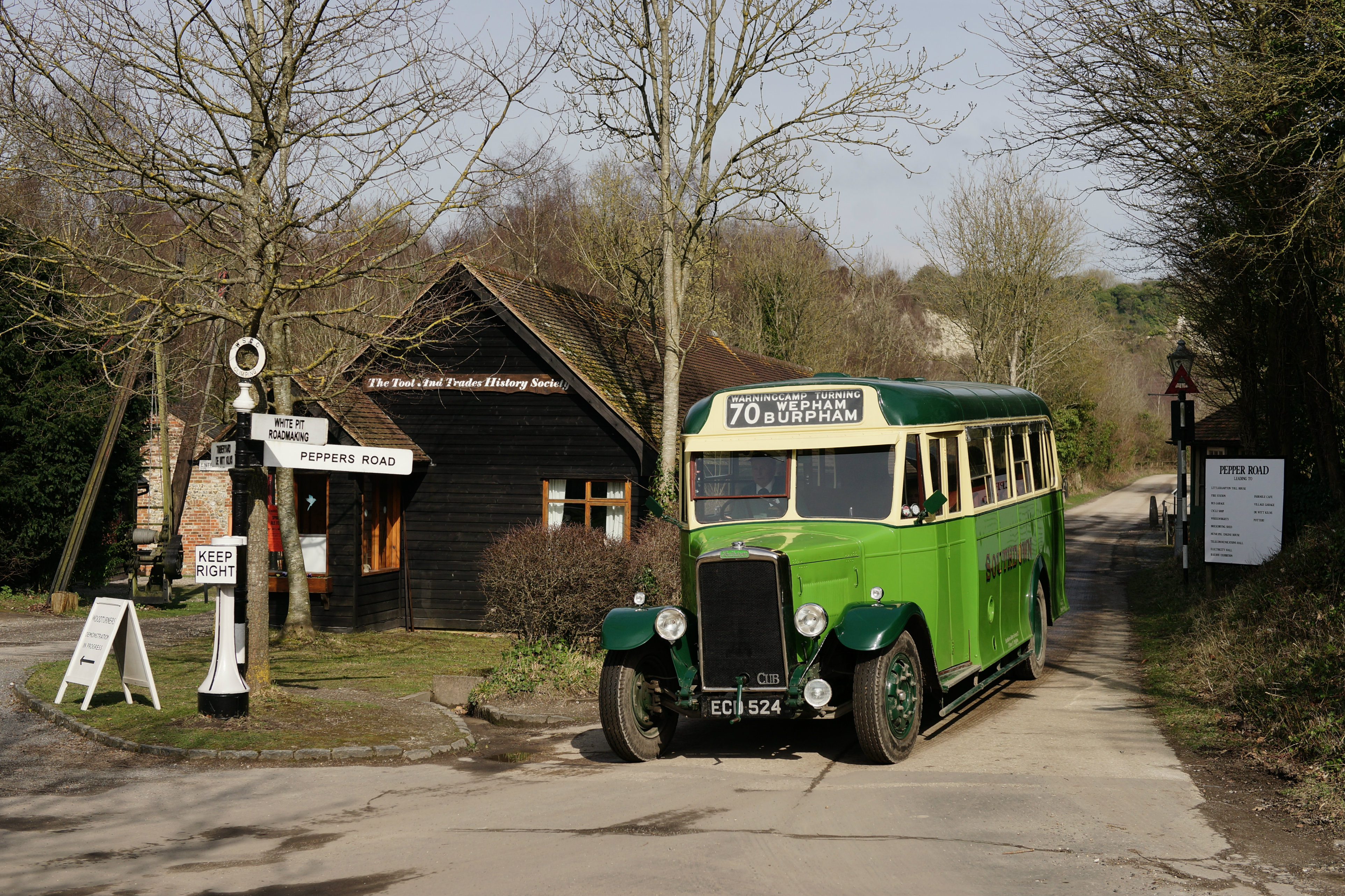
Two collections anchor the museum's transport heritage. The Amberley Museum Railway is a narrow-gauge railway and exhibition hall with forty-five locomotives -- five steam, twenty-nine internal combustion, four battery electric -- and around eighty items of rolling stock, largely inherited from the former Brockham Museum in 1982. The collection includes material from the Dorking Greystone Lime Company and the Groudle Glen Railway on the Isle of Man. Alongside the railway, a reconstructed 1920s Southdown bus garage houses working vehicles from the local operator Southdown Motor Services. On open days, visitors can ride buses dating from 1914 to 1937, including a Leyland Titan double-decker from 1931 and a fragile 1914 Tilling Stevens open-top that is used only sparingly to protect its centenarian frame.
Living Skills
Amberley is not a museum where everything sits behind glass. Craftspeople demonstrate woodturning, broom-making, walking-stick carving, and blacksmithing on site. The machine shop's tools are still used for maintenance of other exhibits -- a museum that repairs itself. A reproduction 1950s fire station houses roadworthy historic fire engines, and a Billingshurst signal box, reconstructed after being used to control a level crossing, has been carefully refurbished. The nature trail that winds through the quarry reveals the geological story beneath the industrial one: the chalk downs of Sussex, laid down in warm Cretaceous seas, that provided the raw material for the lime-burning industry that gave the site its original purpose.
From the Air
Located at 50.90N, 0.54W near the village of Amberley in the Arun Valley, West Sussex, nestled against the South Downs escarpment. The white chalk quarry is distinctive from the air. Shoreham Airport (EGKA) is approximately 12nm east-southeast. Goodwood/Chichester Airport (EGHR) is approximately 10nm west. Best viewed at 1,500-2,500 ft AGL with the South Downs providing dramatic backdrop.