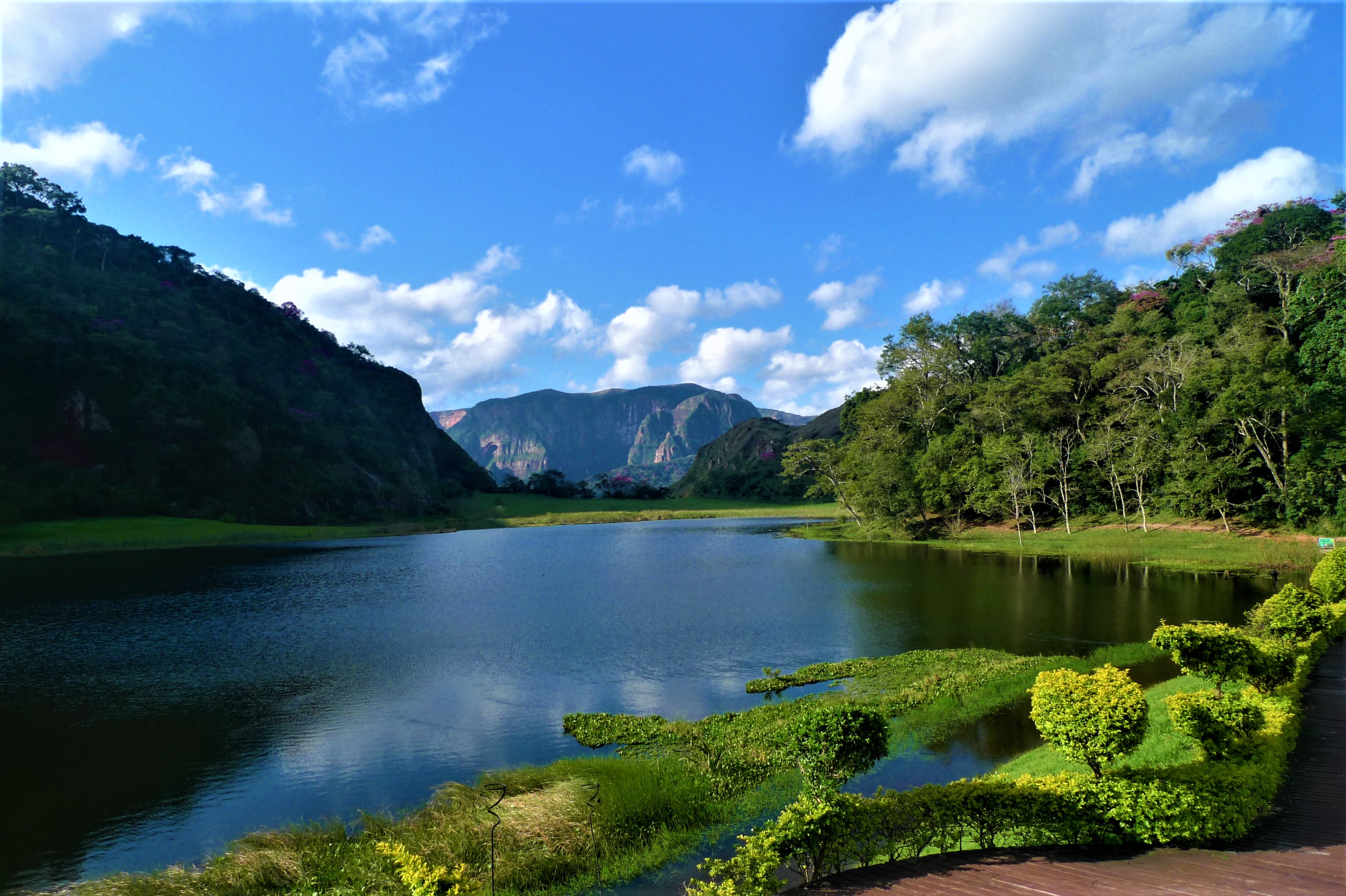
Amboro National Park
Walk into the giant fern forest in Amboro National Park and the scale of things shifts. The ferns -- ancient, tree-sized, their fronds arching overhead like green cathedral vaults -- belong to a lineage older than the Andes themselves. They thrive here because Amboro sits at the collision point of three ecosystems: the high Andes, the northern Chaco, and the Amazon basin. Within the park's 4,425 square kilometers, elevations swing from 300 meters to 3,338 meters, and the landscape changes accordingly -- from cloud forests wrapped in permanent mist to dry lowland forests where jaguars hunt. This park holds 50 percent more known plant species than the entire British Isles in a smaller area. It is one of the most biodiverse places on the planet, and one of the hardest to reach.
Three Worlds in One Park
Amboro occupies the central Sub-Andean region of Bolivia, in the transitional Yungas zone where the Andes foothills descend toward the lowlands. Originally established as the Reserva de Vida Silvestre German Busch, the area became a national park in 1984. The elevation difference of more than 3,000 meters within the park's boundaries creates a vertical mosaic of habitats. Highland cloud forests, where rain can reach 4,000 millimeters per year, give way to montane woodlands and then to lowland dry forests that receive about 1,400 millimeters annually. Volcanic lagoons dot the landscape between ridges. The terrain is extreme -- landslides and localized flooding are common hazards -- and the park's access roads, particularly on the north and south sides, are rural dirt tracks that become slick, potholed obstacles during the rains. A four-wheel-drive vehicle is not a suggestion but a requirement.
A Census of the Living
More than 3,000 plant species have been documented in Amboro, including forests of giant ferns, orchids in bewildering variety, and endemic species found nowhere else. The animal roster is equally extraordinary. More than 175 mammal species inhabit the park: spectacled bears in the high forests, pumas and ocelots stalking the mid-elevations, jaguars in the lowland jungle, and over 40 species of bat patrolling the night sky. The park's rivers and streams harbor endemic amphibians and the pacu, a large freshwater fish related to the piranha but with a preference for vegetarian fare. Birdwatchers face a staggering list of more than 900 species, from the military macaw to the helmeted curassow to the Andean condor soaring above the ridgelines. Walking through Amboro's forests, you hear the park before you see it -- the calls layered so densely that separating individual species from the chorus becomes its own challenge.
Earning the Entry
From Santa Cruz, Bolivia's second-largest city, the park is 57 kilometers northwest via the Carretera Las Cruces, a drive of about ninety minutes to the park administration office. Park entry is free, but regulations require every visitor to be accompanied by a guide -- a practical necessity given the terrain's difficulty and the ease of getting lost in dense forest with few marked trails. The simplest approach is to book a guided tour through a travel agency in Santa Cruz. Once inside, transportation means either a four-wheel-drive truck or your own feet. The trails are steep, muddy, and unmarked in places, and the rainy season can close entire sections of the park without warning. This is not a park designed for casual visitors. It rewards preparation, fitness, and a willingness to be uncomfortable in exchange for encounters with wildlife and landscapes that few people ever see.
The Intersection of Everything
What makes Amboro exceptional is not any single feature but the convergence. Three major biogeographic regions meet within its boundaries, producing a density of life that few protected areas anywhere can match. The cloud forests of the upper elevations catch moisture from the Amazon basin to the east, creating conditions where mosses, bromeliads, and orchids coat every available surface. Below the clouds, the montane forests transition to drier woodland where different species take over -- different trees, different birds, different cats. The park connects to neighboring Carrasco National Park to the northwest and, together, the two reserves form one of the largest continuous protected areas in the Bolivian Andes. For scientists, Amboro is a living laboratory. For visitors willing to endure the mud and the altitude, it is a reminder of what the world looks like where humans have barely left a mark.
From the Air
Located at 17.78S, 63.98W in the central Sub-Andean region of Bolivia, approximately 57 km northwest of Santa Cruz. From altitude, the park appears as a dense green mass of forested ridges and valleys on the eastern Andean slopes, contrasting with the drier terrain to the east. Elevations range from 300 to 3,338 meters, with visible cloud cover frequently draped over the higher ridges. Nearest major airport is Viru Viru International Airport (SLVR) in Santa Cruz, approximately 70 km to the southeast. The park borders Carrasco National Park to the northwest. Best viewed at medium to high altitude in clear conditions.