Amboseli National Park
The photograph exists in a thousand variations, but the composition never changes: a line of elephants crossing a flat, dust-brown plain, and behind them, impossibly close, the snow-capped dome of Kilimanjaro rising 5,895 meters into a sky that is either perfectly clear or wrapped in the clouds that hide the mountain for most of the day. Amboseli National Park is where that photograph happens. At just 392 square kilometers, it is not a large park, but it may be the most visually dramatic wildlife landscape in East Africa, a place where the scale of Africa's highest peak meets the intimate detail of elephant families feeding in swamps fed by the mountain's own glacial meltwater.
The Mountain's Gift
Kilimanjaro does not merely backdrop Amboseli. It sustains it. The mountain's snowmelt and glacial runoff seep underground through volcanic rock and emerge as springs that feed the park's swamps, including Enkongo Narok and Ol Tukai. These wetlands are the engine of Amboseli's ecosystem, providing water and lush vegetation year-round in a landscape that is otherwise semi-arid, with temperatures that swing from 40 degrees Celsius at midday to 5 degrees at night. The swamps attract elephants, hippos, buffalo, and enormous concentrations of waterbirds. Around the wetlands, the terrain shifts between palm thickets, yellow-barked acacia woodland, salt-tolerant scrub, and open plains where wildebeest, zebras, Grant's and Thomson's gazelles, impalas, and gemsboks graze alongside predators including lions, cheetahs, hyenas, and African wild dogs. The park's more than 900 elephants are its greatest draw, but the web of life that Kilimanjaro's hidden water makes possible is what keeps everything alive.
Nine Hundred Elephants
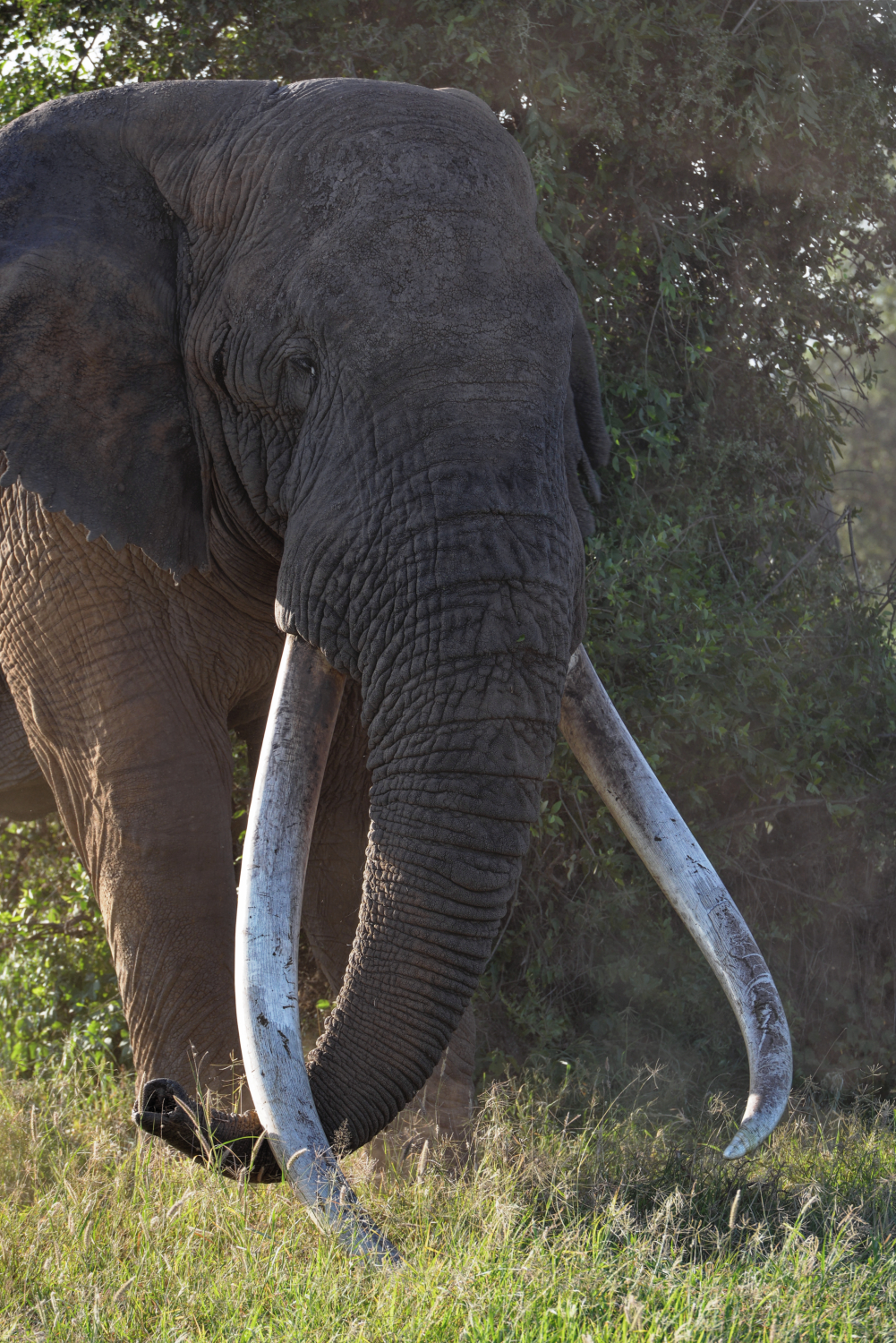
Amboseli's elephant population is one of the most studied in the world. The Amboseli Elephant Research Project, founded by Cynthia Moss in 1972, has tracked individual elephants and family groups across decades, producing some of the most detailed data ever gathered on elephant social behavior, communication, and lifespan. The result is a park where elephants are remarkably habituated to vehicles, walking calmly past safari trucks in long single-file lines that have become the signature image of the East African safari. Over 900 elephants roam the park freely, and their daily movements between the swamps and the dry plains structure the rhythm of any game drive. Early mornings and late afternoons are the prime viewing hours, when the herds are active and the dust they raise catches the low-angle light. At midday, the heat empties the plains as animals retreat to shade and water.
Observation Hill
Walking is prohibited inside Amboseli except at one place: Observation Hill, a low rise near the center of the park that offers a 360-degree panorama. From its summit, the full geography of the park unfolds. To the south, Kilimanjaro dominates the horizon. Below, the Enkongo Narok swamp shimmers with birdlife and the slow shapes of elephants wading through the reeds. The dry salt pans of seasonal Lake Amboseli stretch to the east, and on clear days the Chyulu Hills are visible beyond. It is the only spot where visitors can stand on their own feet and absorb the scale of the place. At sunset, when the mountain glows orange and the plains darken, it becomes one of the most memorable viewpoints in Kenya. Beyond the park boundaries, Maasai communities maintain traditional pastoral life in surrounding conservancies. Guided visits to a manyatta, a traditional Maasai village, offer a glimpse of customs, dances, and the beadwork tradition that has become one of the region's most recognizable art forms.
Dust and Distance
Amboseli sits roughly four to five hours south of Nairobi by road, near the Tanzanian border. The park has several gates, with Meshanani Gate serving travelers arriving from the border town of Namanga and Kimana Gate handling traffic from the east. Roads inside the park are rough, dusty, and often corrugated, and a four-wheel-drive vehicle is essential during the rainy seasons of March through May and November, when tracks around seasonal Lake Amboseli can flood without warning. There is no fuel inside the park. There are no ATMs near the gates. Supplies must be sourced in Kimana, Namanga, or Emali before entering. The remoteness is part of the experience. Lodges range from mid-range to luxury, and many offer sundowners, bush breakfasts, and campfire evenings with Kilimanjaro as the backdrop. Over 400 bird species have been recorded here, with migratory arrivals between November and April bringing African fish eagles, crowned cranes, flamingos, and pelicans to the wetlands. But it is the elephants that people come for, and the mountain behind them that makes the scene unforgettable.
From the Air
Amboseli National Park is located at 2.65S, 37.25E in southern Kenya, directly north of Mount Kilimanjaro. From the air, the park appears as a flat, semi-arid basin with distinctive green swamp patches contrasting against brown plains and the white salt flats of seasonal Lake Amboseli. Kilimanjaro (5,895m) dominates the southern horizon. Best viewed at 3,000-6,000 feet AGL. The nearest airstrip is Amboseli Airport (HKAM) inside the park. Wilson Airport (HKNW) in Nairobi handles charter flights to the region. Kilimanjaro International Airport (HTKJ) in Tanzania is approximately 100 km to the south.