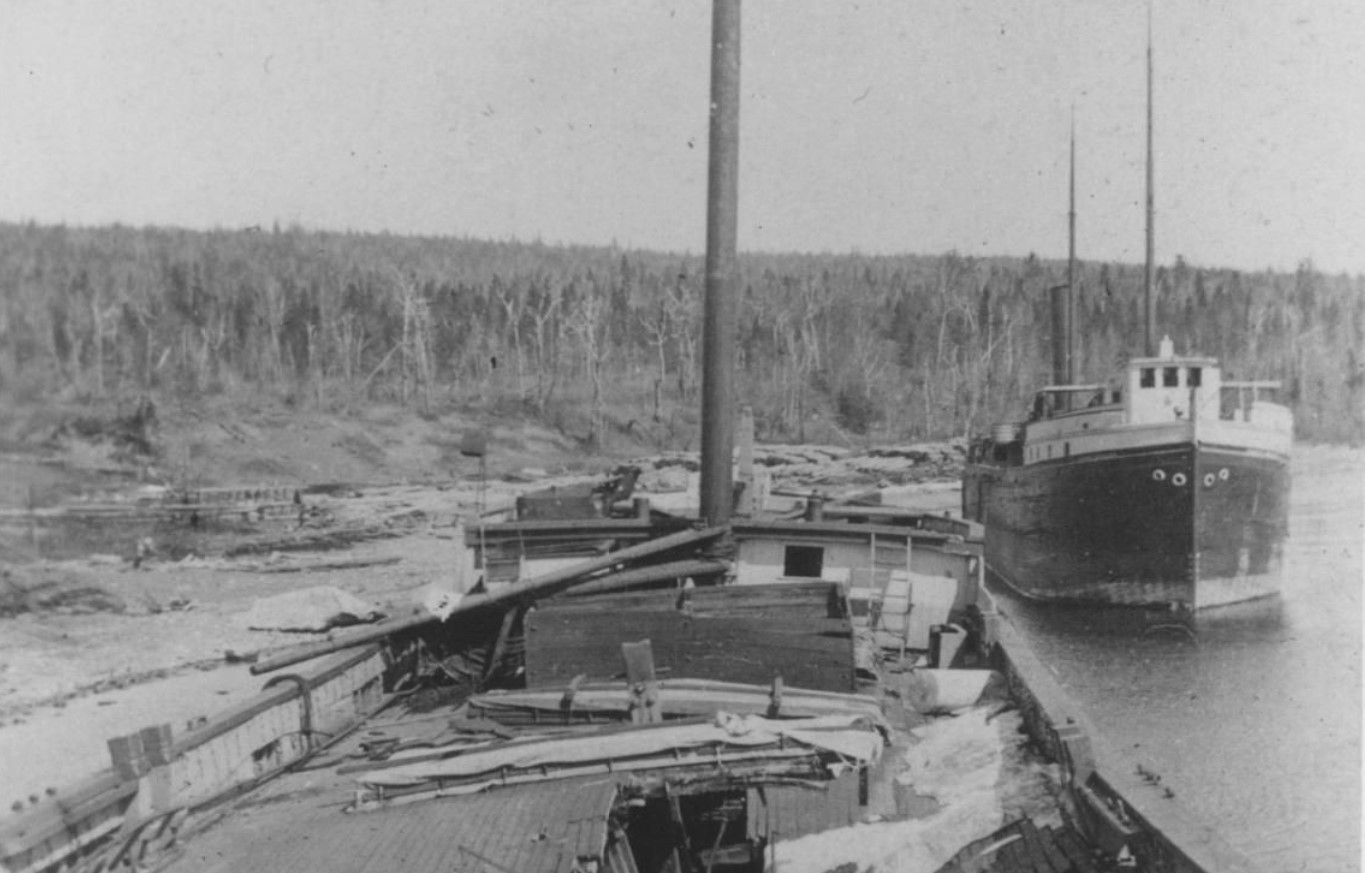
Amboy and George Spencer Shipwreck Sites
For thirteen hours, the crews clung to the disintegrating hulls while November waves pounded the vessels apart. The George Spencer, a wooden bulk freighter built in Cleveland in 1884, and the Amboy, a schooner-barge constructed a decade earlier for Minnesota's iron ore trade, had been traveling together from Buffalo, New York, bound for Duluth with a cargo of coal. On November 28, 1905, the Mataafa Storm -- one of the most destructive tempests in Great Lakes history -- swallowed them both. When it was over, 18 ships lay wrecked or stranded across Lake Superior, and one, the steamer Ira H. Owen, had vanished with all hands. The Spencer and the Amboy, driven ashore on Cook County's North Shore, became a single archaeological site that now sits on the National Register of Historic Places.
A Schooner-Barge Called Trouble
The Amboy had been cheating fate for decades before the Mataafa Storm caught up with her. Built in 1874 by Quayle & Murphy in Cleveland, Ohio, she was originally christened Helena and designed specifically to haul Minnesota iron ore. In July 1891, the Helena sank in a collision on the St. Marys River, killing one crew member. In August 1892, she limped into Cleveland full of water after a storm off Escanaba, Michigan, overwhelmed her pumps; tugboats Gregory and Blazier towed her to safety. The following October she broke loose from her tow in a gale and ran aground in Buffalo. In September 1898, low water in the Niagara River caught her keel, and four tugboats failed to free her until a lighter removed part of her cargo. Each time, someone patched her up and sent her back to work. The Great Lakes were full of vessels like her -- aging, wooden, and perpetually one storm away from their final voyage.
The Mataafa Storm Strikes
November 28, 1905, began with the Spencer towing the Amboy westward across Lake Superior. When the storm hit, visibility dropped to nothing in blinding snow. Captain Frank Conland of the Spencer and Captain Fred Watson of the Amboy lost their bearings entirely. The crew of the Spencer cut the towline, hoping to save both vessels by letting each maneuver independently, but neither ship could fight the gale. Both were driven ashore on a sandy beach along the North Shore. The Duluth Evening Herald later reported the scene: as soon as the ships struck, the crews threw buoys with lines over the side. Fishermen onshore caught the ropes as they floated in and made them fast. An improvised breeches buoy was rigged along the hawsers. One by one, the crew members were hauled to shore -- beginning with Mrs. Harry Lawe, wife of the mate, who had been serving as steward. The fishermen rushed into the surf almost to their necks to pull the sailors through the breaking waves.
What the Lake Left Behind
The Spencer, valued at $35,000, was judged beyond saving. The Amboy, worth $10,000, fared no better. Much of their hulls were eventually removed, but the lake keeps what it claims on its own schedule. Today the remains of both vessels lie near each other along the shore. The Amboy's keelson -- the structural timber that runs along the bottom of the hull -- sits encased in sand and cobbles. The section parallel to the beach has been worn by over a century of waves, revealing side-by-side white oak timbers secured with hundreds of iron bolts, each seven-eighths of an inch in diameter. Near the southern end, an upright timber rises from the wreckage, believed to be part of the Amboy's centreboard. These fragments of oak and iron are what remain of a vessel that spent thirty-one years hauling ore and coal across the Great Lakes, surviving collision, swamping, and grounding before the Mataafa Storm finally wrote her last chapter.
A Place on the Register
In 1994, the combined wreck site of the George Spencer and the Amboy was added to the National Register of Historic Places, joining a collection of Great Lakes shipwrecks recognized for their archaeological and historical significance. The site tells the story not just of two vessels but of an entire era of Great Lakes commerce -- the age of wooden ships hauling iron ore, coal, and grain between the industrial cities of the Midwest. The George Spencer was built by Thomas Quayle & Sons in Cleveland, the same shipbuilding tradition that produced the Amboy a decade earlier under the Quayle & Murphy name. Both ships were products of a Cleveland shipbuilding industry that fed the Great Lakes fleet throughout the late nineteenth century. Their final resting place on Cook County's shore, battered by the same Lake Superior weather that destroyed them, remains a tangible link to the merchant sailors who worked these waters when wooden hulls were all that stood between a crew and the deepest of the Great Lakes.
From the Air
Located at 47.478°N, 90.999°W along the North Shore of Lake Superior in Cook County, Minnesota. The wreck site lies on the shoreline and is not easily visible from altitude, but the coastline itself is distinctive -- rocky headlands and sandy stretches framed by boreal forest. Nearest airport is Grand Marais/Cook County Airport (KCKC) approximately 30 nm northeast. Duluth International Airport (KDLH) lies roughly 100 nm southwest along the shore. Highway 61 follows the coast and serves as a reliable visual reference. Best viewed from 2,000-4,000 feet AGL following the North Shore coastline. Lake Superior's open expanse dominates the view to the northeast.