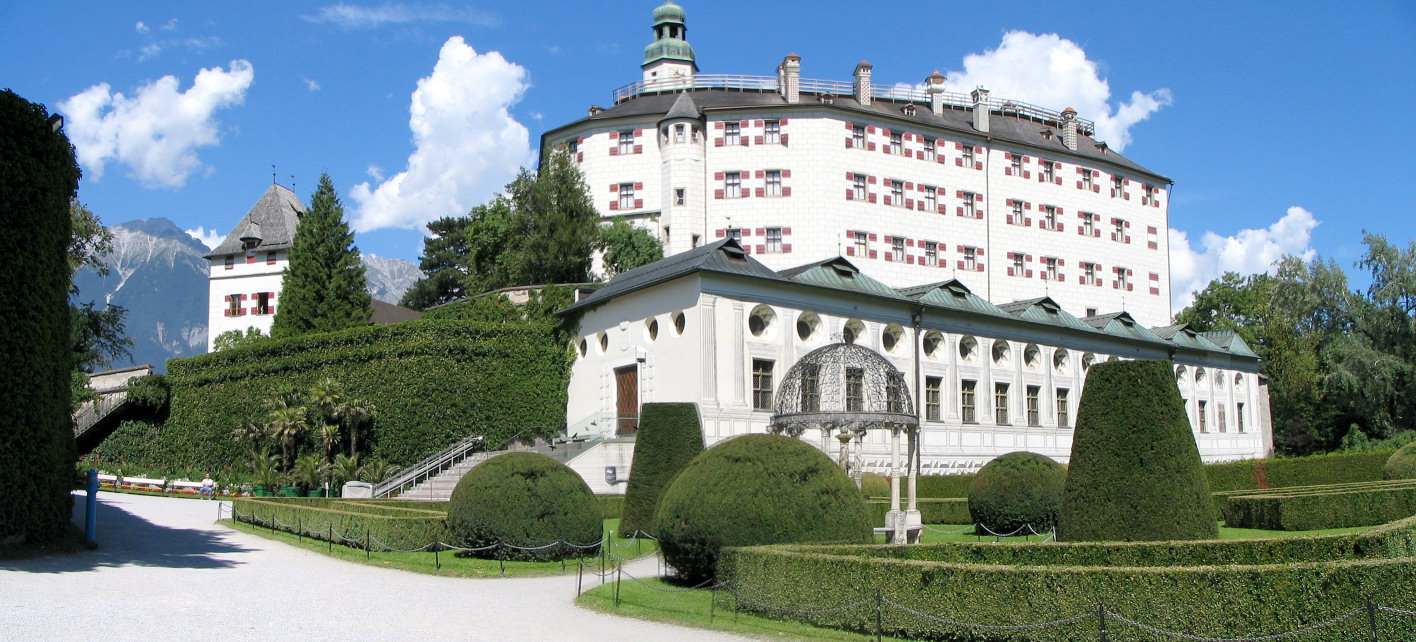
Ambras Castle
Archduke Ferdinand II had a problem that was also a love story. As the sovereign of Tyrol and a son of Emperor Ferdinand I, he was expected to marry within his rank. Instead, he married Philippine Welser, the daughter of a wealthy Augsburg merchant -- a commoner by Habsburg standards. The union was morganatic, initially kept secret, and scandalous enough to require its own architectural statement. Ferdinand ordered the medieval fortress above Innsbruck transformed into a Renaissance palace worthy of the woman he had chosen over protocol. Ambras Castle, perched 632 meters above sea level in the hills south of the city, became both a home and an argument: proof that a commoner's wife could live in splendor that rivaled any court in Europe.
Before the Habsburgs
Long before Innsbruck existed as a city, a fortification stood on this hilltop. References to Amras or Omras appear in documents from the 10th century, when the site anchored the southwestern corner of Bavaria. The Counts of Andechs held power here, eventually rising to become Margraves of Istria and Dukes of Merania, a short-lived imperial state that lasted from 1180 to 1248. The original fortress was destroyed in 1133, and no traces of it survive above ground, though some of its stone was recycled into later construction. By the time Ferdinand II turned his attention to the site in the 1560s, centuries of rebuilding had already layered history upon history into the hillside.
The Cabinet of Wonders
Ferdinand was one of the great collectors of the Renaissance, and Ambras became his museum. He built the Lower Castle specifically to house his collections, making it one of the oldest purpose-built museum structures in the world. The Chamber of Art and Curiosities -- the Kunst- und Wunderkammer -- survives in its original location, the only Renaissance curiosity cabinet in Europe still displayed where its creator placed it. The armouries hold masterpieces of European arms and armour spanning the reigns of Emperor Maximilian I through Emperor Leopold I. Ferdinand did not collect casually. He collected systematically, driven by a humanist's belief that assembling the remarkable objects of the world was a form of understanding it.
The Spanish Hall and the Painted Courtyard
Above the Lower Castle rises the Spanish Hall, a grand ceremonial space that Ferdinand had built for the court festivals he loved to host. Its intricate wood-inlay ceiling stretches the length of the room, and the walls display 27 full-length portraits of the rulers of Tyrol -- a visual genealogy rendered in paint. The hall is considered one of the finest examples of German Renaissance architecture. Below, the Inner Courtyard preserves grisaille frescoes painted between 1564 and 1567, grey-toned images applied to wet plaster that depict princely virtues, muses, and heroic deeds. These are among the best-preserved Renaissance frescoes of their kind, a quiet counterpoint to the hall's more theatrical grandeur.
Philippine's Bath
Tucked within the castle is a detail that says more about Ferdinand and Philippine's relationship than any portrait or document. The Bathing Chambers of Philippine Welser are the only completely preserved 16th-century bath in existence. This was not a public feature or a ceremonial space but a private luxury, built for a woman whose position at court was always more complicated than her husband wished it to be. The chapel, dedicated to St. Nicholas and first consecrated in 1330, was rebuilt repeatedly over the centuries. Its current painted interior, completed by the Innsbruck artist August von Worndle in the 19th century, adds yet another layer of time to a building that has been continuously reimagined for a thousand years.
From Palace to National Treasure
Ambras Castle is now one of the most visited attractions in Tyrol. The Upper Castle houses the Habsburg Portrait Gallery, an extensive collection of paintings depicting members of the House of Austria and other ruling European dynasties, with a particular concentration of portraits of princely children -- solemn small faces in oversized clothing, painted to record alliances and bloodlines. The castle's significance was further recognized when Austria chose it as the subject of a silver 10-euro commemorative coin, with the obverse showing the castle and its Renaissance gardens and the reverse depicting three court musicians crossing the floor of the Spanish Hall, based on an image from 1569. Ferdinand would have approved. He built Ambras to be seen, to be admired, and above all, to be remembered.
From the Air
Located at 47.26N, 11.43E on a hillside south of Innsbruck, Austria, at 632 meters elevation. The castle complex is visible from the Inn Valley as a prominent structure on the wooded hills above the city. Nearest airport: LOWI (Innsbruck Airport), just 3 km to the northwest in the valley floor. The Nordkette mountain range rises dramatically to the north of the city. Best viewed at 4,000-6,000 feet AGL approaching from the Inn Valley. The castle gardens and Renaissance layout are distinguishable in good visibility.