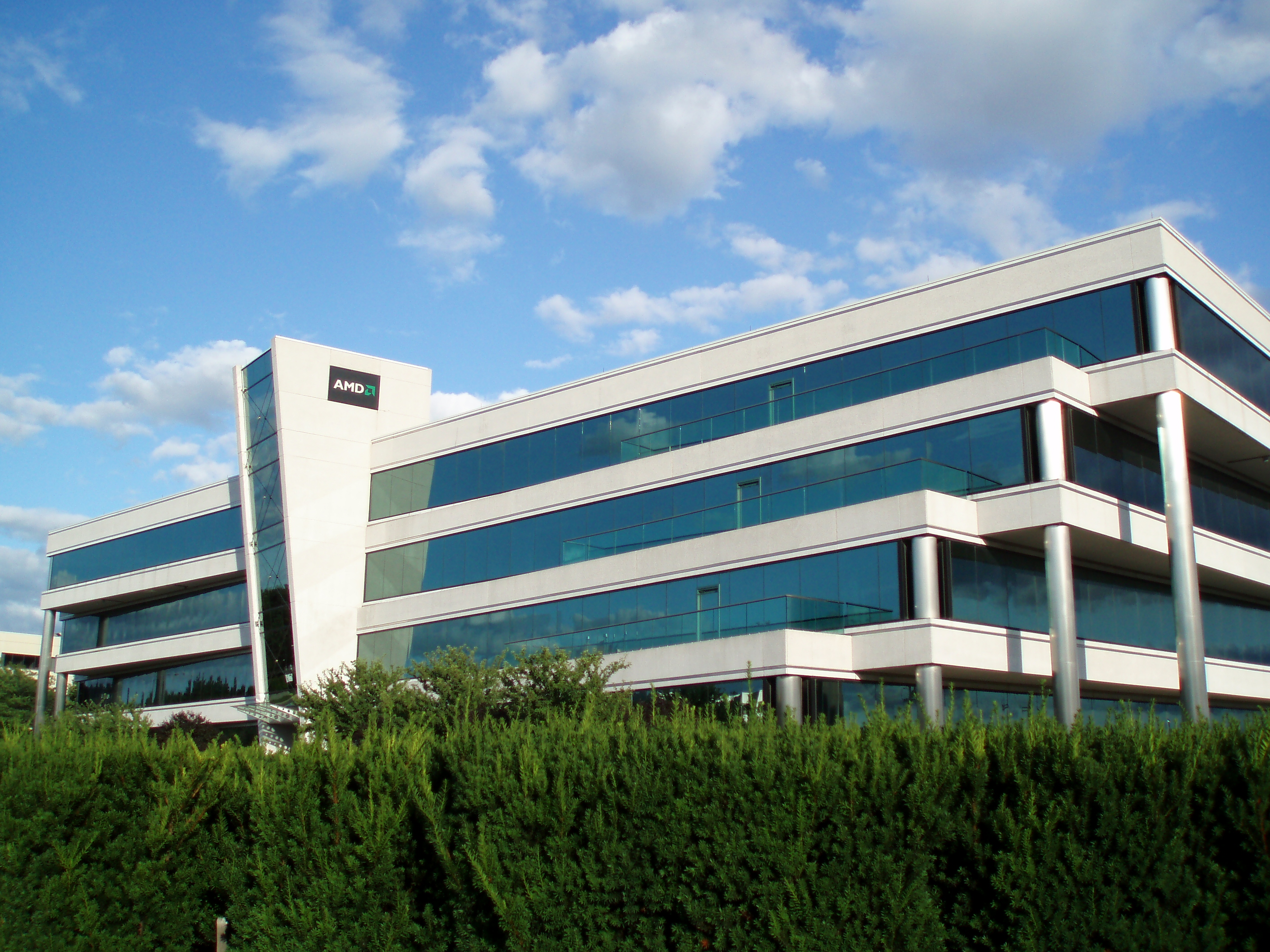
AMD
For most of its history, Advanced Micro Devices was the other chip company -- the scrappy number two to Intel's dominant number one, always faster to market with some innovations but never quite able to break the monopoly's grip. Then something shifted. AMD's Ryzen processors began outperforming Intel's offerings. Its EPYC server chips won the data center. Its acquisition of Xilinx gave it programmable chips for the edge. And when the AI revolution needed GPUs to train its models, AMD's competition with Nvidia suddenly mattered as much as any rivalry in technology. From its headquarters in Santa Clara, the company that was founded in a living room in 1969 is now central to the infrastructure of artificial intelligence.
Born in a Living Room
AMD was founded on May 1, 1969, by Jerry Sanders and seven colleagues who had left Fairchild Semiconductor -- part of the legendary exodus that seeded Silicon Valley's semiconductor industry. Sanders, a charismatic salesman with a taste for expensive suits, was an unlikely chip company founder, but his business instincts proved sound. AMD started as a second-source manufacturer, producing chips designed by other companies, then gradually developed its own designs. The company's early decades were defined by its relationship with Intel: AMD manufactured Intel-compatible processors under a licensing agreement, then fought bitterly in court when Intel tried to end the arrangement. The legal battles established AMD's right to compete in the x86 processor market.
The Athlon Breakthrough
AMD's first moment of genuine technological superiority came with the Athlon processor in 1999, which outperformed Intel's Pentium III and proved that AMD could design world-class chips, not just clone them. The Opteron server chip followed in 2003, introducing 64-bit computing to the x86 architecture and forcing Intel to adopt AMD's design. But these victories were followed by stumbles -- the Bulldozer architecture disappointed, and AMD's market share in both desktop and server chips declined through the early 2010s. The company came perilously close to bankruptcy, its stock trading below two dollars.
The Zen Renaissance
Under CEO Lisa Su, who took the helm in 2014, AMD executed one of the most remarkable turnarounds in semiconductor history. The Zen architecture, launched in 2017 as the Ryzen processor family, delivered performance competitive with Intel's best at lower prices. EPYC server processors captured data center market share that Intel had held unchallenged for years. AMD's acquisition of Xilinx in 2022 for $49 billion added programmable chips to its portfolio. Today, AMD produces CPUs, GPUs, FPGAs, and adaptive computing platforms from its Santa Clara headquarters, competing simultaneously with Intel in processors and Nvidia in graphics and AI accelerators. The company that nearly died is now valued at hundreds of billions of dollars.
From the Air
AMD headquarters at 37.386N, 121.999W in Santa Clara, California, in the heart of Silicon Valley. Nearest airports: KSJC (San Jose International, 4nm south), KNUQ (Moffett Field, 4nm north). Best viewed at 2,000-4,000 ft AGL.