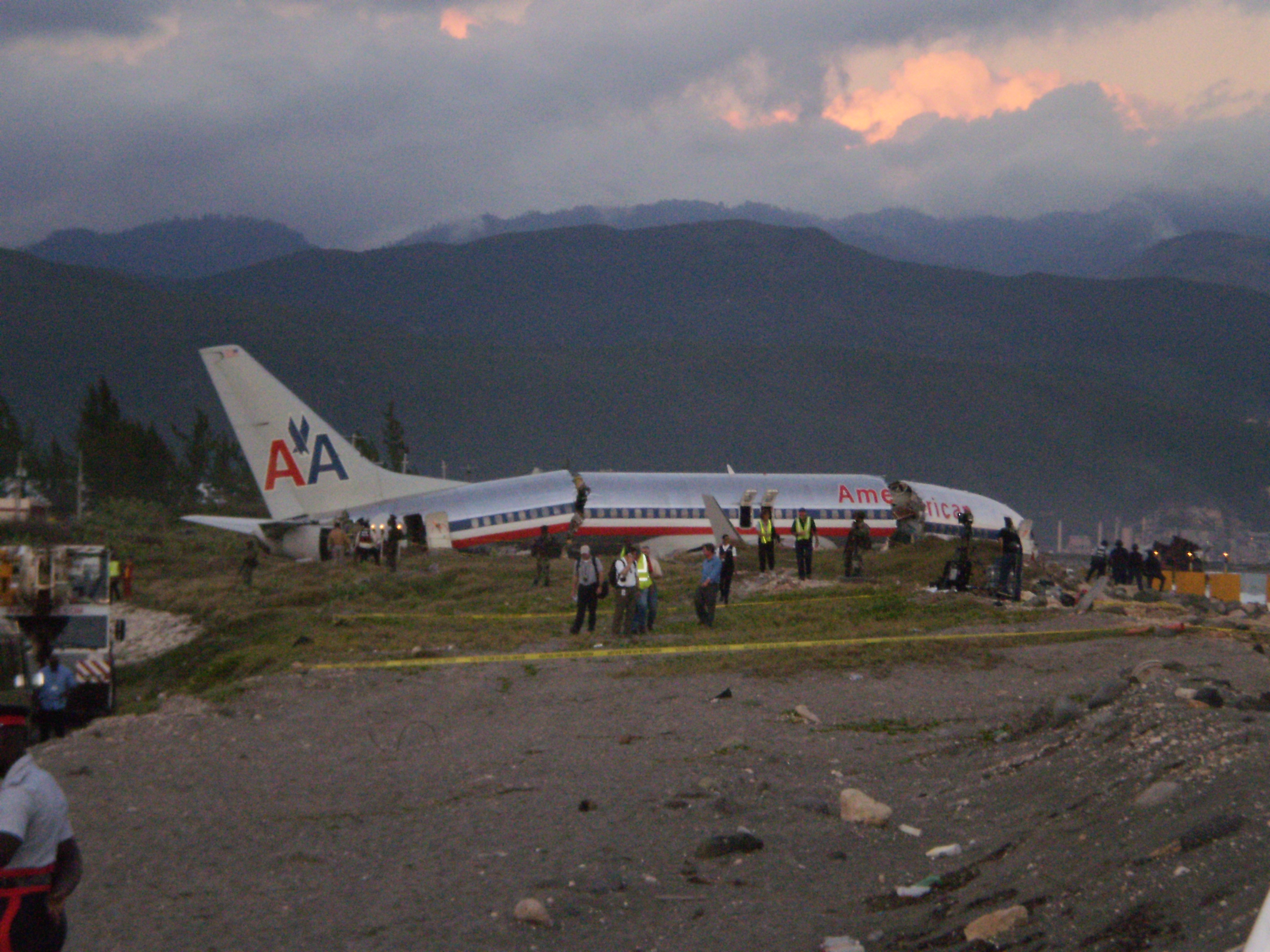
American Airlines Flight 331
The controller warned the crew that the runway was wet. He told them about the tailwind and offered them a different runway. They declined. At 10:22 p.m. on December 22, 2009, American Airlines Flight 331 -- a Boeing 737-800 carrying 148 passengers and 6 crew from Miami -- touched down on Runway 12 at Norman Manley International Airport in Kingston, Jamaica, more than 4,000 feet past the threshold. The remaining runway was not enough. The aircraft skidded on the rain-soaked pavement, blew through the perimeter fence at highway speed, crossed Norman Manley Highway, and came to rest on the beach -- upright, broken into sections, and meters from the open Caribbean Sea. Eighty-five people were injured, fourteen of them seriously. No one died.
A Sequence of Choices
The chain of decisions that put Flight 331 on a wet, short runway in a tailwind began well before the approach. The crew contacted Jamaica Air Traffic Control and requested an ILS approach for Runway 12, the runway broadcast by the airport's Automatic Terminal Information Service that evening. But controllers advised of tailwind conditions on Runway 12 and offered a circling approach for Runway 30 instead -- a landing into the wind, which would have provided shorter stopping distances. The crew repeated their request for Runway 12. They were cleared to land, with a final advisory that the runway was wet. What they apparently did not know was that a standing water warning had been issued for the airport. The crew had not reviewed their approach options carefully enough to catch it. They also did not select the maximum autobrake setting or deploy full flaps, choices that would have shortened their landing roll significantly.
Through the Fence
The Boeing 737-800 touched down roughly halfway along the 8,910-foot runway. At that point, the physics became unforgiving. Heavy rain had pooled on a surface that lacked the drainage grooves common at larger airports, and the tailwind meant the aircraft was carrying extra groundspeed. The landing gear could not stop the plane in the remaining distance. The jet slid off the end of the runway, its gear collapsing as it left the pavement, dropping the fuselage onto its belly. Momentum carried the aircraft through the perimeter fence and across Norman Manley Highway at what investigators described as freeway speeds. The fuselage fractured forward and aft of the wings. One engine tore away. The nose section crumpled. When the wreckage finally stopped, the aircraft sat upright on the narrow strip of beach between the highway and Kingston's outer harbor, within meters of the Caribbean Sea. That it remained upright -- that it did not cartwheel, or plunge into the water, or ignite -- is the reason 154 people walked away.
What No One Had Practiced
The NTSB investigation uncovered a systemic gap in American Airlines' training program. In post-accident interviews, the flight crew told investigators they had never received training on conducting landings in tailwind conditions. Other American Airlines pilots confirmed the same: no simulator training on tailwind landings, no guidance on the runway overrun risks that tailwinds create. The airline was already under FAA scrutiny when Flight 331 crashed. In the two weeks before the Kingston accident, two other American Airlines flights had experienced landing incidents in which wingtips struck the ground. The Flight 331 investigation also found that the crew had not been provided with an accurate or current report on runway conditions at Kingston. Some of the airport's approach lights were not functioning, though Jamaican officials noted that the runway itself was properly lit and ground-based navigation aids tested normal after the accident.
Lessons Written in Wreckage
On December 7, 2011, the NTSB issued its safety recommendations. The final report cataloged a cascade of contributing factors: the crew's insistence on Runway 12 despite the tailwind advisory, the missed standing water warning, the late touchdown point, the failure to use maximum autobrake and full flaps, and the heavy fuel load the aircraft was carrying -- enough for a roundtrip flight back to the United States. The Jamaica Civil Aviation Authority echoed the NTSB's findings and recommended that airlines require landing distance assessments with conservative safety margins before every approach. The parallel was hard to miss: American Airlines Flight 1420 had crashed under nearly identical circumstances a decade earlier in Little Rock, Arkansas -- a late-night arrival in a thunderstorm, a wet runway, a crew that pressed an approach they should have abandoned. That crash killed eleven people. Flight 331's crew and passengers were luckier, but the lesson was the same. Captain Cole returned to flying with American Airlines in 2013. The runway at Norman Manley International still stretches along the Palisadoes, the narrow spit of land separating Kingston Harbour from the Caribbean, a reminder that the margin between tarmac and open water is thinner than any pilot wants to discover at highway speed.
From the Air
Located at 17.931N, 76.775W at the eastern tip of the Palisadoes, the narrow peninsula that forms Kingston Harbour. Norman Manley International Airport (MKJP) is clearly visible from any approach altitude -- its single runway extends along the spit with water on both sides. Runway 12/30 runs roughly southeast-northwest. The crash site is at the southeastern end of Runway 12, between the airport perimeter and the beach. Kingston's urban area lies to the northwest across the harbour. Tinson Pen Aerodrome (MKTP) is visible on the opposite shore.