American Airlines Flight 77
At 9:37 AM on September 11, 2001, American Airlines Flight 77 slammed into the western face of the Pentagon at over 500 miles per hour. The Boeing 757, hijacked after departing Washington Dulles International Airport bound for Los Angeles, carried 64 people -- passengers, crew, and five hijackers. Inside the Pentagon, 125 more would die. In the hours and days that followed, an extraordinary effort unfolded: military personnel and civilians rushed toward the flames, firefighters battled temperatures so extreme that conventional tactics failed, and investigators pieced together evidence from wreckage that had penetrated deep into the building's reinforced concrete rings.
Into the Flames
Rescue efforts began the instant the building shuddered. Military and civilian employees inside the Pentagon were the first responders, pulling colleagues from the smoke and debris before any fire company arrived. Within minutes, firefighters from Fort Myer and Reagan National Airport reached the scene, but the volunteers already working near the impact site had to be ordered back -- they lacked the equipment to survive the hazards. One firefighter would later recall that they "pretty much knew the building was going to collapse because it started making weird sounds and creaking." Rumors of additional incoming planes forced two full evacuations during the day. Firefighters mounted a two-pronged attack against fires that officials estimated reached extreme temperatures, but the Pentagon's reinforced structure actually worked against them -- they could not breach the walls to reach the flames inside.
The Grim Search
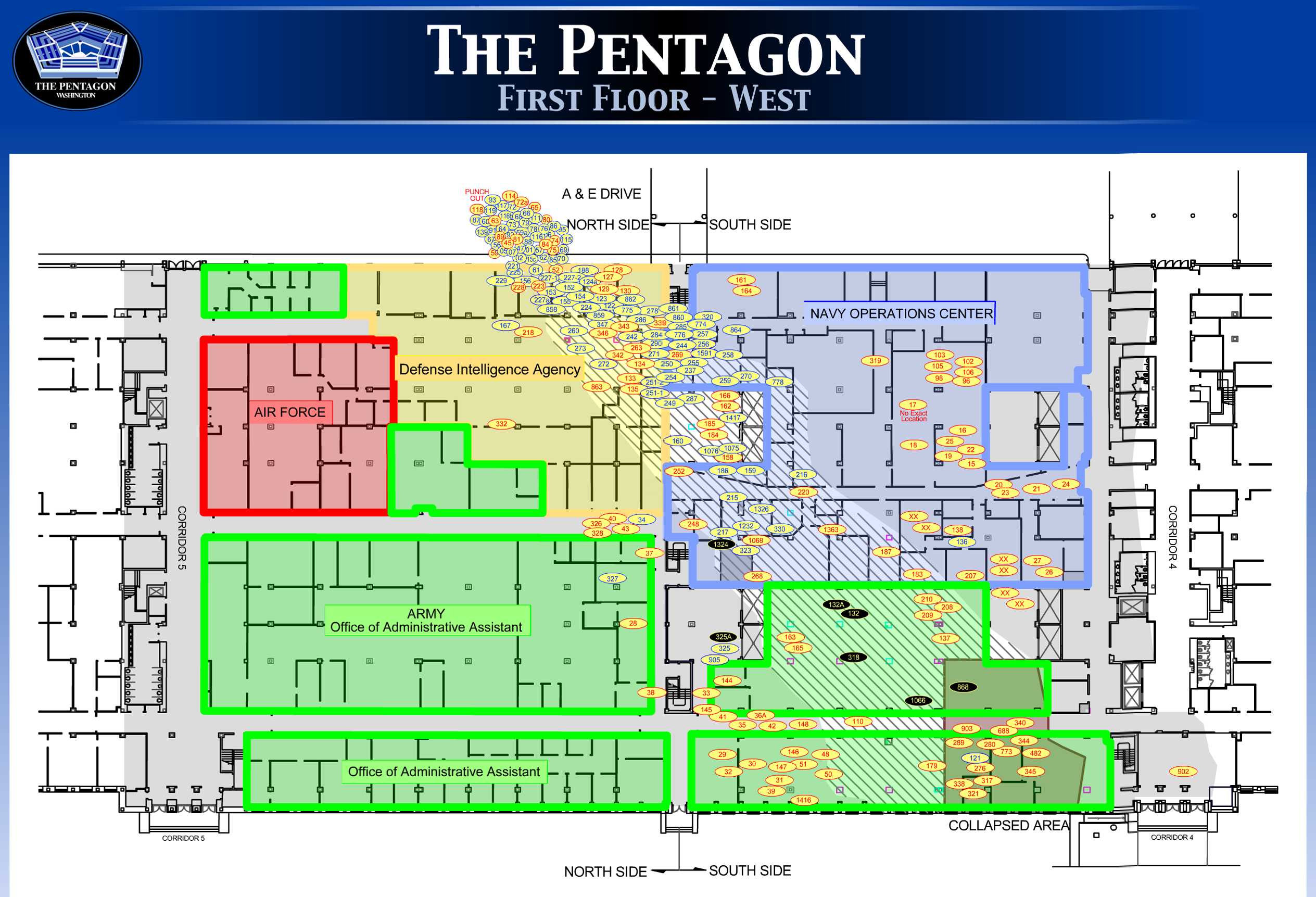
Army engineers determined by 5:30 PM on September 11 that no survivors remained in the damaged section. Soldiers from Fort Belvoir were the first to survey the interior crash site, finding human remains throughout the wreckage. Navy photographer Kevin Rimrodt, documenting the Navy Command Center, described the scene: "There were so many bodies, I'd almost step on them. So I'd have to really take care to look backwards as I'm backing up in the dark, looking with a flashlight, making sure I'm not stepping on somebody." FEMA Urban Search and Rescue teams and the Fairfax County task force joined the effort, working through debris that was systematically transported to the Pentagon's north parking lot for detailed examination. Investigators eventually identified 184 of the 189 people who died. The five hijackers were identified through elimination and their remains turned over to the FBI. Early in the morning of September 14, search team members Carlton Burkhammer and Brian Moravitz discovered an intact seat from the plane's cockpit, while paramedics located both black boxes near a punch-out hole deep inside the building.
The Pentagon Endures
Secretary of Defense Donald Rumsfeld was in his office on the opposite side of the Pentagon when the plane struck. He ran to the impact site and helped the injured before returning to join a secure videoconference with Vice President Dick Cheney. While officials considered relocating command operations to Site R, a backup facility in Pennsylvania, Rumsfeld insisted on staying, sending Deputy Secretary Paul Wolfowitz instead. The National Military Command Center continued operating even as smoke infiltrated the facility -- engineers manipulated ventilation systems to draw smoke out and bring in fresh air. At 6:42 PM that evening, Rumsfeld held a press conference inside the Pentagon and declared: "The Pentagon's functioning. It will be in business tomorrow." Employees returned the next day.
The Evidence in the Rubble
The cockpit voice recorder and flight data recorder were found where the plane entered the building. The cockpit voice recorder, an L-3 Communications model that used magnetic tape, was too damaged to yield any data -- the NTSB reported that "the majority of the recording tape was fused into a solid block of charred plastic." But the flight data recorder, which used a solid-state drive, surrendered all its information intact. Security camera footage, released years later in response to Freedom of Information Act requests, showed the aircraft as a "thin white blur" in a single frame before the explosion. Additional footage from a nearby Citgo station and the Doubletree Hotel in Crystal City captured the aftermath but not the impact itself.
Remembering the 184
The rebuilt section of the Pentagon contains a small indoor memorial and chapel at the point of impact. At Arlington National Cemetery, a pentagonal granite marker honors five victims whose remains were never found -- among them Dana Falkenberg, three years old, who was aboard Flight 77 with her parents and older sister. The Pentagon Memorial, designed by Julie Beckman and Keith Kaseman, opened on September 11, 2008, exactly seven years after the attack. Located just southwest of the building in Arlington County, Virginia, it holds 184 illuminated benches -- one for each victim -- arranged by age, from the youngest at three to the oldest at seventy-one. Each bench is a cantilevered unit over a small reflecting pool, oriented so that benches for those who were in the building face the sky, while benches for those on the plane face the Pentagon.
From the Air
Located at 38.87N, 77.06W in Arlington County, Virginia. The Pentagon is one of the most recognizable structures from the air -- its distinctive five-sided shape is unmistakable along the Potomac River, just south of the National Mall. The Pentagon Memorial is visible on the southwest side of the building. Nearby airports: Ronald Reagan Washington National (KDCA) less than 1nm to the south, Washington Dulles International (KIAD) 24nm west. Approach with respect -- this is hallowed ground.