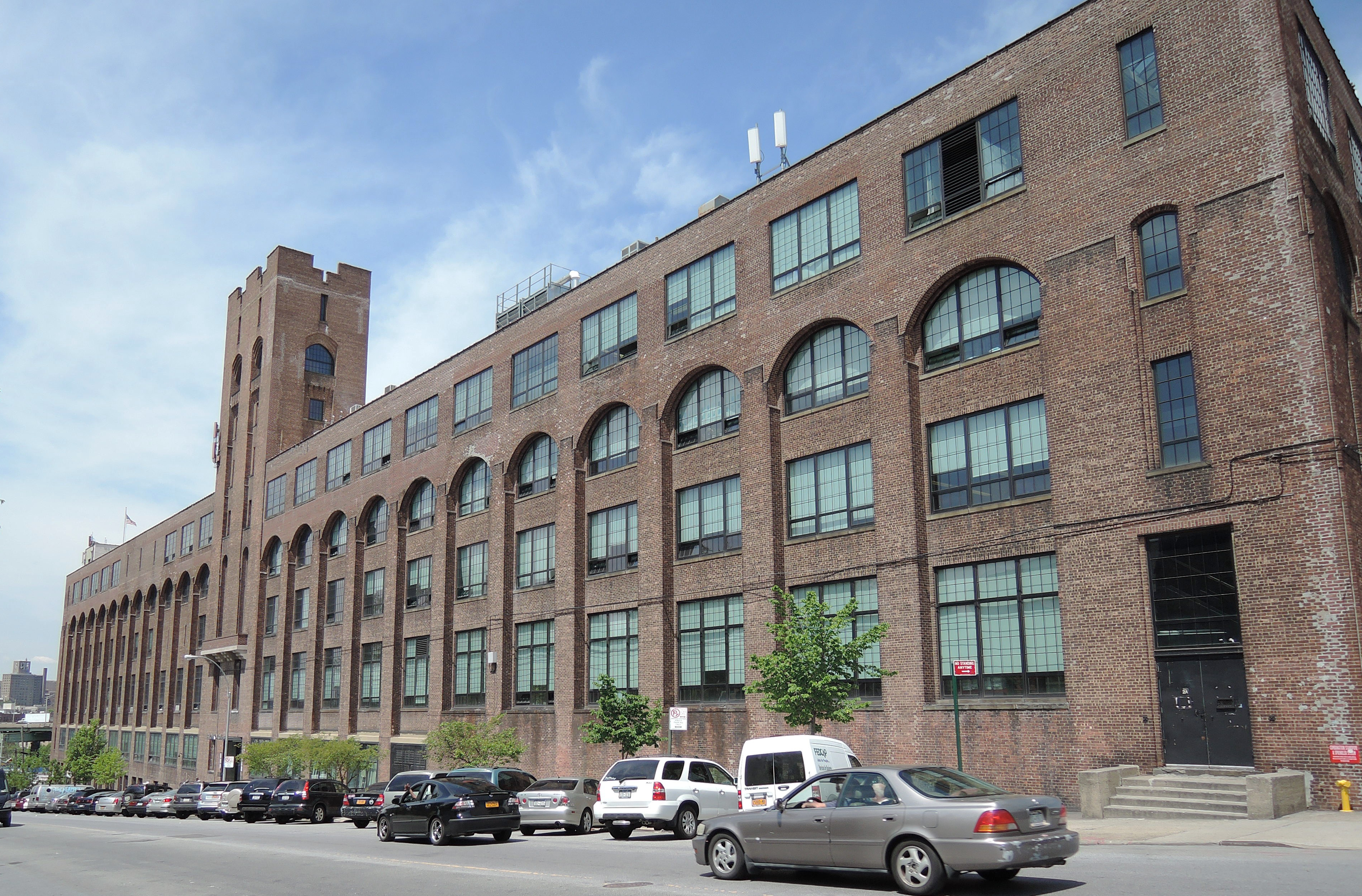
American Bank Note Company Printing Plant
In 1963, the American Bank Note Company employed 33 engravers in a house style they described with perfect deadpan seriousness: their stock certificates favored "folded robes, bare-chested men, and half-naked women who seem to be a cross between a Wagnerian soprano and the White Rock nymph." This was not artistic whimsy. Stock exchange regulations required certificates to include human figures with visible flesh, because the fine details of draped fabric and exposed skin were considered the hardest elements for a counterfeiter to duplicate. The building where these engravers worked, a mammoth industrial complex in the Hunts Point neighborhood of the Bronx, has its own story of reinvention that spans more than a century.
Seven Firms Become One
The American Bank Note Company was born on April 29, 1858, when seven major engraving firms merged into a single entity. Their first printing plant occupied a building at Wall and William Streets in Manhattan that would later become the United States Custom House. By 1908, the company was looking to separate its administrative offices from its production facilities, a move they believed would increase efficiency. The search for a new plant site settled on a large tract in Hunts Point, purchased from a real estate developer who had been building two-family houses on what was once the 85-acre estate of tea merchant Edward G. Faile. Proximity to the New York, New Haven and Hartford Railroad was a deciding factor; the plant would need the railroad to handle 10,000 short tons of paper and supplies each year. Architects Kirby, Petit & Green designed the complex with steel framing that allowed three times the window area of an all-brick structure, flooding the interior with daylight essential for inspecting detailed color printing.
The Machine That Fought Fraud
The plant was a technological showpiece when it opened. Each press ran on its own electric motor, a system called "unit drive" that was advanced for the era and would not become widespread until the 1920s. Column spacing reached 40 feet in places, with 21-foot ceilings and floors rated for heavy loads. The company printed currency, stock certificates, bonds, and food stamps, always pushing the limits of what counterfeiters could replicate. Their research program constantly developed better engraving techniques, inks, and papers. A fourth story was added to the Lafayette wing in 1925, and at its peak the plant hummed with the work of producing the intricate documents that underpinned global finance. In 1977, the complex was bombed by the FALN, a Puerto Rican nationalist group that targeted it as a symbol of what they called "Yanki repression and exploitation." The explosion near the Lafayette Avenue entrance shattered windows up to the fourth floor, one of over seventy bombings attributed to the group over nearly a decade.
From Currency to Culture
By the mid-1980s, the plant had dwindled to about 500 employees, and American Bank Note relocated to Blauvelt, New York. What followed was a series of reinventions. Walter Cahn and Max Blauner purchased the site in 1985 for $8.3 million and converted it into the Bronx Apparel Center. Clothing manufacturers moved into spaces that once housed engraving presses. The Bronx Academy of Arts and Dance took up residence, as did art studios, a wine cellar, and a homeless shelter. In 2008, Taconic Investment Partners and Denham Wolf Real Estate Services bought the complex for $32.5 million, investing another $37 million in renovations with the stated goal of making it a haven for cultural groups priced out of Manhattan. A business incubator opened, offering startups month-to-month leases for as little as a single desk. The JVL Wildcat Academy, a high school campus, set up culinary programs and a hydroponics garden in the Lafayette wing.
Promises and Price Tags
The cultural rebirth had its tensions. When Taconic refused to extend the Bronx Academy of Arts and Dance's lease at its existing rate in 2013, instead offering a one-year extension at double the rent, the Academy's co-founder accused the new owners of breaking their promise to maintain the building's character as an arts hub. The Academy left. In 2014, Taconic sold the entire site to Madison Marquette and Perella Weinberg for $114 million, a price that reflected Hunts Point's rising real estate values more than its artistic aspirations. The New York City Landmarks Preservation Commission had designated the plant a city landmark in 2008, recognizing it as part of the city's industrial heritage. The building endures, its terra-cotta details and massive steel frame a reminder that the Bronx once manufactured the paper promises that moved the world's money.
From the Air
Located at 40.817N, 73.891W in the Hunts Point section of the Bronx, adjacent to the Hell Gate Line railroad tracks (formerly New York, New Haven and Hartford Railroad). The three interconnected industrial buildings and distinctive tower are visible from above. Best viewed at 2,000-3,000 feet AGL. Nearest airports: KLGA (LaGuardia, 5nm southwest), KTEB (Teterboro, 12nm west). One block from Bruckner Boulevard; the Bronx River is immediately east.