American Civil War Museum
The provisional Confederate Constitution sits behind glass in Richmond, Virginia, a few blocks from the building where it was drafted. Nearby, 500 original battle flags hang in climate-controlled cases, their fabric still carrying the gunpowder stains and field repairs of soldiers who fought under them a century and a half ago. The American Civil War Museum exists because a group of determined Richmond women decided in 1894 that the house where Jefferson Davis lived as Confederate president should not be demolished, and that the objects of a defeated nation deserved preservation rather than a bonfire. What began as a shrine has become one of the most comprehensive Civil War collections in the country, spread across three sites that tell the war's story from multiple perspectives.
The Ladies Who Saved a House
Isabel Maury started it. The daughter of Robert Henry Maury, she led the effort to save the White House of the Confederacy -- the gray stucco mansion two blocks north of the Virginia State Capitol where Jefferson Davis and his family lived from 1861 to 1865. The Ladies Hollywood Memorial Association joined the cause, and on February 22, 1896 -- the anniversary of Davis's inauguration as Confederate president -- the building opened as the Confederate Museum. Maury became the first Regent of the Confederate Memorial Literary Society, and with her Relics Committee she began collecting the personal effects of Confederate leaders: swords, uniforms, letters, the small objects that humanize history. By the time the house was named a National Historic Landmark in 1963, the collection had grown far beyond what any private residence could hold.
Iron, Fire, and Welsh Ambition
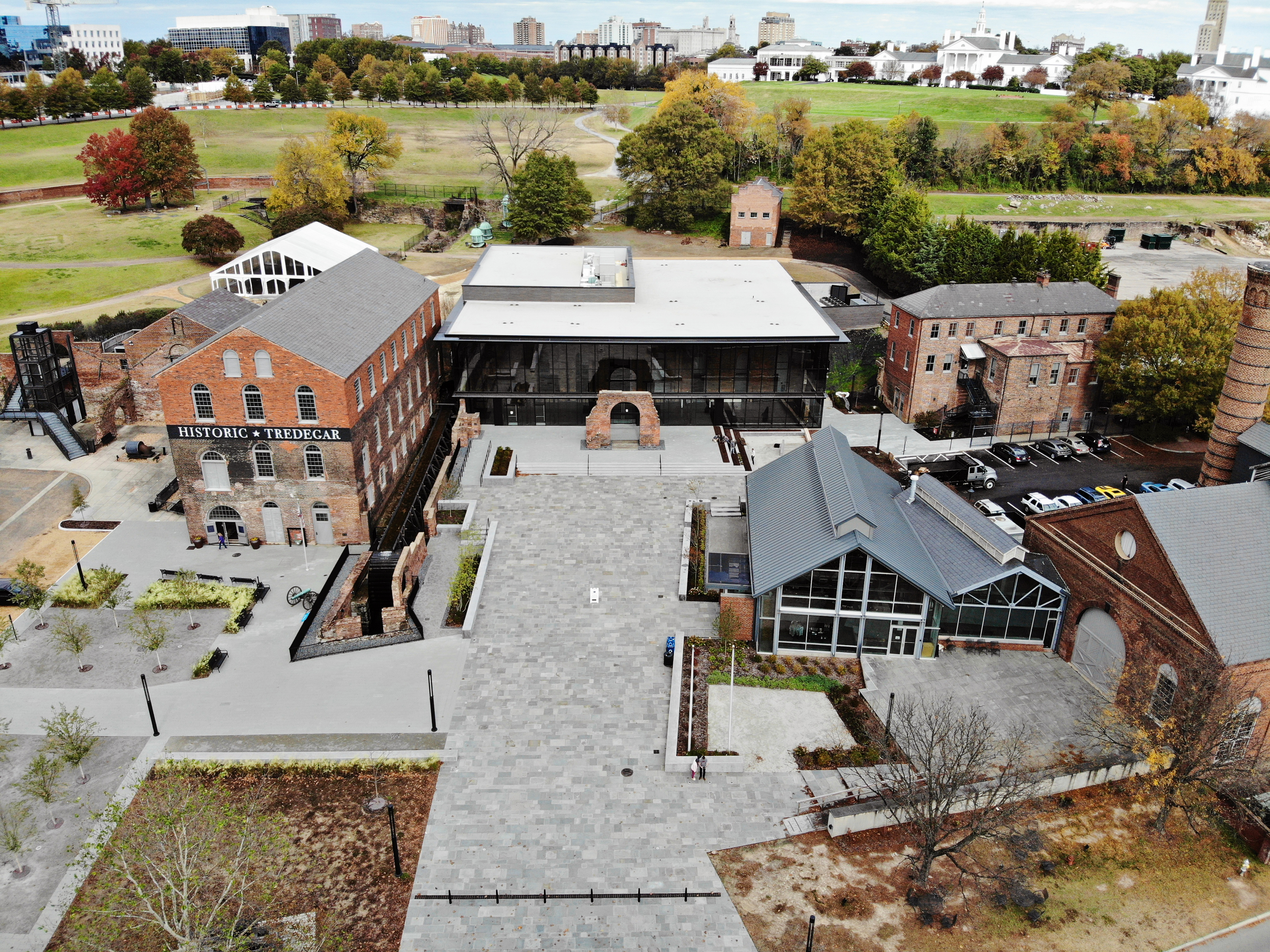
The museum's second site carries a different kind of weight. Historic Tredegar traces its origins to 1836, when Francis B. Deane founded an iron works on the north bank of the James River and named it after a Welsh town. When Joseph Reid Anderson took over, Tredegar became the industrial engine of the Confederacy, producing locomotives, train wheels, spikes, cables, ships, boilers, and naval hardware. The iron works was the largest in the South and one of the few facilities capable of manufacturing heavy ordnance for the Confederate military. Today, the renovated complex houses more than 7,000 square feet of gallery space. The anchor of the CSS Virginia -- the Confederacy's first ironclad warship, which fought the USS Monitor in the Battle of Hampton Roads on March 9, 1862 -- was once displayed at the museum entrance, a piece of iron forged in these very works and hauled up from the riverbed.
From Shrine to Museum
For decades, the Museum of the Confederacy functioned more as a memorial than a place of historical inquiry. The shift began around the Civil War centennial in the 1960s, when the governing board decided the institution needed professional museum practices. In 1963, the Confederate Memorial Literary Society hired its first trained museum director. In 1970, they changed the name from the Confederate Museum to the Museum of the Confederacy. The collection expanded beyond Confederate relics to include Union perspectives and the experiences of enslaved people. Exhibitions like "Before Freedom Came: African-American Life in the Antebellum South" signaled the museum's broadening vision. Visitors peaked at 91,000 per year in the early 1990s, then dropped to around 51,000 by the early 2000s -- a decline that pushed the museum toward a more fundamental transformation.
Two Become One
In November 2013, the Museum of the Confederacy merged with the American Civil War Center at Tredegar, and in January 2014 the combined institution announced its new name: the American Civil War Museum. The merger brought together the Confederacy-focused collection of personal effects, flags, and documents with Tredegar's industrial history and broader war narrative. A third site at Appomattox -- the town where Lee surrendered to Grant -- rounded out the geographic footprint. The White House of the Confederacy, painstakingly restored to its 1861-1865 appearance after a twelve-year project completed in 1988, offers tours of the rooms where Davis governed. Scholars including Douglas Southall Freeman, Drew Gilpin Faust, and Edwin C. Bearss have all conducted research in the museum's archives, and its more than 15,000 documents and artifacts make it an essential resource for understanding the war.
What the Flags Still Carry
The collection's emotional center may be its 500 original Confederate battle flags. These are not reproductions. They are fabric that was carried through smoke and gunfire, patched by soldiers in camp, and in some cases taken from the field after the men who bore them fell. Items owned by Robert E. Lee, Stonewall Jackson, J.E.B. Stuart, Joseph E. Johnston, and other commanders fill the galleries alongside artifacts from ordinary soldiers and civilians. The Great Seal of the Confederacy -- the official emblem of a government that existed for only four years -- is here too. Together, these objects form one of the most significant collections of Civil War material culture in existence, preserved in a city that was once the capital of the nation that created them.
From the Air
The American Civil War Museum's Tredegar site is located at 37.540N, 77.430W on the north bank of the James River in downtown Richmond, Virginia, adjacent to the old Tredegar Iron Works and Brown's Island. The White House of the Confederacy is at 37.542N, 77.434W, two blocks north of the Virginia State Capitol. From the air, Tredegar is identifiable along the riverfront near the Lee Bridge and the James River rapids. Nearest airports: Richmond International Airport (KRIC) approximately 7 nm east; Chesterfield County Airport (KFCI) approximately 10 nm southwest. Best viewed at 1,500-2,500 ft AGL following the James River through downtown Richmond.