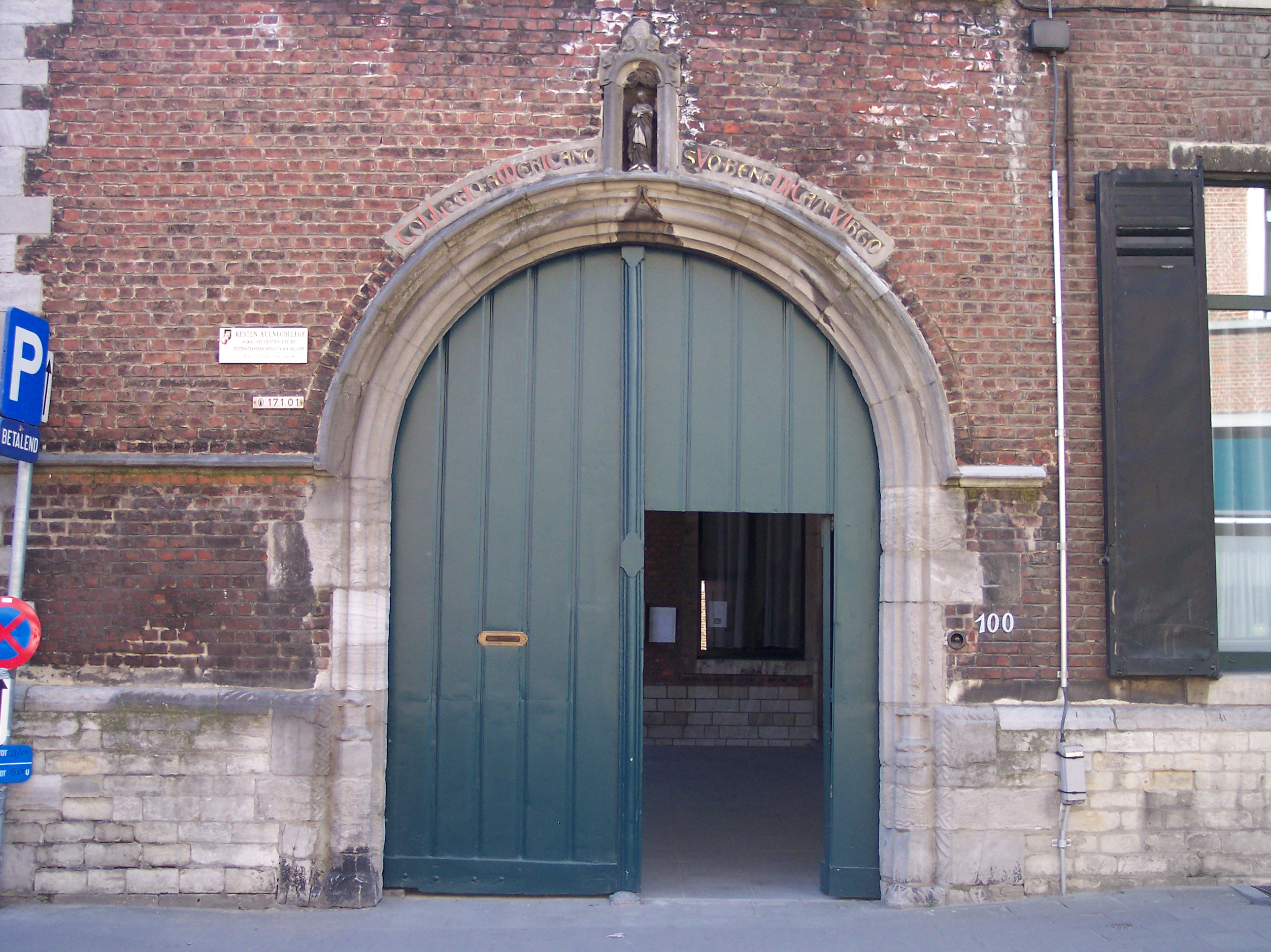
The American College, Leuven
When the bishops of Louisville and Detroit founded a small Catholic seminary in Leuven in 1857, the American Catholic Church was an immigrant project running short of priests. The United States was a vast country, the existing pool of native-born American clergy was small, and the obvious solution was to recruit and train European seminarians willing to cross the Atlantic. So they bought a building on the Naamsestraat, hired a young Detroit priest named Peter Kindekens as the first rector, and opened a college whose entire purpose was to ordain men in Belgium and send them west. Over the next century and a half it would train more than eight hundred priests for the United States, hide the holy treasures of Leuven during the German occupation of 1914, weather two world wars and a Belgian linguistic civil war, and then quietly close its doors in June 2011 because not enough young Americans wanted to be priests anymore.
An Immigrant Church's Solution
By 1857, the Catholic population of the United States had been growing for forty years on a tide of Irish, German, and increasingly Belgian and Dutch immigration. Bishops in places like Detroit, Louisville, Boise, and San Francisco were desperate for priests who could serve immigrant flocks in their own languages. Bishop Martin J. Spalding of Louisville and Bishop Peter Paul Lefevere of Detroit, both men with deep European roots, proposed an unusual solution: rather than wait for American boys to grow into the priesthood, the American bishops would establish a seminary in Europe to train men who already had the languages, the theological background, and the willingness to emigrate. They chose Leuven for a reason. The Catholic University of Leuven, refounded in 1834, was the leading Catholic theological school in northern Europe. The Belgian Low Countries had a long tradition of sending missionaries abroad - to the Congo, to Mongolia, to North America. Seminarians could complete their philosophy and theology coursework at the university while living at the new American College and being formed for the priesthood under American supervision. The first signature song of the college, O Sodales, was a Marian hymn composed in 1862 by a Belgian priest named Gustave Limpens. Generations of seminarians would sing it before crossing the Atlantic, often never to return.
Apostles to the Edges of America
The graduates went to remarkable places. Charles John Seghers, a Ghent native ordained at Mechlin in 1863 after completing his studies at the American College, became the founding apostle of the Alaska mission - he was murdered by a deranged companion on the Yukon River in 1886. Patrick William Riordan, born in New Brunswick of Irish immigrant parents, served as Archbishop of San Francisco through the earthquake of 1906 and rebuilt the city's Catholic infrastructure from rubble. Alphonse Glorieux became the first bishop of Boise, Idaho. John Baptist Brondel served the Diocese of Helena, Montana, in country where Catholic settlements were still days apart by horse. By 1900 more than eight hundred American College alumni were serving in American dioceses and territorial vicariates from the Maine coast to the Pacific Northwest. The college's reach was so wide that students sometimes joked it was easier to find a Leuven-trained priest in Oregon than in Brussels.
The Walls That Hid the Sedes Sapientiae
In August 1914, when German troops sacked Leuven and burned the university library in one of the most notorious atrocities of the early war, the American College stayed open. The United States was still neutral, the American flag flew over the seminary, and the rector Jules De Becker quietly negotiated with the occupying authorities to keep the doors open. What followed was extraordinary. The college converted itself into a relief operation. Behind its walls, staff hid the most precious treasures of the burning city - among them the medieval statue of the Sedes Sapientiae, the Seat of Wisdom, which is the symbol of the university itself. The kitchens fed up to fifteen hundred Leuven residents a day. The dormitories became an emergency hospital. For four years, the seminary that had been founded to train priests for America served as one of the principal humanitarian institutions of occupied Leuven. The statue of the Sedes Sapientiae survived. It still presides over the university.
Closure and Afterlife
The decline came slowly, then quickly. After Vatican II in the 1960s, vocations to the priesthood in the United States began a long decline that has not yet stopped. The Leuven crisis of 1968 split the Catholic University into two institutions - KU Leuven in Flemish Leuven and the new Universite catholique de Louvain in French-speaking Louvain-la-Neuve - leaving the American College in a complicated relationship with both. By the academic year 2010-2011, only nineteen seminarians remained, drawn from a scatter of dioceses including Boise, Cheyenne, Green Bay, Spokane, and one each from Salford and Lublin. On 22 November 2010, the United States Conference of Catholic Bishops announced the college would close in June 2011 because there were no longer enough seminarians or faculty priests to sustain it. The doors closed quietly that summer, 154 years after they had opened. But the building was not abandoned. After renovation in 2013, the American College reopened as a KU Leuven student residence with 141 rooms and 17 studio apartments, housing roughly 180 mostly Belgian and international students. A small Catholic intentional community called the Saint Damien Community - named for the Flemish missionary to Hawaii who studied in Leuven before his work among the leprosy patients of Molokai - continues to live there, organizes an annual academic conference, and maintains a chaplaincy in English.
What Remains
The neo-Gothic Chapel of the Immaculate Conception, designed by the East Flemish priest-architect Petrus Van Loo in 1892-93, still stands inside the complex. Its modernist stained glass, installed between 1961 and 1970, replaced the original Victorian windows. The Flemish government provided 58,347 euros in 2021 for restoration of the chapel facades - the kind of small, careful institutional act that is the present-day Belgian equivalent of building a cathedral. The chapel hosts Anglican services for the English-speaking Diocese in Europe and a Malankara Orthodox Syrian congregation. Mass and vespers are still celebrated by the Saint Damien Community. In the front foyer, the painted portrait of Peter Kindekens, the founding rector who never imagined his small seminary would still be standing in 2026, looks down on undergraduates who have no idea who he was.
From the Air
The American College stands on Naamsestraat in central Leuven, at approximately 50.873 N, 4.700 E. Brussels Airport (EBBR) lies 13 minutes by direct train to the northwest; the airport's runway 25L approach passes within 12 km of the building. From cruise altitude, central Leuven appears as a compact medieval core marked by the brick tower of the university library on Ladeuzeplein and the unfinished west tower of Saint Peter's Church on the Grote Markt. The American College sits just south of the Grote Markt, near the bend in the Dijle river.