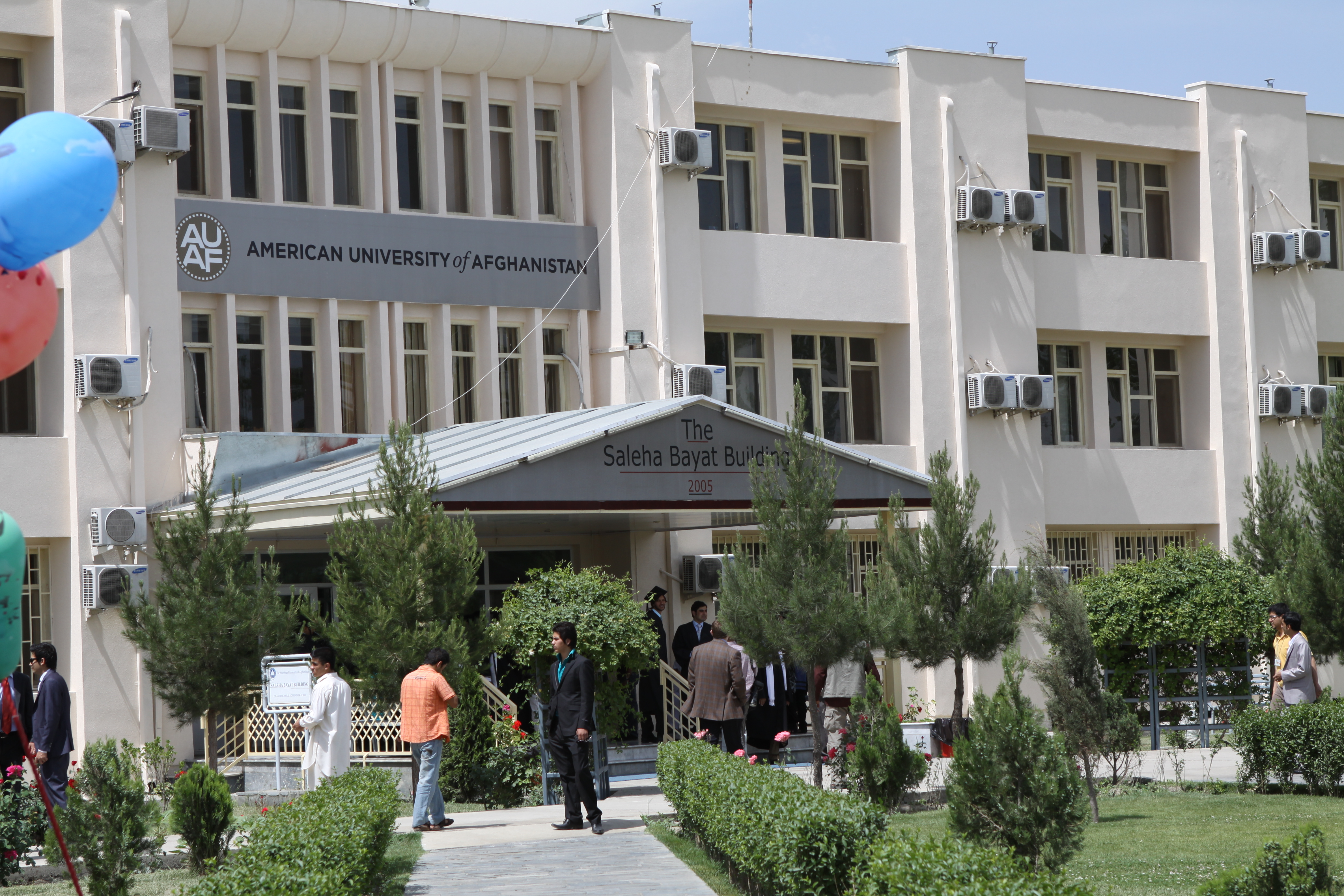
American University of Afghanistan
On the last day, they burned the records. University president Ian Bickford and a handful of remaining students stood around a bonfire on the Darulaman Road campus, feeding files and hard drives to the flames. It was August 2021, and the Taliban were entering Kabul. The American University of Afghanistan -- the country's first private, not-for-profit institution of higher education -- had survived bombings, kidnappings, and fifteen years of operating in a war zone. What it could not survive was the disappearance of the country it was built to serve.
A Minister's Gamble
The idea began in 2002, when Dr. Sharif Fayez, Afghanistan's Minister of Higher Education, proposed something that had never existed in the country: a private university. The timing was audacious -- the Taliban had been ousted barely a year earlier, and Afghanistan's educational infrastructure lay in ruins. But Fayez found powerful allies. U.S. Ambassador Zalmay Khalilzad, himself a product of the American University of Beirut, championed the concept. In 2003, First Lady Laura Bush announced American support for educational initiatives in Afghanistan before UNESCO. The Afghan government offered leases on 55 acres of land in the Darulaman section of Kabul, and on July 26, 2004, the Ministry of Higher Education granted a charter. The inaugural Board of Trustees met in Dubai that December, with Fayez elected president pro tempore. He would remain involved until his death in 2019, having watched his improbable idea grow from a proposal into an institution that drew students from all 34 of Afghanistan's provinces.
Fifty Students and a Promise
The first class enrolled in March 2006 -- fifty students who began not with lectures in political science or business, but with English language courses and study skills. By September, the university was offering its first credit-bearing undergraduate courses. Growth came fast. USAID funding, bolstered by a $40 million commitment announced by Laura Bush in 2008, covered more than half of operating expenses. Stanford Law School launched its Afghanistan Legal Education Project on campus in 2008, producing the first new legal textbook dedicated to the Afghan system in decades. By 2011, AUAF held its first commencement, awarding degrees to 32 graduates. The Professional Development Institute, running since the university's founding year, trained professionals from government, NGOs, and the private sector. An MBA program launched in 2011; a Master of Arts in Education followed in 2014, drawing 318 students from every province. For the 2012-13 school year, over 50 percent of entering students were women -- a remarkable figure in a country where the Taliban had once banned girls from school entirely.
Under Fire
The violence that shadowed Afghanistan found the university repeatedly. In January 2014, two AUAF employees were among 21 people killed in a Taliban gun and bomb attack on a Kabul restaurant. On August 7, 2016, an American professor and an Australian professor were kidnapped from near the campus by gunmen wearing Afghan National Police uniforms. A U.S. Special Forces rescue attempt failed, and the two men remained captive for three years before being released in November 2019 in exchange for three Taliban prisoners. Just seventeen days after the kidnapping, on the evening of August 24, 2016, three attackers breached the campus itself. They opened fire and detonated explosives, killing seven students, one professor, one policeman, three university security guards, and a guard from a neighboring school. The university reopened. Students returned. The 29 Fulbright Scholars among AUAF's alumni were proof that the project was working, that education could take root even in contested ground.
The Bonfire on Darulaman Road
The end came with stunning speed. As U.S. troops withdrew through 2020 and 2021, the Taliban advanced across Afghanistan's provinces. By August 15, 2021, they had entered Kabul. President Ashraf Ghani fled the country. At AUAF, the priority shifted from education to survival -- of people and of identities. Student records, employee files, anything that could mark someone as affiliated with an American institution had to be destroyed. The bonfire consumed years of institutional memory. The campus buildings on Darulaman Road survived physically -- as of 2022, they remained intact -- but they no longer served any teaching or research function. The Women's Center, where the International Center for Afghan Women's Economic Development had worked to advance women's roles in the economy since 2013, went dark. The Bayat IT Center, which had opened just two years earlier, fell silent.
Scattered but Unfinished
AUAF's story did not end with the fall of Kabul, though it was profoundly changed. Thousands of university-educated Afghans sought to flee the country, many unable to do so. Those who escaped scattered -- to Qatar, where plans emerged for a new AUAF campus; to the American University of Central Asia in Bishkek, Kyrgyzstan; to Bard College in New York. The university shifted to online operations, becoming in exile what it could no longer be in person. In spring 2025, even that lifeline wavered when USAID funding cuts briefly suspended the semester, though funding was later extended through June 2025. From above, the Darulaman Road campus still looks like a university: the Azizi Building, the Bayat Building, the gymnasium, the two masjids. But the classrooms are empty, and the students who once filled them are learning in a dozen different countries, carrying forward an education that was born from one minister's conviction that Afghanistan deserved something it had never had.
From the Air
Located at 34.48N, 69.13E on Darulaman Road in southwestern Kabul, near the Darul Aman Palace. The campus is visible as a cluster of institutional buildings along the road. Nearest airport is Kabul International Airport (OAKB), approximately 10 km northeast. Elevation roughly 1,800 meters (5,900 feet). The Darulaman area sits in the broad Kabul valley, flanked by mountains on all sides.