Amon Carter Museum of American Art
Philip Johnson called it his 'jewel box.' Five arches of creamy Texas shellstone frame a wall of glass that looks east across Fort Worth's skyline -- a building designed not just to hold art but to command a view. Amon G. Carter Sr., the newspaper publisher who conceived this museum, personally chose the hillside site in 1951, four years before his death. He spent the last decade of his life assembling more than 300 works by Frederic Remington and Charles M. Russell, the two artists who defined the visual mythology of the American West. When the museum opened in January 1961, it was a small memorial to one man's passion for cowboys and frontier drama. It did not stay small. Today, the Amon Carter Museum of American Art holds over 350,000 photographic works, masterpieces spanning two centuries of American painting, and one of the finest collections of Hudson River School landscapes anywhere. Admission is free.
Cowboys in Bronze and Oil
The heart of the Carter remains where it started: over 400 works by Frederic Remington and Charles M. Russell. Remington worked from a New York studio, producing vivid images of frontier life that shaped eastern audiences' perceptions of the West. Russell lived the part -- a Montana cowboy who started painting professionally after more than a decade of ranch work. Neither man had experienced the frontier at its height, but both drew from direct observation. Russell moved to Montana Territory in 1880, nine years before statehood. Remington traversed Arizona Territory in 1886 as an illustrator for Harper's Weekly. Their masterworks anchor the collection: Remington's A Dash for the Timber, the 1889 painting that established him at the National Academy of Design; The Broncho Buster, his first bronze sculpture from 1895; and Russell's Medicine Man, a 1908 portrait of a Blackfeet shaman that reflects the artist's deep empathy with Native American culture. Amon Carter Sr. began acquiring these works in 1935 and spent twenty years building the collection that would fill his museum.
The American Landscape, Collected
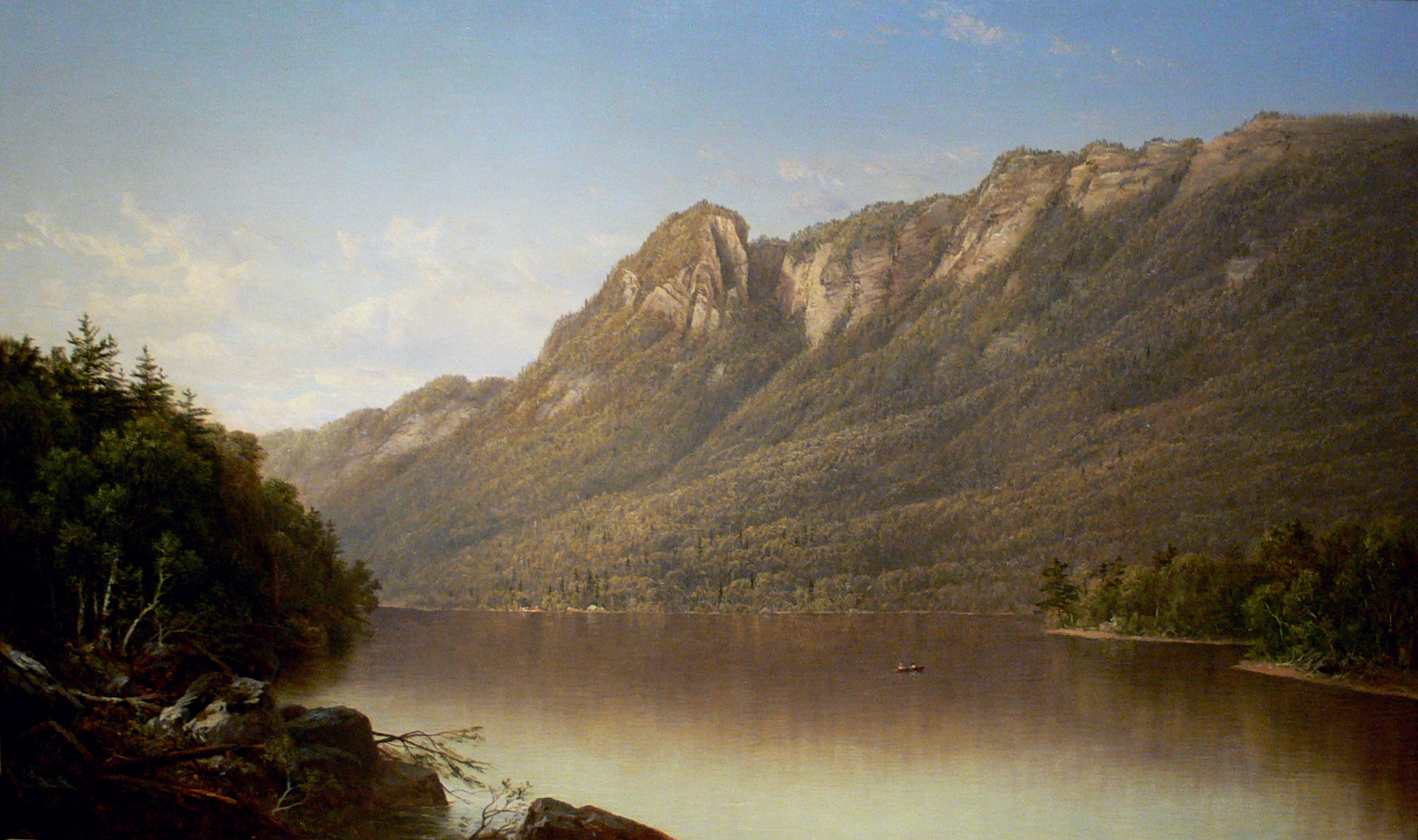
What began as a western art museum transformed, almost from the start, into something broader. Director Mitchell Wilder arrived in 1961 and, with the board's support, expanded the collecting scope to embrace the full sweep of American art history. The Hudson River School became a major focus -- Thomas Cole, Frederic Edwin Church, and Jasper Francis Cropsey are all represented by significant oils. Martin Johnson Heade's Thunder Storm on Narragansett Bay from 1868, with its dark and brooding atmosphere, is considered by many to be the artist's masterpiece. Albert Bierstadt's Sunrise, Yosemite Valley, completed around 1870 after his third western trip, brought the grandeur of Hudson River School painting to a California subject. Thomas Eakins's Swimming, one of the most celebrated realist figure paintings in American art, was acquired in 1990 through a capital campaign that raised ten million dollars. Winslow Homer, John Singer Sargent, Georgia O'Keeffe, and Stuart Davis round out holdings that span from colonial-era portraiture to mid-twentieth-century modernism.
350,000 Photographs and Counting
The Carter's photography collection is one of the largest and most important in the country: over 350,000 works, including 45,000 exhibition-quality prints spanning every major photographic process from daguerreotypes to digital. The personal archives of photographers Laura Gilpin, Eliot Porter, Erwin E. Smith, and Karl Struss form core resources. The collection also houses prints from early western government surveys -- the Fremont Expeditions of 1842-44, the Emory and Abert Expeditions of 1846-47 -- providing visual records of landscapes, Native American life, and frontier communities that existed before the camera became commonplace. A complete set of planographic prints from George Catlin's 1844 North American Indian Portfolio and ornithological prints from John James Audubon's The Birds of America sit alongside lithographs by George Bellows and prints by Edward Hopper. The 150,000-item research library, with its 14,000 reels of microfilmed nineteenth-century newspapers and biographical files on 9,000 artists, makes the Carter as much a scholarly resource as a public gallery.
Johnson's Shellstone Temple
Philip Johnson maintained a forty-year relationship with the museum, designing the original 1961 building and two major expansions. The first building was a modest 20,000-square-foot structure: five arches facing east, clad in Texas shellstone, sheltering a two-story curtain of glass with bronze mullions. Inside, a hall of shellstone and teak led to ten intimate galleries. The Architectural Forum called it 'beautifully situated and beautifully illuminated.' But a museum that was collecting faster than it could display needed more room. A 1964 addition provided offices and storage. A 1977 expansion by Johnson and partner John Burgee doubled the museum's size. Under director Rick Stewart, two previous additions were demolished and replaced with a much larger facility, reopening in 2001. The most recent renovation in 2019 rethought the interior entirely, arranging collections thematically instead of chronologically, installing American white oak floors, and adding LED skylights that honored Johnson's original vision for natural light.
A Publisher's Gift to Fort Worth
Amon G. Carter Sr. was Fort Worth's most powerful civic booster -- publisher of the Fort Worth Star-Telegram, a relentless champion of his city's interests, and reportedly so loyal to Fort Worth that he would pack a sack lunch rather than spend a dime in rival Dallas. In 1945, he and his wife Nenetta created the Amon G. Carter Foundation and transferred much of their wealth into it. In 1950, Carter informed the city of his intention to 'erect and equip' a museum. His daughter Ruth Carter Stevenson managed the project and hired Philip Johnson. She then spent the next half-century guiding the institution, working with five directors to shape its evolution from a western art memorial into a comprehensive American art museum. The Carter sits in Fort Worth's cultural district alongside the Kimbell Art Museum and the Modern Art Museum of Fort Worth. In 1996, the three institutions' libraries formed a consortium, later joined by the National Cowgirl Museum. The Amon Carter Museum was renamed the Amon Carter Museum of American Art in 2011 on its fiftieth anniversary -- a name that finally matched what it had become.
From the Air
Located at 32.748N, 97.369W in the Fort Worth Cultural District, on a hillside west of downtown. The museum's east-facing portico overlooks the Fort Worth skyline. Nearest airports are Fort Worth Meacham International (KFTW), about 4nm north, and Dallas/Fort Worth International (KDFW), about 15nm northeast. The Cultural District cluster -- including the Kimbell Art Museum and Modern Art Museum -- is visible as a parklike campus west of the Trinity River. The building's shellstone facade and arched portico are distinctive from lower altitudes.