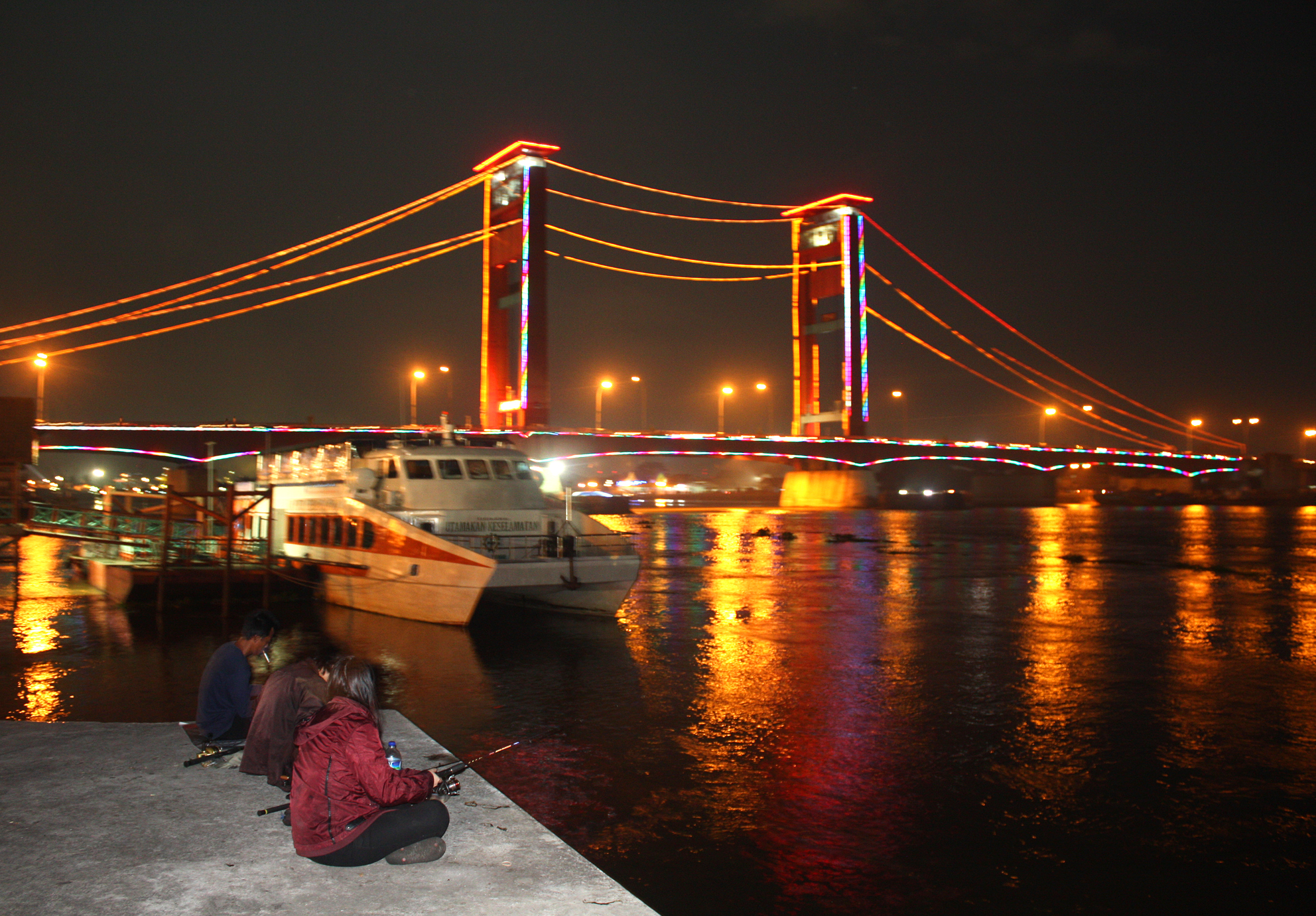
Ampera Bridge
Its full name translates to the Mandate of People's Suffering. The Ampera Bridge -- short for Amanat Penderitaan Rakyat -- spans the Musi River in Palembang, South Sumatra, connecting the city's two halves: Seberang Ulu on the south bank and Seberang Ilir on the north. Opened in 1965 as a symbol of Indonesian ambition, the bridge was designed to lift its center span and let oceangoing ships pass beneath. It managed this trick only a handful of times before the mechanism seized permanently. The story of the Ampera Bridge is a story of grand intentions undermined by soft ground, political vanity, and the stubborn physics of river mud.
A President's Ambition
Sukarno, Indonesia's first president, wanted a bridge that could stand beside London's Tower Bridge. The comparison was deliberate -- this would be a structure that announced Indonesia's arrival as a modern nation. The funds came from an unlikely source: Japanese war reparations, payments meant to compensate for the occupation of the Dutch East Indies during World War II. Fuji Heavy Industries, the company now known as Subaru Corporation, received the contract for design and construction. There was an irony the planners may not have appreciated: at the time, Japan had no vertical-lift bridges of its own, and Fuji Heavy Industries had never built a bridge of any kind. The project was an act of faith on multiple levels.
Two Names, One Bridge
When Governor Abujazid Bustomi of South Sumatra officially opened the bridge on November 10, 1965, it bore the name Bung Karno Bridge -- Bung being the familiar title for Sukarno. The timing was catastrophic. Within weeks, the political upheaval known as the Transition to the New Order was underway. Sukarno's grip on power disintegrated, and the De-Sukarnoization campaign that followed scrubbed his name from monuments, streets, and institutions across the country. The bridge became the Ampera Bridge, its new name drawn from the preamble of the Indonesian constitution. The structure itself didn't change. Only the politics of what it meant to cross it did.
The Span That Stopped Rising
For a few years the bridge performed as designed. The center span could be raised at approximately ten meters per minute, creating clearance for ships up to 44.5 meters tall. But the lifts happened only a handful of times, and by 1970 the mechanism was permanently frozen. The official explanation cited the thirty-minute delay the lifting caused to traffic and the silting of the Musi River, which had made the waterway impassable for large vessels anyway. The unofficial story is more damning. According to architect Wiratman, who served as a consultant before construction began, the bridge was doomed from the start. The soft mud beneath the Musi River could not support the tower foundations, and as those foundations shifted, the bridge deformed until the lifting mechanism could no longer function. Wiratman maintained that he raised these concerns early and was overruled for political reasons.
Frozen Monument
In 1990, engineers removed the massive ballast weights that had been designed to counterbalance the center span during lifting operations. The weights served no purpose on a bridge that would never open again, and leaving them in place posed a safety risk -- if the deteriorating mechanisms failed, tons of counterweight could plummet onto the roadway below. With the weights gone and the lifting mechanism disabled, the Ampera Bridge became a fixed crossing, its two towers standing as decorative remnants of a more ambitious design. The bridge still carries traffic across the Musi River every day, and it remains the most recognizable landmark in Palembang -- a city that had been a seat of the Srivijaya empire a thousand years before anyone tried to build a drawbridge on its river.
Symbol Over Function
The Ampera Bridge works perfectly well as a bridge. Cars, motorcycles, and pedestrians cross it constantly. It simply doesn't do the one thing that made it special. In that gap between aspiration and reality lies a particular kind of Indonesian story -- one about a young nation building monuments to its own modernity with borrowed money and borrowed engineering, naming them after presidents who would fall before the paint dried. The bridge connects Palembang's two halves as reliably as it ever did. That the center span no longer rises is a fact most residents have long since stopped noticing. The Musi River flows beneath, silted and slow, carrying its own cargo of history past towers that were built to move and learned, instead, to stand still.
From the Air
Located at 2.99S, 104.76E spanning the Musi River in central Palembang, South Sumatra. The bridge is a prominent visual landmark from the air -- look for the twin towers and the wide river crossing in the city center. Nearest airport is Sultan Mahmud Badaruddin II International Airport (WIPP), approximately 12 km north of the bridge. The Musi River itself is the primary navigational reference, cutting east-west through Palembang. Best viewed at 3,000-5,000 feet for clear structural detail.