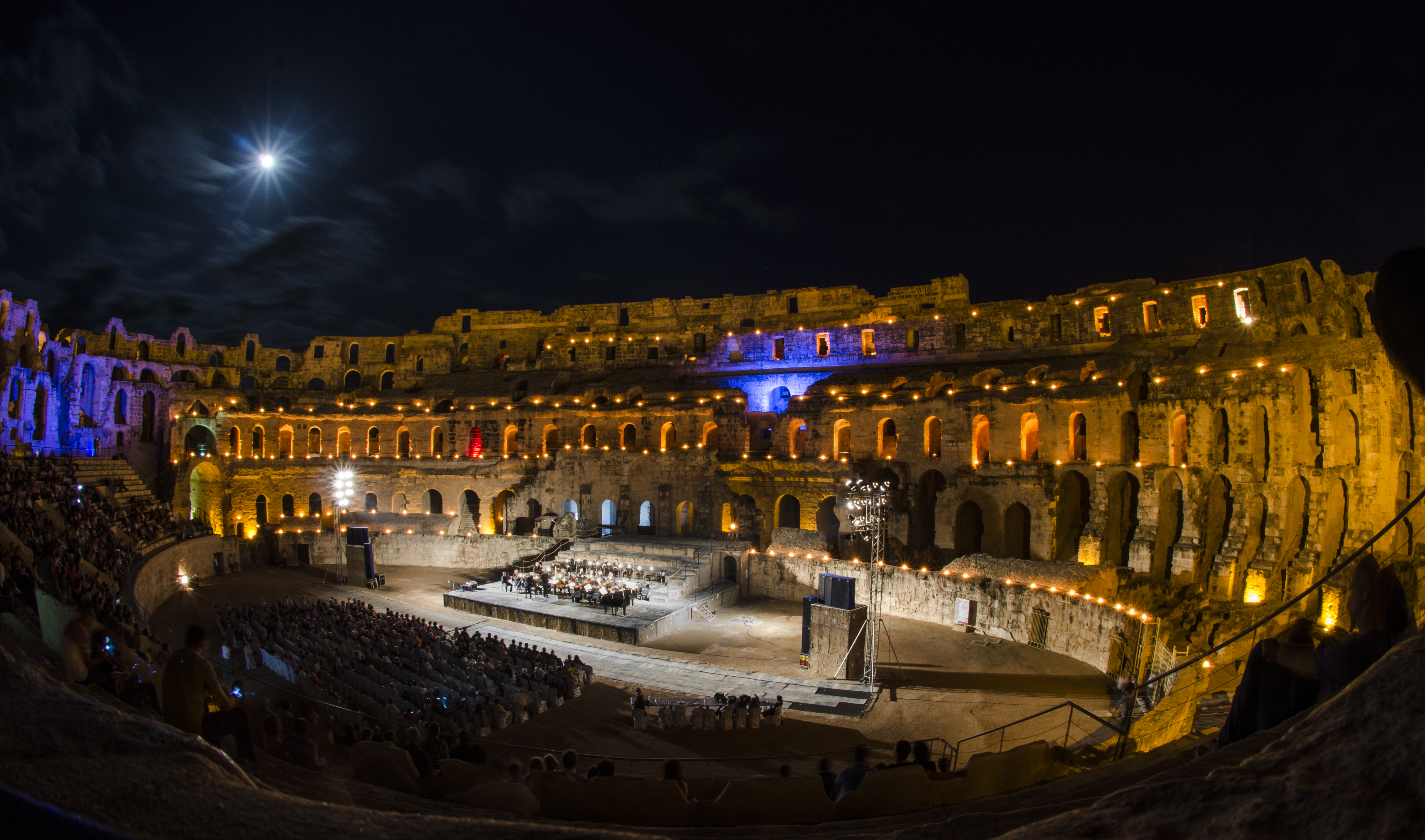
Amphitheatre of El Jem
It appears from the air like something misplaced. A Roman amphitheatre the size of the Colosseum stands in the middle of a small Tunisian town, its honey-colored arches rising above flat-roofed houses and dusty streets. The Amphitheatre of El Jem was built around 238 AD in Thysdrus, then one of the wealthiest cities in Roman Africa, enriched by the olive oil trade that made this region indispensable to Rome's food supply. Today Thysdrus is gone. The amphitheatre remains.
An Empire's Appetite for Spectacle
The numbers are staggering for a provincial city. The amphitheatre's major axis measures 148 meters, its minor axis 122 meters, and it could seat an estimated 35,000 spectators. Built entirely of stone blocks on flat ground rather than carved into a hillside, it is one of the largest freestanding amphitheatres in the Roman world and the biggest ever built in Africa. UNESCO recognized it as a World Heritage Site in 1979. The wealth that financed this monument came from the surrounding countryside, where vast olive groves produced the oil that flowed to Rome by the shipload. Thysdrus was not a capital or a military headquarters; it was a commercial town, and its amphitheatre was a declaration of just how much money the olive trade could generate.
Survival Through Reinvention
The amphitheatre outlasted the empire that built it by finding new uses in every century. When the spectacles ended, the structure became a fortress. When the fortress was no longer needed, it became a saltpetre factory in the late eighteenth and nineteenth centuries. Around 1850, Ahmad I ibn Mustafa, the Bey of Tunis, enlarged a breach in the wall to approximately 30 meters, a wound that remains visible today. In the second half of the nineteenth century, parts of the structure housed shops, dwellings, and grain storage. The amphitheatre survived not because anyone preserved it out of reverence, but because it was too massive and too useful to tear down.
Beneath the Arena Floor
Below the sandy arena lies the hypogeum, the underground network of corridors and chambers where gladiators waited, animals were caged, and the machinery of spectacle was hidden from the audience. At El Jem, the hypogeum is remarkably well preserved and open to visitors, offering a rare opportunity to walk the same passages that performers and condemned prisoners walked nearly two thousand years ago. The vaulted tunnels run beneath the full length of the arena, and standing in them, looking up toward the daylight filtering through the arena floor, the scale of the engineering becomes visceral rather than abstract.
A Second Life on Screen
The amphitheatre's cinematic presence has given it a kind of modern fame. Monty Python's Life of Brian used it as a location, and in 1996, Nike filmed its iconic "Good vs Evil" commercial here, staging a gladiatorial soccer match featuring Eric Cantona, Ronaldo, Paolo Maldini, and Luis Figo. The amphitheatre has also served as the backdrop for The Amazing Race. But the most fitting second act may be the annual Festival international de musique symphonique d'El Jem, which fills the ancient arena with orchestral music, the acoustics shaped by the same stone walls that once amplified the roar of crowds watching contests of a very different kind.
From the Air
Located at 35.296N, 10.707E in east-central Tunisia, approximately 60 km south of Sousse. The amphitheatre is unmistakable from the air, a massive oval structure dominating the small town of El Djem. Nearest airports: Monastir Habib Bourguiba International (DTMB), 70 km north; Sfax-Thyna International (DTTX), 65 km south. Recommended viewing altitude: 3,000-5,000 feet AGL for best perspective on the structure's scale relative to the surrounding town.