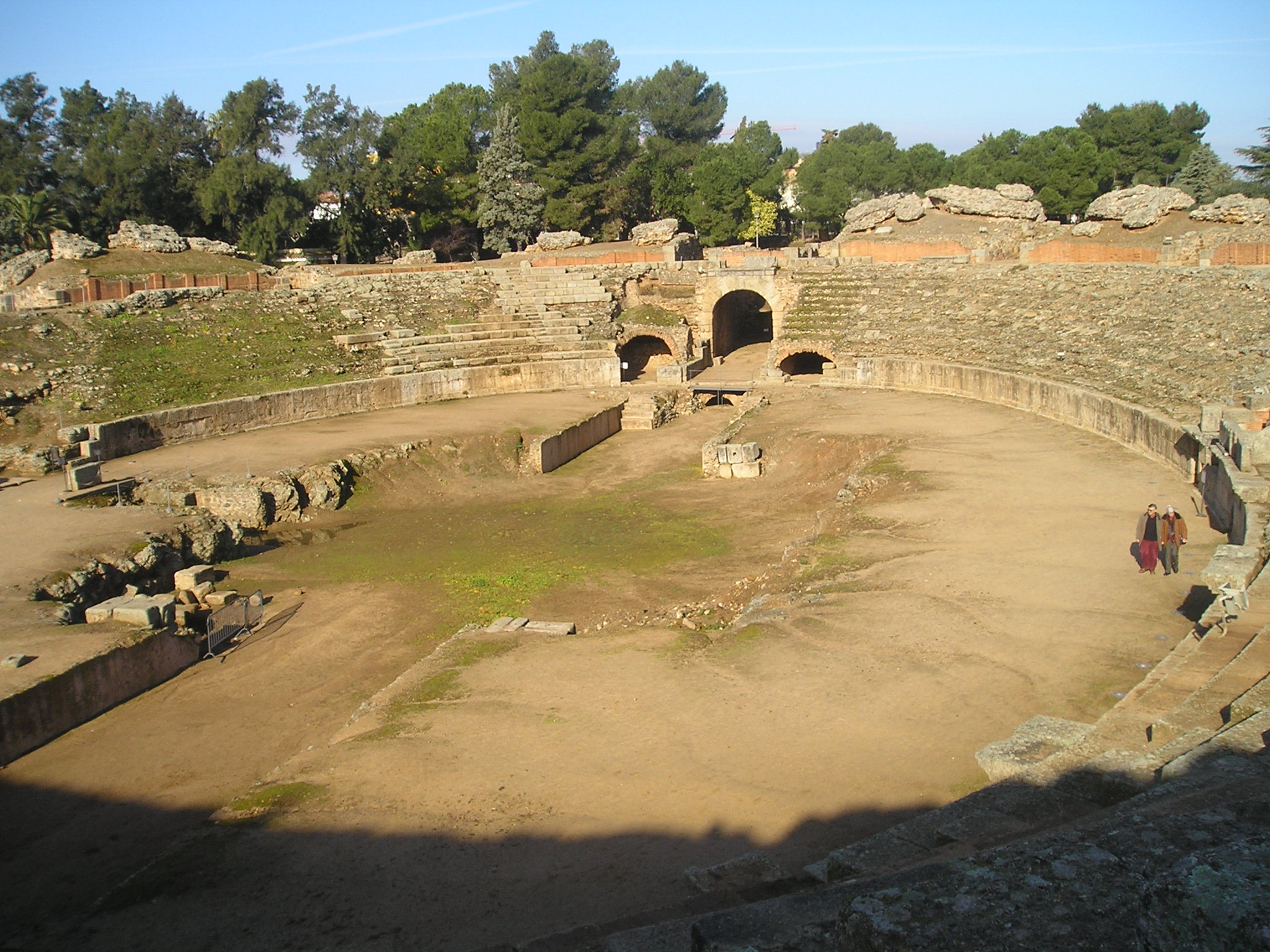
Amphitheatre of Mérida
The city's name tells you everything. Emerita Augusta -- a settlement for the emeriti, the honorably discharged. In 25 BC, Emperor Augustus founded this colony on the banks of the Guadiana River as a retirement community for veterans of the Cantabrian Wars, soldiers from the Legio V Alaudae and Legio X Gemina who had spent years subduing the last unconquered peoples of the Iberian Peninsula. Rome rewarded its veterans with land, infrastructure, and entertainment. Seventeen years later, in 8 BC, it gave them an amphitheatre.
Built for Blood and Spectacle
The amphitheatre was not a place for refined entertainment. This was where gladiators fought and died, where wild animals were released from underground pens to battle each other or human combatants in staged hunts called venationes. At the center of the elliptical arena -- 64 meters by 44 meters of sand-covered ground -- a fossa bestiaria was dug, covered with wooden planking and more sand. Animals were kept in this pit, invisible to the crowd above, until trapdoors opened and they burst into the light. The amphitheatre was constructed as part of an entertainment complex alongside the adjacent Roman Theatre, the two venues sharing an audience that could number 15,000 for the bloodier shows.
Tiers of Roman Society
The stands were arranged in three concentric bands that mapped the social hierarchy with architectural precision. The ima cavea -- the lowest tier, closest to the action -- reserved its front row for the local elite, with ten more rows behind for ordinary citizens of means. Above it, the media cavea offered more modest seating, and the summa cavea, now severely deteriorated, held the least privileged spectators at the greatest distance from the arena floor. A network of stairways and internal corridors called scalae threaded through the structure, ensuring that all 15,000 spectators could enter and exit without different social classes having to mingle. Two grandstands flanked the minor axis of the ellipse, one built above the main entrance hall, the other facing it across the arena.
Dimensions of Empire
The amphitheatre's proportions speak to the confidence of its builders. The major axis stretches 126 meters, the minor axis 102 meters -- dimensions that placed it among the larger amphitheatres in the western provinces, befitting the capital of Lusitania. Monumental inscriptions found beneath the grandstands allowed archaeologists to date the structure precisely to 8 BC. The elliptical shape, a Roman engineering innovation that gave every spectator an unobstructed sightline, was a design principle replicated from the Republic's earliest wooden arenas to the Colosseum itself.
From Ruin to World Heritage
After the fall of Rome, the amphitheatre followed the trajectory of most imperial entertainment venues -- abandoned, quarried for building stone, and gradually buried. Today it stands in open ruin, its skeletal walls and tiered seating exposed to the Extremaduran sun. But it is far from forgotten. As part of the Archaeological Ensemble of Merida, the amphitheatre was inscribed on the UNESCO World Heritage List in 1993, joining the adjacent theatre, the aqueducts, the Alcazaba, and the Roman bridge in one of Spain's most extensive archaeological sites. Marble reliefs of gladiators, excavated from the ruins, now reside in the nearby National Museum of Roman Art. The arena floor is silent, the fossa bestiaria empty. But the geometry of the place still works -- stand in the center and speak, and your voice carries to the farthest surviving seats.
From the Air
Located at 38.92N, 6.34W in Merida, Extremadura, immediately adjacent to the Roman Theatre. The elliptical outline of the amphitheatre is clearly visible from the air. Nearest airport is Badajoz (LEBZ), approximately 60 km west. The archaeological complex is on the eastern side of the modern city.