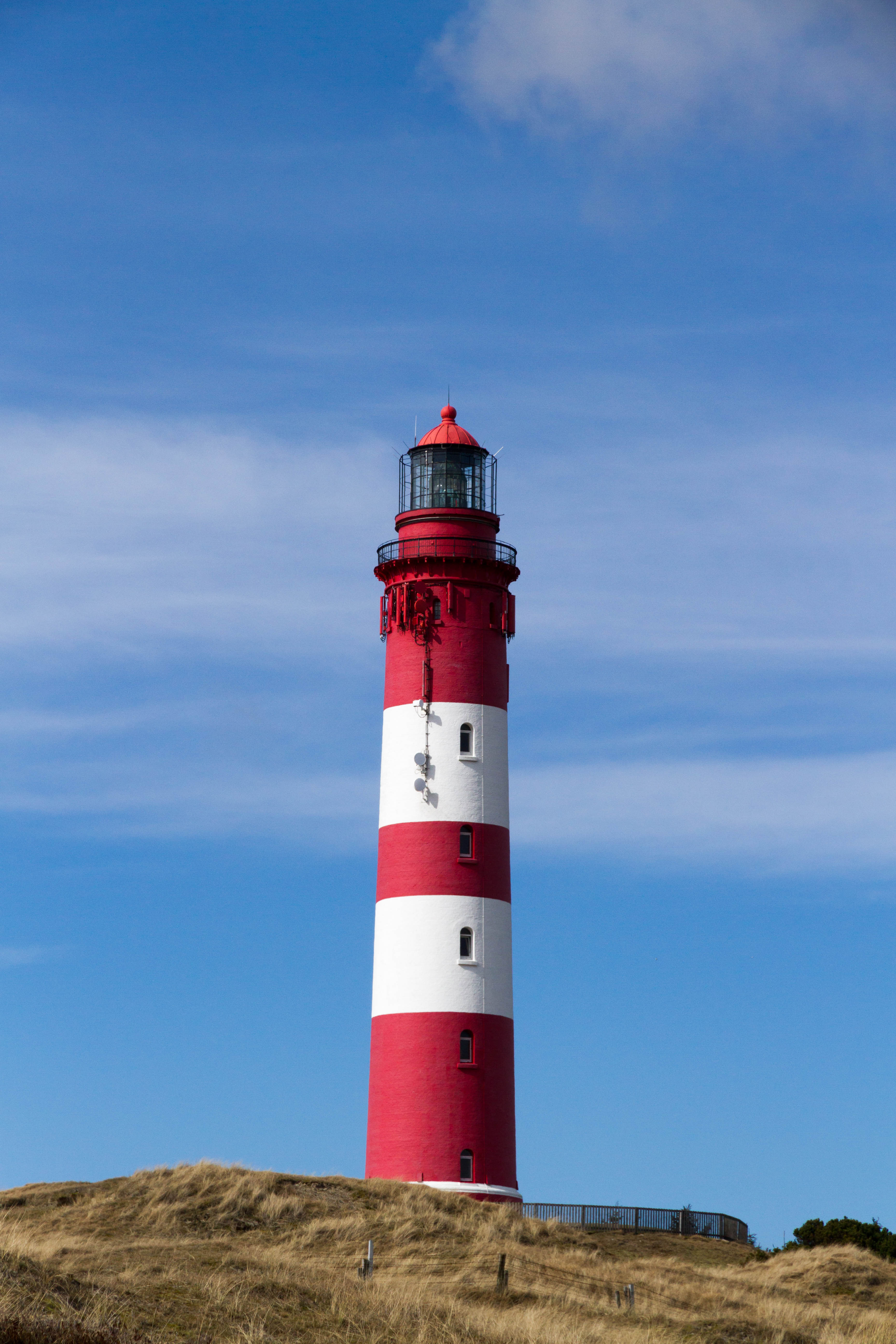
Amrum Lighthouse
The granite arrived late, and the workers quit. It was the spring of 1873, five weeks into the build, and the shipment of granite blocks meant for the spiral staircase had simply not appeared. When the stones finally turned up, a number of the brought-in labourers refused to disembark. Amrum, they decided after one look, was too dull a place to spend the rest of the summer. The remaining hands and a few hastily-hired auxiliaries kept hammering. A year and a half later, on the afternoon of 1 January 1875, the first lighthouse ever built in North Frisia flashed for the first time, just before sunset. The dull island had got its eye on the North Sea.
Three Wrecks and a Newspaper Article
The lighthouse exists because of a piece of journalism. In 1868 the Hamburger Zeitung ran a story on the loss of three vessels in the waters between Amrum and Sylt, and the debate that followed dragged on for years. Engineers, naval officers, and merchants argued over where exactly to put a light that might have saved those ships. The decision came in 1872: build it atop the high dune in Amrum's south, far enough back from the surf that storm tides could not reach it. The dune itself stands twenty-five metres above the sea. The tower would add forty-one more. From the lantern room, the focal plane of the light sits sixty-three metres above mean sea level - one of the highest along the entire German North Sea coast.
A Lens from the Paris Exposition
What the bricklayers were finishing in November 1874 was not just a tower. Inside it they installed a first-order Fresnel lens with an Argand lamp burning five wicks - the same optic that had been displayed at the 1867 Paris Exposition Universelle. The lens is 2.7 metres tall, weighs 2.9 tonnes, and is now valued at five million euros. Sixteen panels of converging glass turn a single flame into a beam visible 23.3 nautical miles out to sea. The character is Fl, 7.5s: one long pulse every seven and a half seconds. The ball-bearing on which the entire optic revolves was so well made that it ran continuously from 1875 to 1993 before anyone needed to change it. One hundred and eighteen years on a single bearing.
The Red and White Stripes
For its first sixty-one years the lighthouse was a plain brick cylinder. The Argand lamp was electrified only in 1936, two generations after activation. The famous red-and-white daymark - the wide painted bands that make it photogenic on every postcard of the island - did not arrive until 1952. The last keeper turned the key in 1984 when automation made the dwelling house redundant. Three keepers had lived in that house, in shifts, since 1875. They had raised children below the dune. They had walked up the spiral stair every evening at dusk to light the lamp. Deutsche Post put the lighthouse on a stamp in 2005 and again in 2008. It is open to the public in summer, and the climb to the gallery still rewards anyone willing to take 297 steps for the view across the Kniepsand.
What the Beam Sees
From sixty-three metres up, the geography of this corner of the North Sea reveals itself in a way no map quite captures. Westward lies the Kniepsand, the enormous sandbank that has been migrating against the island's shore for centuries. North-northeast, Foehr; further north, Sylt. The light's white sector sweeps over shipping lanes that still carry the ferry traffic to Wittduen and the freighters working between Hamburg and Scandinavia. On clear winter nights, fishermen as far as the Halligen can see the flash. The article that started the debate in 1868 was about three ships that were lost. The lighthouse those losses produced has been quietly preventing a fourth, every seven and a half seconds, for a hundred and fifty years.
From the Air
The Amrum Lighthouse stands at 54.6312 N, 8.3546 E, two kilometres west of Wittduen on the southern end of Amrum. The nearest airport is Sylt (EDXW), 25 km north. From cruise altitude the red-and-white tower is hard to pick out, but the bright crescent of the Kniepsand against the dark heath is unmistakable. In clear weather the focal plane is visible from 23 nautical miles offshore.