Amrum
There are more Amrumers in the United States than there are on Amrum. The island holds maybe 2,300 year-round residents on a strip of dunes, heath and shifting sand a little over ten kilometres long. But the church registers and the genealogy mailing lists tell a different story: the descendants of the men and women who left in the nineteenth century - mostly for the American Midwest - now outnumber the people still living on the home island. Once a year someone hosts a reunion in Iowa or in Suddorf, and the dialect spoken at the long table is the same on both sides of the Atlantic. Oeoemrang. North Frisian. A language that survived because the people who spoke it stayed in touch.
The Kniepsand
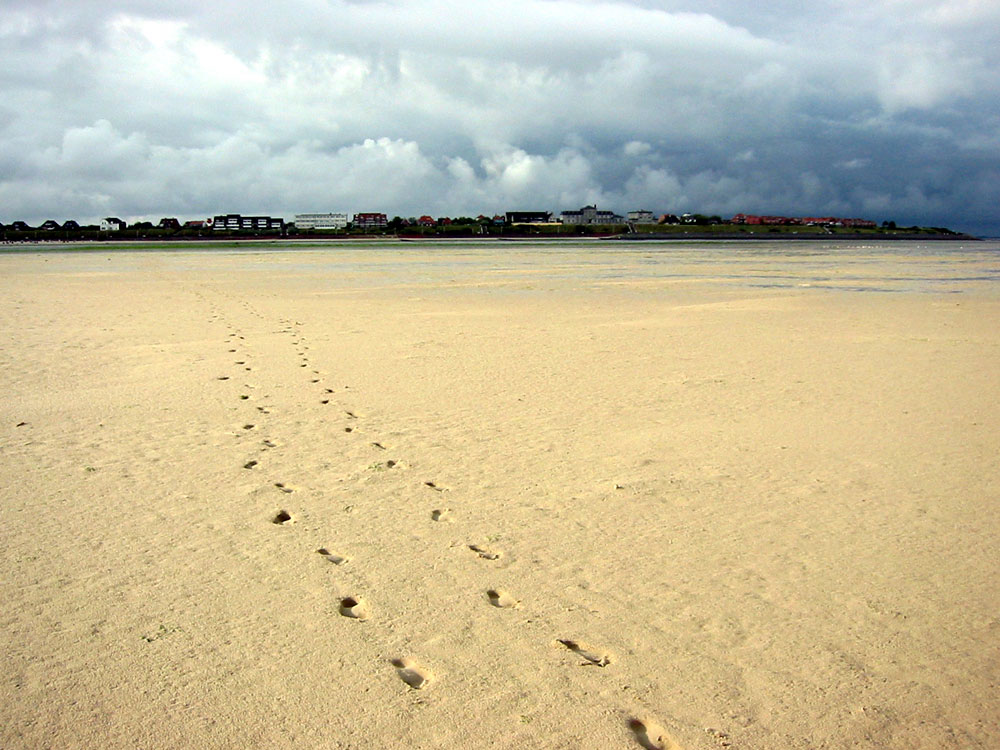
Amrum's defining feature is not the island itself but the sandbank attached to its western flank. The Kniepsand is one of the largest sandbanks in northern Europe - a kilometres-wide expanse of pale beach that grew across the original shoreline over centuries and is still migrating. At low tide it is wide enough that a person walking from the dune line toward the surf can feel like they are crossing a desert. Marram grass binds the older dunes; behind them lie heath, peat bogs that occasionally host the carnivorous common sundew, and a band of stunted pines bent eastward by the prevailing wind. Eurasian curlews nest here. Brent geese, red knot, and sanderling pause on migration. Since 1999 a protected marine area off the western coast has helped the harbour porpoise population recover.
Whaling, Salt, and the Sklavenkasse
For centuries Amrumers made their living from the sea - salt-making and fishing first, then whaling, then merchant shipping. By the 1700s a sizable share of the male population was crewing whalers and trading vessels working out of Hamburg and the Dutch ports. The risks were real. In 1724 a young sailor from Suddorf named Hark Olufs was taken by Barbary corsairs on a voyage from Nantes to Hamburg, sold in Algiers, and rose over the next eleven years to become commander in chief of the cavalry of the Bey of Constantine before returning home in 1735. His story is famous, but the slave fund that should have ransomed him - the Sklavenkasse of the Danish kingdom - refused because his ship had sailed under Hamburg colours. Politics in the Outer Lands could be that fine-grained.
Outer Land, Inner Border
Amrum and western Foehr spent the Middle Ages as Uthlande - the Outer Lands - a quasi-autonomous strip outside the Duchy of Schleswig but inside the Danish realm. After the Second Schleswig War in 1864, Denmark lost the duchy to Prussia. For three years Amrum was governed jointly by Prussia and Austria, then taken into Prussia outright in 1867 and folded into the new province of Schleswig-Holstein. In the 1920 plebiscites that redrew the German-Danish border, Amrumers voted overwhelmingly to stay with Germany. Tondern, the district capital on the mainland, voted the other way and went to Denmark. The island has been Nordfriesland ever since.
Biakendai and the Bonfire
On the night of 21 February, Amrumers light an enormous bonfire on the dunes to drive out winter. The festival is called Biakendai, descended from the old liturgical feast of Cathedra Petri on 22 February, and it is celebrated across North Frisia - though Amrumers will tell you their version is the proper one. People blacken each other's faces with soot from the fire. On New Year's Eve, the Hulken takes over: young people dress up in costumes and walk house to house letting the neighbours try to guess who they are, in exchange for sweets if they are children or schnapps if they are not. The black-and-white national costume, heavily decorated with silver, comes out at confirmations. The bicycle network is excellent. There is no airstrip, because every plan to build one has been firmly voted down.
The Pallas and What It Meant
On 29 October 1998 the cargo ship Pallas ran aground off Amrum after a fire that had been burning in her hold for days. Around 200 to 300 tonnes of fuel oil washed ashore, killing roughly 16,000 seabirds - mostly common eiders. Parts of the wreck are still visible off the western coast at low tide. The disaster prompted Germany to create the Central Command for Maritime Emergencies (Havariekommando) and forced a national reckoning about emergency tow capability on the North Sea coast. For Amrum, the wreck became a landmark and a warning, scribbled in rust against the same sandbank that has been redrawing this island's coastline for as long as anyone has been keeping records.
From the Air
Amrum lies at roughly 54.65 N, 8.34 E in the North Frisian Islands. The nearest airport is Sylt (EDXW), 25 km north; Husum-Schwesing (EDXJ) is on the mainland to the east. From cruise altitude the island is unmistakable: a thin north-south spine of green dunes fringed on the west by the pale, much wider Kniepsand sandbank. Wittduen sits at the southern tip, Norddorf at the north. Coastal navigation in clear weather offers an unobstructed run between Amrum and the Wadden Sea National Park.