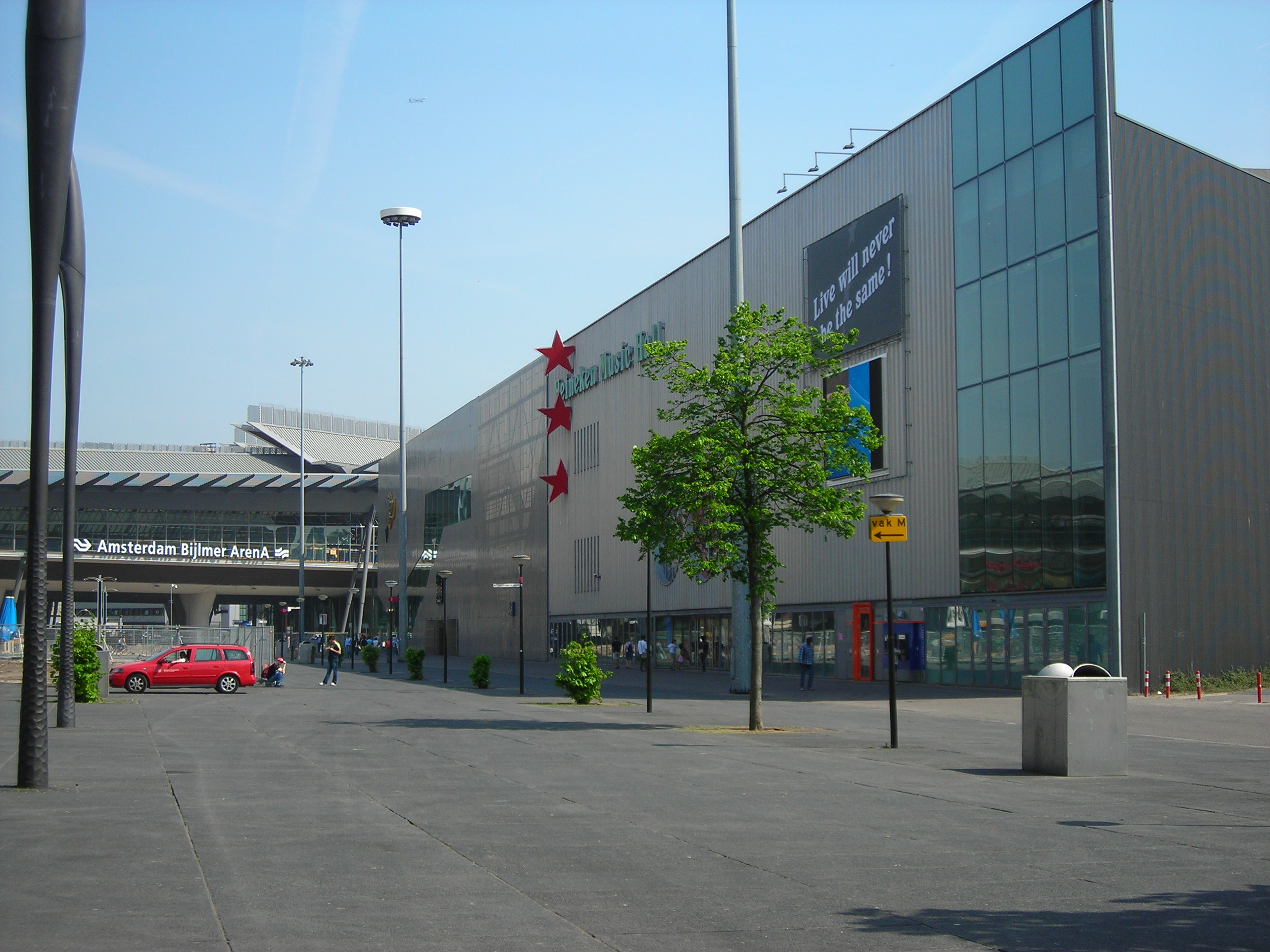
Amsterdam Bijlmer ArenA station
Walk down ArenA Boulevard at dusk on a match day and the station rises ahead of you like a roof made of glass. A hundred metres long, seventy wide, thirty tall, almost entirely transparent, it arches over the boulevard itself rather than sitting beside it. Trains run above your head. Crowds funnel beneath. The Johan Cruyff Arena, where AFC Ajax play, stands a short walk away on one side; the AFAS Live concert hall and the Ziggo Dome on the other. Amsterdam Bijlmer ArenA, rebuilt and reopened in 2007 to a design by Grimshaw Architects of London with Arcadis, was conceived to handle these crowds and to look, in the process, like a piece of urban theatre.
Built for the Surge
The station's job is not the daily commute, though it does plenty of that. Its real test is the surge: 50,000 fans piling out of the Cruyff Arena after a Champions League night, 17,000 leaving the Ziggo Dome after a concert, 5,500 from AFAS Live, the cinema crowd from Pathe ArenA, the shoppers from Amsterdamse Poort, all converging on a single transit point within twenty minutes. The architects designed for that pulse. Five platforms and eight tracks accommodate the rush. Two of the tracks and one platform serve Amsterdam Metro lines 50 and 54. Six tracks and four platforms serve the heavy-rail intercity and Sprinter services from Schiphol, Utrecht, Rotterdam, Arnhem, and Nijmegen. A large bus station tucks into the complex underneath the train viaduct.
An Architecture of Light
The original station, opened in 1971 as Amsterdam Bijlmer, was a functional concrete platform serving the Bijlmermeer, the great experiment in modernist high-rise housing that ringed it. By the 2000s the area was being reinvented as a destination, the boulevard becoming a strip of arenas and venues. The station needed to keep up. Grimshaw's solution was a long, light, vaulted canopy of glass and steel that swept above the tracks and over the street. The structure deliberately resists the heaviness of older Dutch railway architecture. Where Amsterdam Centraal is brick monumentality, Bijlmer ArenA is daylight and exposure. Standing on the metro platform, you can see the trains above, the bus station below, the boulevard outside, all at once. The complex announced that the southeast of Amsterdam had become somewhere people came on purpose.
The Name Change
Until December 2006 the station was simply Amsterdam Bijlmer, after the neighbourhood. That month the operator renamed it Amsterdam Bijlmer ArenA, matching the name of the stadium just outside, then known as the Amsterdam ArenA. In 2018 the stadium itself was renamed the Johan Cruyff Arena, in honour of the Ajax footballer and philosopher of the game who had died in 2016. The station kept its name, so a small linguistic fossil now persists on every signboard: the ArenA the station was renamed after no longer exists by that name. The station shares a campus, in effect, with Ajax. Cruyff came up through Ajax's youth academy a few kilometres west. Many of the players now arriving for matches did the same. The infrastructure of Dutch football and the infrastructure of Dutch transport meet here, under one glass roof.
A Junction, Not a Terminus
Bijlmer ArenA is not the end of any line. Trains here are passing through. Intercity services run twice an hour to Utrecht and on to Arnhem, Nijmegen, Eindhoven, and Venlo, knitting the southeast Netherlands into Amsterdam. Sprinter local services run to Rotterdam, to Rhenen, and across the city. Metro lines 50 and 54 thread through to Isolatorweg and Centraal Station every ten minutes for most of the day. Late at night, Nachtnet services pass through from Rotterdam and The Hague on their way to Utrecht. A constellation of bus routes operated by GVB, Connexxion, and Keolis fans out from the bus station toward Diemen, Aalsmeer, Schiphol, Almere, and Haarlem. The station's geometry, the way platforms and concourses cross at unusual angles under the long roof, is built to keep all of that moving without anyone having to stop and think where they are.
Match Night
Two hours before a Champions League match the boulevard begins to fill. Fans in red and white step off trains from Utrecht, off metros from north Amsterdam, off coaches from regional towns. The transparent canopy means the light from the concourse spills onto the street and the light from the stadium spills back. After the final whistle the flow reverses. Stewards channel crowds toward platforms. Trains arrive every few minutes. Within an hour the place is quieter again. The station, like the stadium it serves, was designed for pulses rather than for steady use, and it absorbs them with a grace that has become quietly characteristic of the southeast of the city.
From the Air
The station sits at 52.31N, 4.95E in Amsterdam-Zuidoost, immediately west of the Johan Cruyff Arena. Schiphol (EHAM) is 15 km west; Lelystad (EHLE) is 50 km northeast. From altitude on approach to Schiphol from the east, look for the Cruyff Arena's distinctive rounded roof, the parallel rail viaducts of the Flevolijn and Gooilijn that meet here, and the long pale roof of Bijlmer ArenA bridging them.