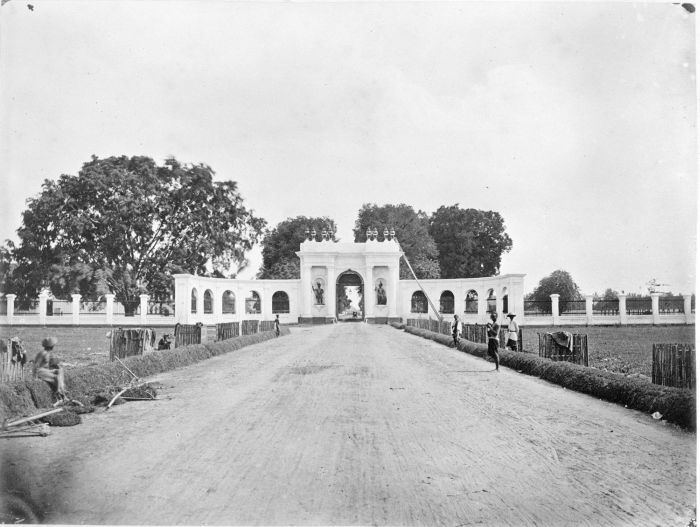
The Gate That Outlasted Its Castle
Mars stood on one side, Minerva on the other. For nearly two centuries, stone statues of the Roman god of war and the goddess of wisdom flanked the south facade of a gate in northern Batavia, guarding an entrance to a castle that no longer existed. The castle had been torn down in 1808. The city around it had changed its name from Batavia to Jakarta. The colonial power that built both gate and fortress had been expelled, occupied, returned, and expelled again. Through all of it, the Amsterdam Gate remained standing -- a single baroque arch decorated with columns and eight black urns, stubbornly persisting at the intersection of Jalan Nelayan Timur and Jalan Cengkeh until sometime in the 1950s, when it finally disappeared along with its guardian deities.
A Castle Expands, a Gate Is Born
The gate's origins reach back to the seventeenth century, when the Dutch East India Company first fortified Batavia's harbor. The original Amsterdam Poort was part of the castle's defenses, but the version that survived into the modern era dates to the 1740s, when Governor General Gustaaf Willem van Imhoff undertook a major expansion of Batavia Castle. Van Imhoff's builders demolished the fort's original southeast wall and constructed a new one further south, along the Amsterdamse Gracht -- a canal that would eventually become Jalan Nelayan Timur. The expansion folded the Castle Square into the fortified grounds, and the new gate, rebuilt in the fashionable Rococo style of the period, became the formal entrance from the south. It acquired multiple names over the years: Amsterdamse Poort, after its canal; Pinangpoort, after the areca nut trade conducted nearby; and Kasteelpoort, the straightforward Dutch for Castle Gate.
Daendels and the Art of Recycling
Governor General Herman Willem Daendels arrived in Batavia in 1808 with grand plans and limited budgets. A revolutionary who had fought alongside the French before entering colonial service, Daendels decided to relocate the seat of government south to the healthier neighborhood of Weltevreden, away from the malarial harbor district where Batavia Castle stood. The castle, already deteriorating, was not mourned. Daendels ordered it demolished -- but not wasted. The stone, brick, and timber of the old fortress were carted south to supply the construction of new government buildings in Weltevreden. Most of the castle disappeared into the foundations and walls of structures that still stand in what is now the Sawah Besar district of Central Jakarta. But the Amsterdam Gate survived the demolition, or at least a portion of it did. The original two-storey gatehouse, with its dome and cupola, was reduced to a single storey. The semi-circular arcades that had connected it to flanking military buildings remained partially intact. It was the last piece of Batavia Castle left above ground.
Gods of War and Wisdom
The gate's architecture reflected the ambitions of its builders. The original gatehouse was large enough to contain a small prison -- a practical reminder that colonial gateways served military as much as ceremonial purposes. Two storeys tall, topped by a dome with a cupola, it anchored semi-circular arcades stretching to military buildings on either side. After Daendels reduced it to a single storey, the gate retained its rounded arch, its decorative columns, and the eight black urns arranged along its top. Most striking were the two niches on the south facade, each holding a statue: Mars, god of war, and Minerva, goddess of wisdom and strategic warfare. They were appropriate guardians for a castle gate -- one promising force, the other counsel. The statues endured tropical heat, monsoon rains, and the decay of the empire that placed them there. They vanished during the Japanese occupation of the Dutch East Indies in World War II, likely melted down for metal or simply lost in the chaos of wartime.
Vanishing Point
By the time Indonesia achieved independence in 1945, the Amsterdam Gate had already outlived its purpose by more than a century. It stood in what was now Kota, the old town district of northern Jakarta, surrounded by the low-rise commercial fabric of a postcolonial city that was rapidly growing beyond its colonial footprint. Photographs from the late nineteenth century show the gate as a solitary arch amid open ground -- the castle and its walls long gone, the arcades crumbling, the surrounding landscape bearing no resemblance to the fortified harbor town the Dutch had built. The gate survived into the 1950s before it too was demolished or simply collapsed. Today nothing marks the intersection of Jalan Nelayan Timur and Jalan Cengkeh where it stood. The Amsterdam Gate existed for roughly two hundred years, the last fragment of a fortress that once controlled the most profitable trade route in the Dutch colonial empire. It outlasted the empire itself, but not by much.
From the Air
The site of the Amsterdam Gate is located at approximately 6.13S, 106.81E in the Kota district of northern Jakarta, near the old harbor area. The intersection of Jalan Nelayan Timur and Jalan Cengkeh is in a dense, low-rise commercial neighborhood. No physical remains of the gate are visible. The area is identifiable from the air by its proximity to Sunda Kelapa, Jakarta's old port, and the Jakarta History Museum (Fatahillah Square) a few blocks to the south. Nearest major airport is Soekarno-Hatta International Airport (WIII), approximately 22 km to the west-northwest. Halim Perdanakusuma International Airport (WIIH) is about 20 km to the southeast.