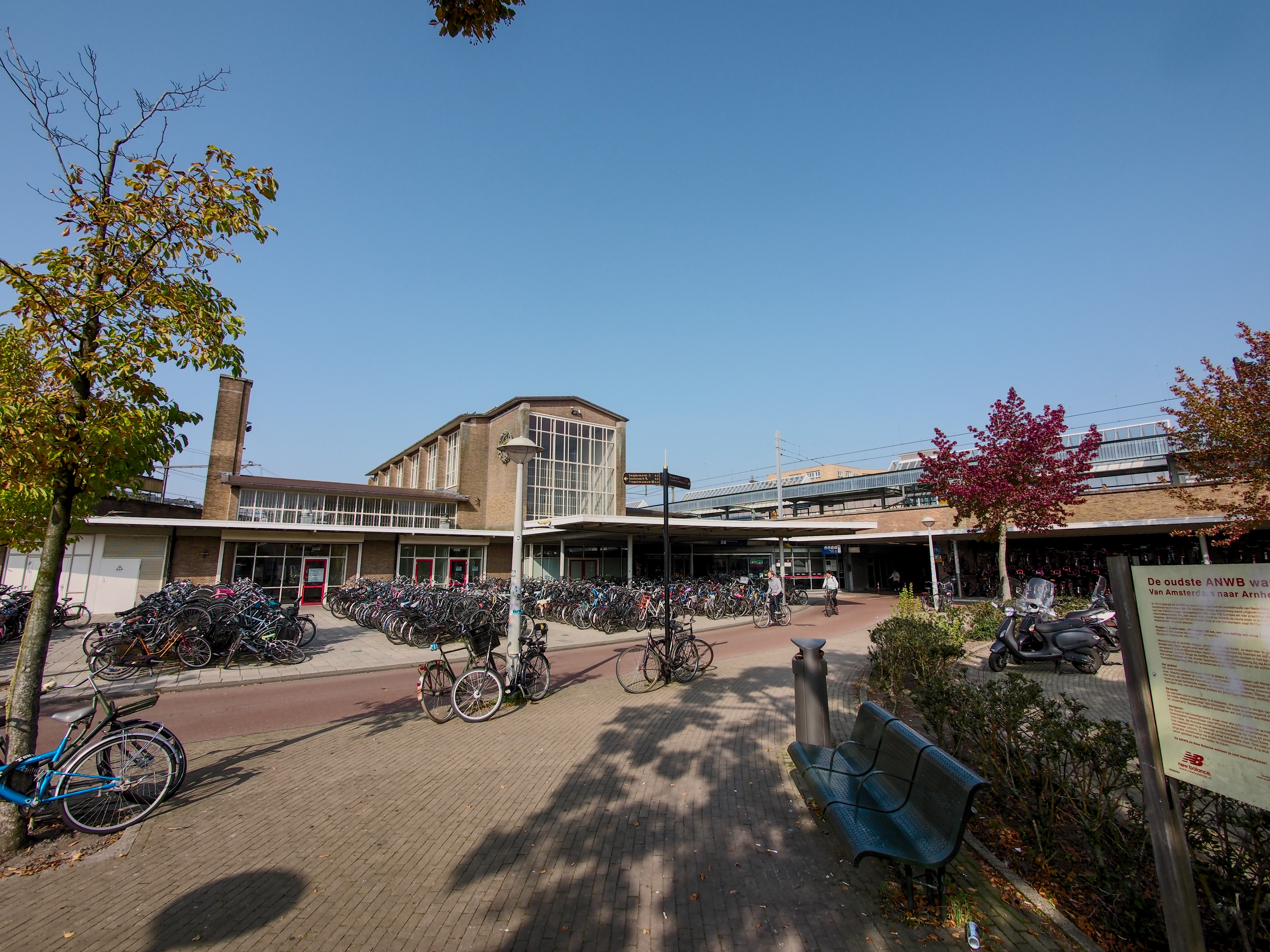
Amsterdam Muiderpoort railway station
On the platform of Amsterdam Muiderpoort, a stained-glass window by the German-born artist Heinrich Campendonk depicts the migration of birds. It was installed in 1939, the year the new raised station opened, when the picture of birds in flight was a familiar shorthand for travel. Three years later that imagery turned terrible. From the summer of 1942 onward, the station was used as a boarding point for Dutch Jews being deported east, taken first from the Hollandsche Schouwburg assembly point in central Amsterdam and then put on trains here for the journey to the Westerbork transit camp in Drenthe. A plaque on the Oosterspoorplein in front of the station marks what happened on these platforms. The bird-migration window still hangs above the entrance hall.
Boarding Point
The deportation of Jews from the Netherlands ran with bureaucratic precision. Families were assembled at the Hollandsche Schouwburg, a former theatre on the Plantage Middenlaan, sometimes for days, sometimes for weeks. From there, in groups, they were marched or trucked the kilometre or so east to Muiderpoort and put on trains. The platforms were not designed for this. They had been opened only three years earlier as part of an ambitious Dutch railway modernisation. A surviving photograph shows Jewish families with luggage waiting on the platform, the train standing beside them, the ordinary architecture of a working station turned into the apparatus of a deportation. Most of those who boarded were taken to Westerbork; from Westerbork the great majority were sent on to Auschwitz and Sobibor. The Netherlands lost about three-quarters of its Jewish population in the war, the highest proportion in western Europe.
The Station Before
There had been trains here long before 1939. A small wooden Stopplaats St. Anthoniedijk operated from 1882 until 1896, when a new wooden station opened east of it at Pontanusstraat with a single island platform reached by an overhead walkway. Even then the station was named for the Muiderpoort, the old Amsterdam city gate, although it stood almost a kilometre east of the gate itself. In 1907 the platform got more waiting rooms and a longer canopy. By the 1930s the city had decided that the level crossings on Amsterdam's east side were intolerable, and a massive project called Spoorwegwerken Oost lifted the railway lines between Centraal Station, Amstel Station, Weesp, and Hilversum onto embankments and viaducts. The old wooden station was demolished in 1937. Two years later the new one rose in its place.
Leupen's Building
The architects were H.G.J. Schelling and Johannes Leupen, both working for the Municipality of Amsterdam. The new Muiderpoort was Functionalist in temperament: brick, glass, clean horizontal lines, a tall signal house at one end that became the building's vertical accent. Inside, the central hall held ticket offices, and two pedestrian tunnels led to the platforms. Around the hall, Campendonk's stained-glass window of bird migration filled the north wall with colour. The station was also unusual structurally. It is what railway architects call a Keilbahnhof, German for wedge-shaped station: the two railway lines through Muiderpoort, the line to Utrecht and the line to Amersfoort, split at the station, with one platform on the eastern side and the other on the western. Muiderpoort is the only Keilbahnhof in the Netherlands. The most famous example of the type is in Zwickau, in eastern Germany.
A Working Station
Today Muiderpoort is a busy commuter stop, four kilometres southeast of Amsterdam Centraal. Sprinter services pass through every fifteen minutes in each direction, heading west to Schiphol and The Hague or east to Weesp, Almere, and Lelystad, north to Hilversum and Amersfoort, south toward Utrecht. Trams 1 and 3 stop in front of the station, threading toward Museumplein and the Flevopark. Four GVB bus lines run out to Indische Buurt, the Watergraafsmeer, and the Bijlmer. In the late 1990s the building was renovated, the central hall and tunnels leased to small businesses, and the platforms made accessible directly from the street. Around 2002 the last ticket office closed. The Signal House was protected as a national monument in 2003. The rest of the station complex became municipal monuments in 2014.
What Stays
The plaque on the Oosterspoorplein names the place quietly. Most passengers walking past it on their way to a tram are heading somewhere ordinary. The station is, by design, a piece of efficient civic architecture meant to move large numbers of people unobtrusively. That ordinariness is part of what the plaque insists on. The deportations did not happen at a special site. They happened at the same platforms that today serve commuters from Hilversum and shoppers from Weesp. Campendonk's window of birds in flight still glows above the entrance hall. Visitors who know the history sometimes pause beneath it. Others walk past on their way to catch a Sprinter to Schiphol, and the trains continue to run.
From the Air
Amsterdam Muiderpoort station sits at 52.36N, 4.93E, in the Watergraafsmeer area of east Amsterdam, four kilometres southeast of Amsterdam Centraal. Schiphol (EHAM) is 12 km southwest. From altitude, look for the raised brick embankment splitting just east of the city centre into the Amsterdam-Utrecht line and the Amsterdam-Amersfoort line, with the station's pale-roofed Signal House at the junction.