Amsterdam Pipe Museum
Twenty-five centuries of human breath have passed through the objects in this house. The Prinsengracht canal house was built around 1680, when Dutch clay pipes were already sailing the world in the holds of East and West India Company ships - turning up later in archaeological digs from Spitsbergen to Cape Town, Japan to New York. The museum inside the house holds more than 35,000 of those pipes and their cousins from every continent humans have inhabited. It started in 1969 as one man's private collection. Today it is the worldwide archive of pipes, the only such institution in the world, and its curator, Don Duco, is more or less the planet's last word on the subject.
One Man's Obsession Becomes a National Reference
The collection began in 1969 as the Pijpenkabinet - the "pipe cabinet" - the kind of slightly self-deprecating name that Dutch private collectors give their growing piles of objects. From 1975 to 1982 it sat in an art gallery on Frederiksplein in Amsterdam. The focus then was clay tobacco pipes, the kind Holland had been famous for since the seventeenth century. In 1982 the collection moved to Leiden, where it operated as a public museum for thirteen years and broadened its scope to include historic and ethnographic pipes from beyond Europe. By 1993 the Dutch Ministry of Culture and Science had granted it A-status within the National Collections, the formal designation that makes the Pijpenkabinet the country's reference collection for tobacco pipes and smoking culture. In 1995 the museum returned to Amsterdam, to the canal house where it remains.
Twenty-Five Centuries of Smoke
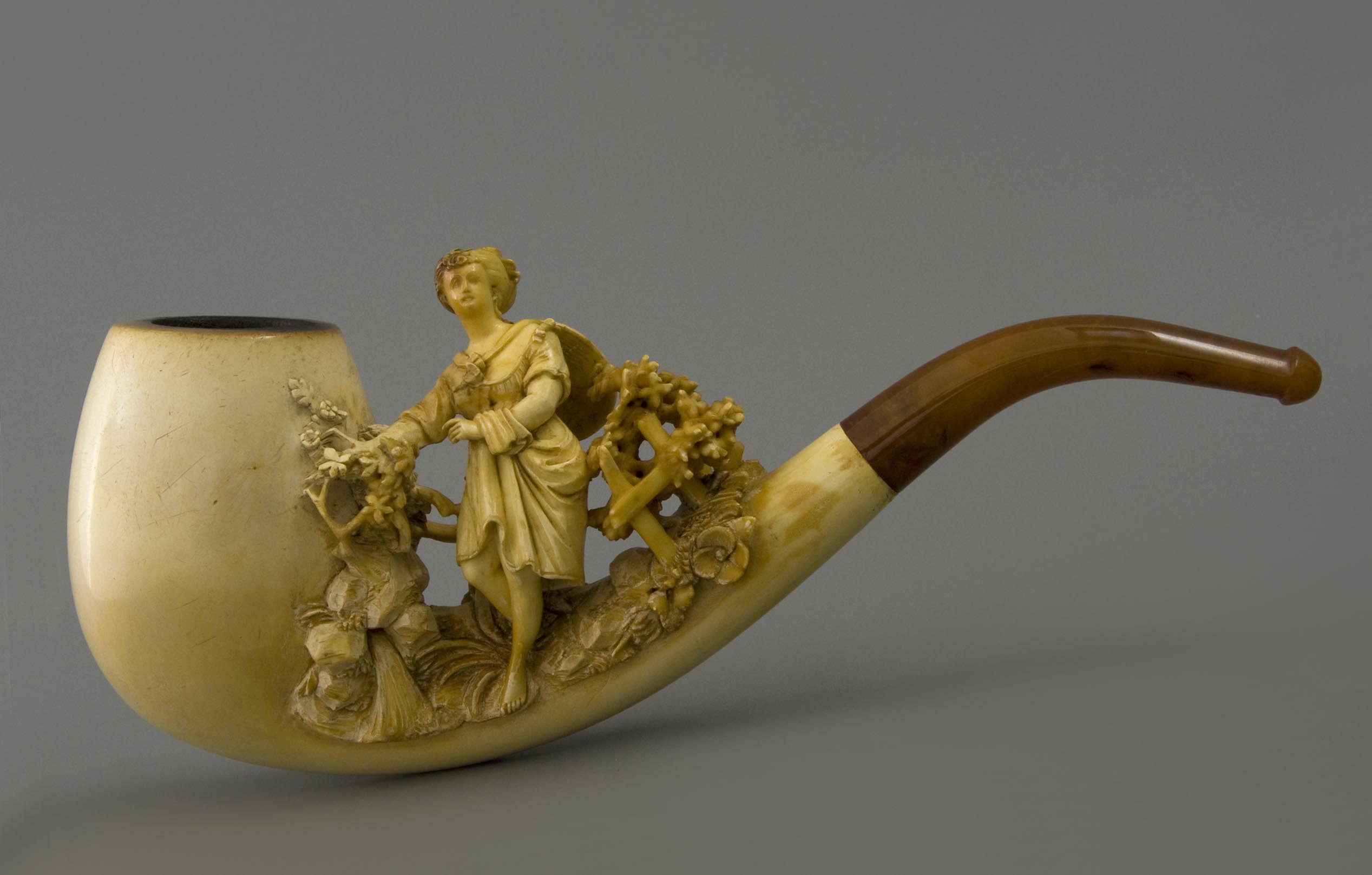
The cabinets reach back further than most museums dare. The pre-Columbian section holds pipes from over 2,500 years ago - the smoking traditions of the Americas long before Europeans arrived to copy them. Then come the clay pipes from Dutch and European archaeological digs, with surveys of individual manufacturers complete enough to trace the rise and fall of nineteenth-century factory towns. There are meerschaum pipes carved into faces and animals, the white mineral darkening with use into amber and brown. There are porcelain pipe bowls painted with hunting scenes and portraits, the kind of thing a gentleman's father might have hung above the hearth. There are opium pipes from China and their imitations from elsewhere, with paraphernalia that turns the act of smoking into an entire ritual apparatus. Categories spill into categories: pipe-makers' tools and clay-pipe moulds, tobacco wrappers, prints of smokers, manuscripts on the tobacco trade. Only a representative selection sits in the public cabinets. The rest waits in storage, systematically arranged for the researchers who travel here from everywhere.
Don Duco's Library
Most museums have curators. The Amsterdam Pipe Museum has Don Duco, who is something more specific - the person you ask when you want to know what a pipe is, where it came from, and what it was used for. He has written the standard work on the European clay-pipe industry, Century of Change: The European Clay Pipe, Its Final Flourish and Ultimate Fall. He has written the standard work on opium smoking, complete with international bibliography. He has written on the French portrait-pipe fashion and its spread across Europe. The museum publishes his research and the research of others in international journals. Archaeologists from across the world send photographs of pipe fragments turned up in excavations, and the museum's staff identify them. When the Niemeyer tobacco museum in Groningen closed in 2011, the Pijpenkabinet bought around four hundred items before the rest went to auction - preserving, as the museum put it, the "core" of that collection.
A Canal House That Knows the World
Walk up the dark stone steps and through the fanlight door, and the building tells you it has been here a while. The Prinsengracht house dates from around 1680 and was renovated around 1800, when the windows were enlarged and the gable replaced with a cornice. Inside, the stucco corridor and marble paneling are restored. The beam ceilings are carved. The original colors have been brought back. It is a typical Amsterdam canal house, except that this typical Amsterdam canal house contains objects from Japan and New York, from Spitsbergen near the North Pole and from Cape Town at Africa's southern end. The basement is the Smokiana pipe shop. The upper floors hold the library. The building, in other words, does exactly what a Dutch canal house has always done: it sits along the water and keeps the world's stuff inside it.
From the Air
Located at 52.364 N, 4.886 E in central Amsterdam on the Prinsengracht canal, between Leidseplein and the Rijksmuseum. Geohash u173z. From the air the museum is buried in the curved Grachtengordel canal belt - a UNESCO World Heritage site whose horseshoe pattern is one of the most recognizable urban signatures in Europe. Schiphol Airport (EHAM) is 13 km southwest. Approach paths to runway 18C overfly central Amsterdam at moderate altitudes, with the canal belt clearly visible below.