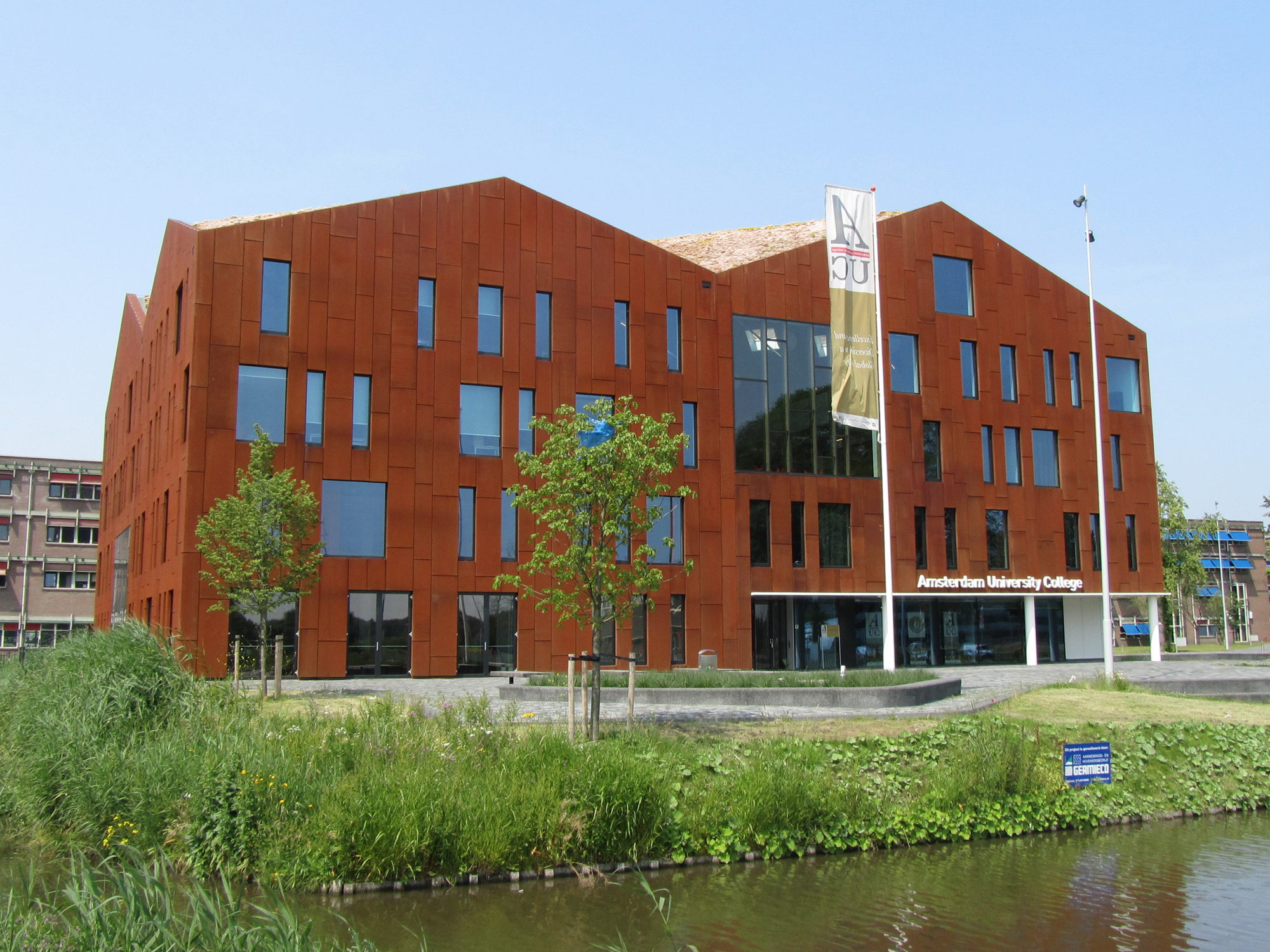
Amsterdam University College
Two Amsterdam universities that had been politely ignoring each other for over a century agreed, in 2009, to share a building. The University of Amsterdam, founded in 1632 as the Athenaeum Illustre, and the Vrije Universiteit, founded in 1880 by orthodox Calvinists who refused to study under state-secular professors, decided they could jointly run an honors college if the city, the UvA, and the VU all signed off. They built it in the Science Park east of the city center, gave it a rust-colored steel skin, and admitted a founding class of about a hundred students. Amsterdam University College is now the largest of the eight University Colleges in the Netherlands, and the only Dutch program where eighty percent of the undergraduates are foreign nationals living in dorms on the same campus as their classes.
The Joint Venture
AUC was officially founded in 2008 and admitted its founding class in 2009 under its first dean, Marijk van der Wende. The premise was deliberately unusual for Dutch higher education. Where a typical Dutch undergraduate enrolls directly into one faculty and studies one subject, AUC offers a three-year honors Bachelor's in Liberal Arts and Sciences with three broad majors: Science, Social Science, and Humanities. Students take an Academic Core of writing, global identity, and Logic, then choose from roughly 245 courses spread across 24 fields of study. The diploma is issued jointly by both the UvA and the VU, with cum laude awarded at a grade point average of 8 and summa cum laude at 8.75. In 2025 the UvA ranks 55th in the QS World University Rankings, and AUC students get to claim that ranking, plus the VU's, on their LinkedIn.
Selection
AUC aims to admit around 300 students each year out of roughly 1,400 applicants. The college targets students in the top thirty percent of their grade distribution and runs admissions through what it calls a 'two pairs of eyes' principle. About half of each class chooses a Science major. The student body is striking by Dutch standards: roughly eighty percent come from outside the Netherlands, drawn from more than sixty-five countries, most from the European Union but a substantial share from further afield. Tuition for the 2024-25 academic year was 4,940 Euros for Dutch and EU students and 13,790 Euros for everyone else. The AUC Scholarship Fund supports about eight percent of the student body, with Talent Fellowships earmarked specifically for Dutch minority students.
The Building Itself
The academic building opened in 2012, designed by the Delft firm Mecanoo. Its exterior is dominated by a facade of rust-colored steel plates that has the deliberate weathered look of something built to age in public. The interior was praised in the Dutch press for its open character; corridors widen into common areas, sight lines run between floors, and the library spills into hallways rather than hiding behind doors. The roof is planted with grass that doubles as insulation and stormwater storage, paired with a geothermal heat pump underneath to minimize energy loss. It is an oddly sincere building for a school that mostly trains students to be skeptical.
Dorms, Committees, and Dormfest
Students live in DUWO-managed housing arranged around a courtyard adjacent to the college, which makes AUC closer to an American small-college experience than anything else in Dutch higher education. The Amsterdam University College Student Association, founded in 2010, automatically enrolls every student and oversees more than thirty-five committees, from a Diversity Commission to a Sustainability Commission to whatever a current class decides to invent. Dormfest, the year-end festival held every June in the courtyard, is open to current students and alumni for free, which is the kind of small detail that explains why a Bulgarian student and a Korean student and a Dutch student can end up at the same wedding in California a decade later.
From the Air
AUC sits inside the Amsterdam Science Park at roughly 52.355N, 4.951E, on the eastern edge of Amsterdam and a few hundred meters from the AMS-IX internet exchange. Schiphol Airport (EHAM) is around 15 km southwest. From the air the campus is a small cluster of low buildings within a green park bordered by railway lines and the A10 ring motorway. The rust-red AUC academic building is hard to pick out from cruising altitude but the larger Science Park complex shows clearly as a green wedge between the Watergraafsmeer and the railway.