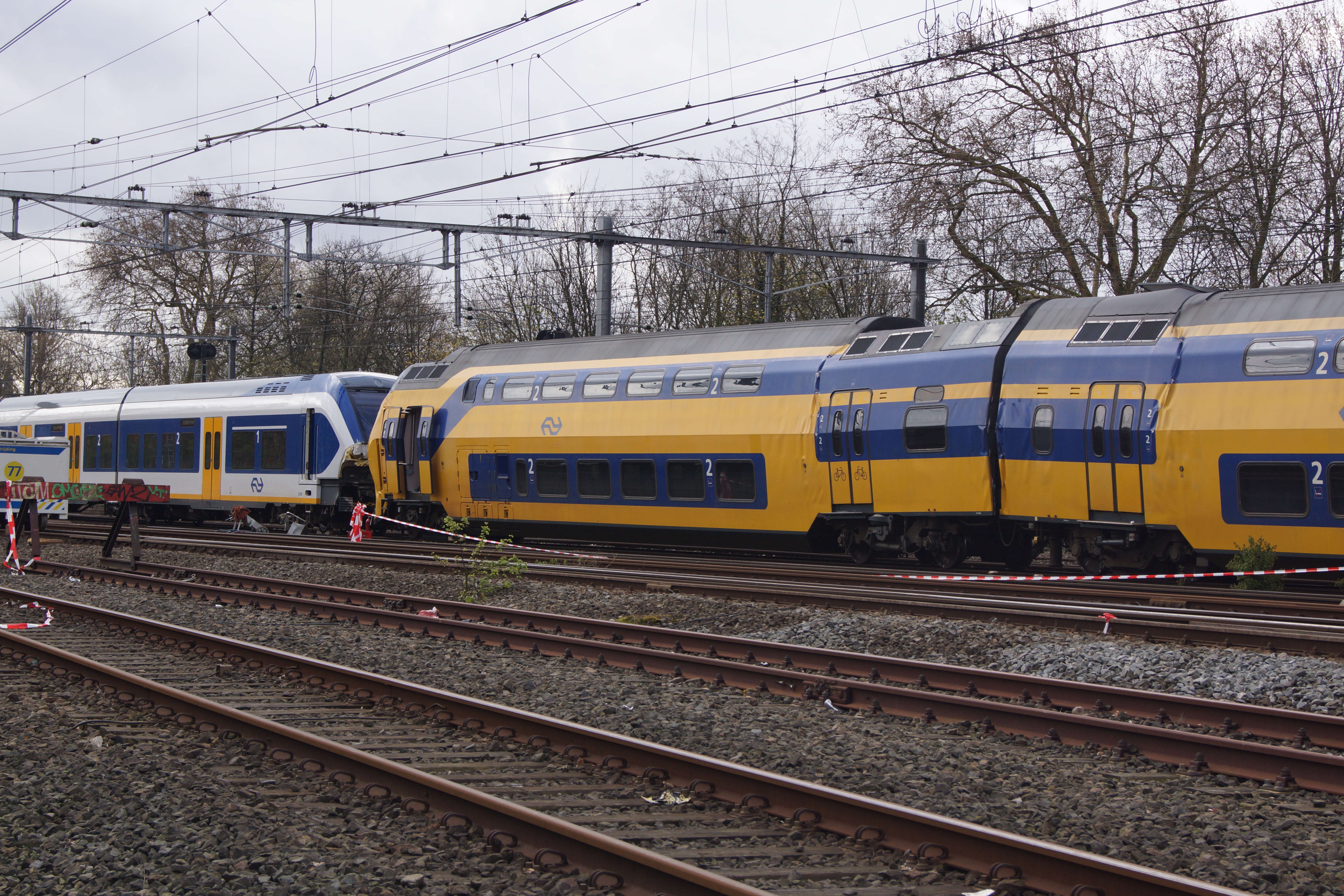
Amsterdam Westerpark Train Collision
It was six-thirty on a Saturday evening, the kind of slow spring rush when the trains out of Amsterdam Centraal carry weekend visitors home and locals heading out for the night. The Sprinter local had just pulled away from the platforms, accelerating into the curve toward Sloterdijk. On the same track, coming the other way, was a blue-and-yellow VIRM double-decker Intercity. Somewhere in the signal sequence between Centraal and Westerpark, on 21 April 2012, something went wrong. Two trains met head-on at low speed - and even at low speed, the impact threw passengers against walls, seats, windows, and each other.
The Collision
The trains involved were everyday workhorses of the Dutch network: a Sprinter Lighttrain from NS Class 2600, unit 2658, and a VIRM Intercity, unit 8711, the familiar yellow-nosed double-decker that runs nearly every long-distance route in the Randstad. Neither train derailed. That detail matters - in most head-on collisions, the carriages buckle and tumble. Here the impact crushed the front cabs but kept the bodies upright on the rails. Inside, however, was chaos. One passenger told the Algemeen Dagblad that everything was covered in blood. A total of 117 people were injured: thirteen critically, more than forty seriously, dozens more with broken bones, bruising, and the kind of neck injuries that come from sudden, violent deceleration. A 68-year-old woman died of her injuries the next day in hospital. The last injured passenger was finally discharged five weeks later, on 23 May.
A Bridge Full of Stretchers
Westerpark is a dense residential district, and the tracks here run through a cutting flanked by the park itself. Within minutes of the collision, emergency services had the site surrounded. Crews used cranes to lift the most badly injured passengers from the wreckage; others were wrapped in protective sheets and carried out on stretchers. A trauma helicopter shuttled the worst cases to nearby hospitals. The walking wounded were taken to an Amsterdam hotel that had been requisitioned as a triage center. For an evening, a railway bridge in west Amsterdam became an open-air emergency room - dozens of paramedics, blankets, IV stands, the sound of sirens echoing off the canal-house facades a few streets away. While doctors worked on the bridge, replacement bus services were already being arranged. The trains would not be moving for days.
The Signal at Danger
Investigators recovered the data recorders from both trains and quickly traced the cause: the Sprinter driver had passed a signal at danger - the rail industry's clinical term for running a red light. The Dutch Safety Board, joined by the Human Environment and Transport Inspectorate, pressed deeper. Why had the driver missed the signal? Why had the automatic train protection not stopped him? The answers were uncomfortable. ProRail, the network operator, acknowledged that the signal in question was part of an older generation of equipment. A modern signal with upgraded ATB safety would have intervened automatically and brought the train to a halt. The driver, the report suggested, might not face prosecution at all - the system itself had failed alongside him. The Westerpark report, published that December, became part of a longer conversation in Dutch rail safety about how many old-generation signals still lined the country's busiest corridors, and how long replacement would take.
What a Quiet Number Hides
From the air, the collision site is unremarkable - a short stretch of cutting between Centraal and Sloterdijk, just past Westerpark's green rectangle. There is no monument. The trains were repaired or scrapped, the signal upgraded, the timetable rebuilt. The official statistics show one fatality and 117 injuries: a quiet number compared to the great rail disasters of European history. But the woman who died had a name and a family. The teenager wrapped in a foil blanket on the bridge eventually went home and learned to take trains again, or didn't. The driver of the Sprinter has carried that evening for the rest of his life. Westerpark is a story of how a single misread signal, on a system that had not quite kept up with itself, made the everyday infrastructure of the Netherlands suddenly fragile - and of how the country looked hard at what had happened, and named the failures by their right names.
From the Air
Coordinates 52.39 N, 4.88 E - just west of Amsterdam Centraal, between Sloterdijk and Westerpark stations. From altitude the cutting appears as a thin gray ribbon between the green rectangle of Westerpark and the dense terraced housing of Amsterdam-West. Schiphol (EHAM) lies 12 km southwest. Recommended viewing altitude 2,000-3,000 ft AGL; the Westerpark cutting is visible against the surrounding street grid in good visibility.