Amsterdam Wooden Drydock I
The problem was simple, and impossible. Amsterdam's merchants wanted a dry dock. The ground under Amsterdam did not. Every building in the city stood on wooden piles driven down through peat and clay until they struck firm sand, and even with that trick the soil resisted heavy structures. A traditional stone graving dock — a pit you pumped dry around a ship — would have to fight not only the IJ Bay's water but the city's own swampy foundation. Vlissingen's navy drydock had been out of service for ninety-two years on account of similar trouble. So in the early 1840s an ex-captain named Jan Daniel Diets bought a different idea entirely: a dock that would float.
An Idea Imported from New York
Diets had spent his career sailing to the West Indies, and he had heard about a strange new contraption operating off Manhattan since 1839 — John S. Gilbert's balance dry dock, a great timber raft with hollow side-chests that could be flooded to sink the whole apparatus, slid under a damaged ship, and then pumped out so that the raft rose, lifting hull and all into the air. Diets bought the American plans through Gilbert's agent, the ship's commander John G. Cushman, for 12,000 guilders, taking them sight unseen. On 16 December 1841 Gilbert's patent was registered in the Netherlands at the address of the U.S. consul in Amsterdam, and Diets walked away with an exclusive five-year license. Within months he had Amsterdam's wealthiest shipowners — Mayor Pieter Huidekoper among them — funding a new company, the Reederij der Drijvende Droogdokken, to build the city its first floating dock.
How to Lift a Ship with a Raft
What J. R. Boelen en Zonen's shipwrights built in 1842 looked nothing like the iron behemoths that would replace it later in the century. The bottom was a true raft, three layers of pine plank — the first thirty centimeters thick, planks placed alternately so the top of one tree butted against the base of another, the seams between them caulked and stuffed with moss. From the raft's edges, beams of a rare timber called Narva rose at a fifty-six-degree angle, framing watertight side-chests divided into four compartments each. To dock a ship, you flooded the chests, the whole structure sank, the ship floated in over the submerged raft, a great trapezoidal stern door was closed, and six steam-driven pumps emptied the chests one by one. The raft rose. Water inside drained back through the door. Eight horsepower of steam engine, made by Van Vlissingen en Dudok van Heel, did the rest. The dock was so tight that one barque sat dry inside it for nineteen days without the pumps being touched.
Forty-Eight Meters of Pine
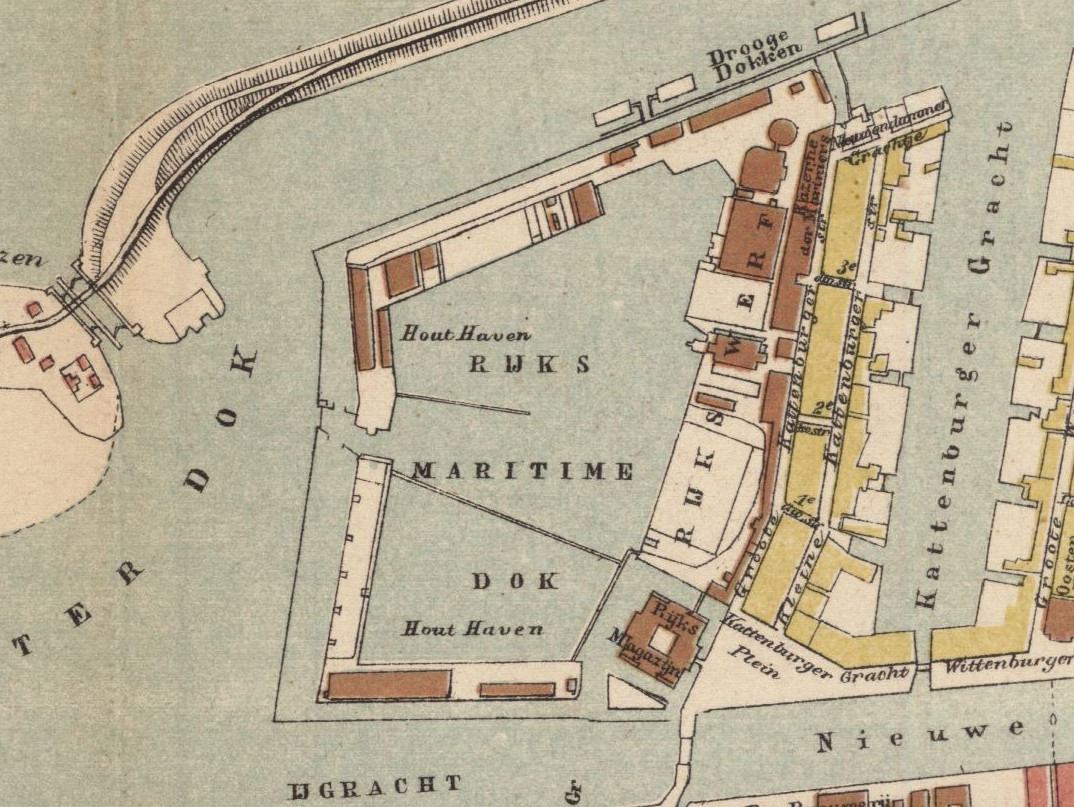
Opened on 30 November 1842 in a corner of the Oosterdok called the Pijp, the new dock measured roughly 48 meters long, 18.7 meters in beam, and carried a draft of just over a meter when empty. From late November 1842 through the following October, sixty-four ships were lifted on its raft, averaging six hundred tons but including vessels of over a thousand. Amsterdam's coppered merchantmen — sheathed in copper for tropical voyages, and prone to fouling — began to be hauled out and inspected after every trip from the Indies. The flexibility of the design surprised owners: a wooden raft could conform slightly to an out-of-true keel without damaging the hull, something a rigid stone basin could not. Engineers came from Le Havre in 1843 to watch it work, and Diets sold them the timber for a 60-meter version. King William II visited on 29 April 1843, rowed across in his Koningssloep while flags snapped overhead and a band played on deck.
Locked In, and Left Behind
The dock's curse was geographic. It floated, but it could not leave the wet docks where it had been built. The Oosterdok lock measured only fifty feet across; the dock, sixty. In 1874 a railway bridge was thrown over the lock entrance, sealing the inner harbor's fate. When the North Sea Canal opened in 1876, ships calling at Amsterdam grew larger — too large to pass through the lock fully loaded, and too large for the old wooden docks anyway. Newer iron drydocks moored out on the IJ took the work. The Reederij's share price collapsed to a quarter of its nominal value by 1885. In 1890 the Westerdok dock was auctioned for breaking up; on 6 January 1902 the three remaining wooden docks in the Oosterdok went under the hammer for 24,900 guilders, bought by H. Schutte. They lingered for decades as the Hera Docks, gradually fading from the city's working life until liquidation in 1940.
The Painting and the Idea
Today the original dock survives only in a painting by Hendrik Vettewinkel, showing the ship Amstel hoisted dry while the king's barge approaches under bunting. But the idea Diets bought sight unseen had already traveled. Surabaya got its own wooden floating dock under a 1843 patent extension. Le Havre got Amsterdam timber. And Amsterdam itself, decades later, would build the iron Koninginnedok of the Amsterdamsche Droogdok Maatschappij on the north shore of the IJ — the direct industrial descendant of a Manhattan invention that an ex-captain had once gambled twelve thousand guilders to bring home, and that a pine raft moored in marshy water made real.
From the Air
The original dock site lies in the Oosterdok at approximately 52.375°N, 4.919°E, just east of Amsterdam Centraal station. Nearest airport is Amsterdam Schiphol (EHAM), about 12 km southwest. Best viewing altitude 1,500-3,000 ft AGL to make out the inner-harbor geometry of Oosterdok and the railway viaduct that ultimately sealed the wooden dock's fate. The IJ Bay opens out to the north; ship traffic passes east-west through the North Sea Canal locks at IJmuiden.