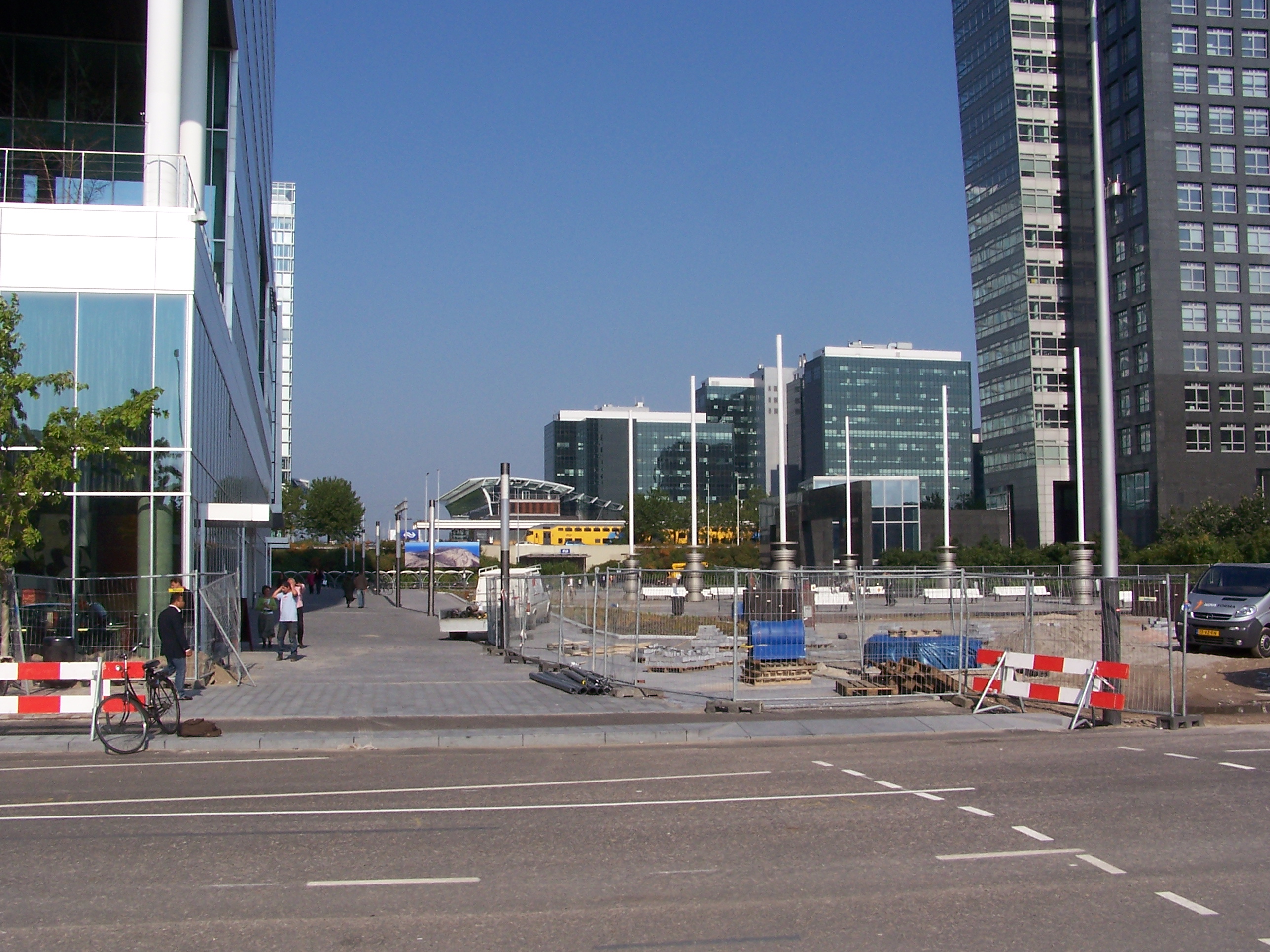
Amsterdam Zuid Station
When Amsterdam Zuid opened in 1978, it was a station built for an idea that did not yet exist. There was no Zuidas. There were no glass towers full of bankers and lawyers. There was farmland, a stretch of the A10 ring road, and a strategic piece of railway called the Zuidtak that nobody much used. Four decades later that quiet platform on the southern edge of the city has effectively replaced Amsterdam Centraal as the capital's main station for direct trains — and the Dutch government is spending billions of euros to bury a motorway underneath it.
The Station That Outgrew Its Premise
Centraal Station, with its 1889 redbrick face on the IJ waterfront, has always been Amsterdam's stage door — the place tourists arrive, the place postcards photograph. Zuid was built to be functional, a Zuidtak commuter halt south of the city. But geography conspired in its favor. A train from Schiphol Airport reaches Zuid in seven minutes, half the journey to Centraal and at roughly half the fare. The Utrechtboog flyover, completed in 2006, finally let trains running from Schiphol to Utrecht, Arnhem, and Eindhoven bypass the congested center entirely. Zuid stopped being a side platform and became the spine of the national network. The reference to the neighboring World Trade Center, which had given the station the awkward name Amsterdam Zuid WTC, was quietly dropped that same year. The expansion of 2006 added platforms 3 and 4, and the queues still outgrew them.
Zuidas, the Financial Mile
Step off the train and you arrive into a district that did not exist a generation ago. Zuidas — the Financial Mile, sometimes called Amsterdam's answer to La Défense — has grown up around the station since the late 1990s, glass and steel rising on what used to be open ground between Buitenveldert and the Olympic Stadium. ABN AMRO put its headquarters here. So did Akzo Nobel, the big law firms, the international accountancies. The Vrije Universiteit campus sits just south, sending students through the station every morning. Up on Strawinskylaan, the square in front of the station hums with commuters and bicycles, two metro lines (50, 52) feeding in below, two tram lines (5 and 25) curling past, buses running to the medical centre and out to Schiphol. International Eurocity trains run directly from here to Brussels and Antwerp, threading through Rotterdam on the way.
The Zuidasdok Project
The fundamental problem at Zuid is that the A10 motorway runs straight across the surface where the station wants to grow. The Zuidasdok project, signed off by Dutch authorities in December 2014, is the audacious answer: dig tunnels and put the eastbound carriageway underground. Above it, the station can finally spread out, with all four mainline platforms widened and reroofed, a new pedestrian underpass named the Britten Passage cut beneath the tracks in honor of Benjamin Britten, and room reserved for two additional mainline tracks to come later. Team V Architecture leads the design consortium; the engineering firm Technolution handles the tunnel control systems. Originally budgeted at 1.9 billion euros when signed in 2014, the project has since grown to an estimated 5.4 billion euros, making it among the largest infrastructure undertakings in Dutch history, and one of the conditions that has held back the long-promised arrival of high-speed HSL-Zuid trains at the platforms.
Trams, Layered Over Decades
The tram history at Zuid reads like a small archaeology of urban planning. Between 1978 and 1990, tram line 5 terminated on Zuidplein, the square out front. From 1990 the stop migrated inside the Zuid metro station. Then in May 2008 the construction of the new north-south metro line (52) forced everything back out again, onto Strawinskylaan. A redesign followed in 2016 to prepare for the conversion of line 51's southern half from sneltram into the new tram 25, which finally opened on 13 December 2020. The current Strawinskylaan stop is officially temporary — too small to store the coupled tram pairs the line now uses, too cramped for proper crew facilities. A permanent terminus along Arnold Schönberglaan, on the south side of the station, is expected in 2028, once the motorway is safely below ground.
The Quiet Capital
Stand on the upper concourse late on a weekday afternoon and watch the rhythm. Bankers in dark coats drift toward the metro. Cyclists thread through the bus station. A Eurocity to Brussels glides in below. A Sprinter from Hoofddorp rolls out the other side. Somewhere a tram bell rings. It is not romantic in the way Centraal is romantic — there is no waterfront, no neo-Renaissance facade, no postcard arch. But this is where modern Amsterdam actually does its work. The station that was supposed to be the back door turned out to be the front.
From the Air
Amsterdam Zuid sits at 52.339°N, 4.873°E in the south of the city, immediately recognizable from above by the cluster of high-rise office towers of the Zuidas district and the A10 ring motorway running east-west across the site. Schiphol Airport (EHAM) is 7 minutes by direct train, about 8 km southwest. Best aerial perspective is from 2,000-4,000 ft AGL, where the green ribbon of the Beatrixpark and the Amsterdamse Bos to the south make the Zuidas's vertical mass especially striking against the older Berlage-planned low-rise of Nieuw-Zuid.