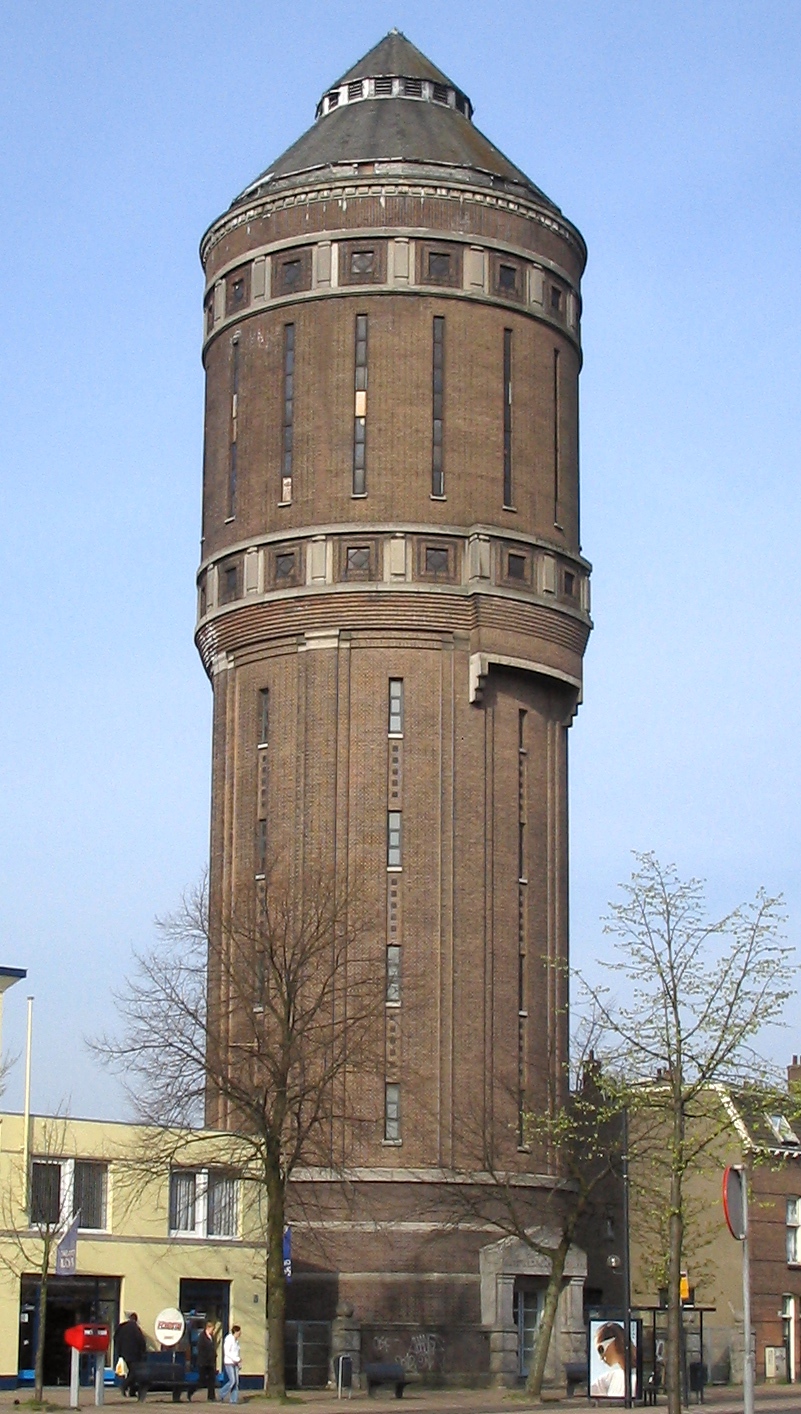
Amsterdamsestraatweg Water Tower
At three o'clock on a Sunday afternoon in October 2017, seven people climbed the iron stairs of the Amsterdamsestraatweg water tower. They strung a banner from a high window. They unrolled sleeping bags. By five the police were at the door. By seven all seven had been arrested. The tower had been empty for thirty-one years at that point, sold and resold, granted national monument status, planned and re-planned, and waiting. The squatters knew exactly what they were doing. The Dutch had criminalized squatting seven years earlier almost to the day, and the tower was their argument.
A Brick Cathedral for Water
The Utrechtsche Waterleiding Maatschappij - the city's water company - built the tower in 1916 as the fourth in its growing network. The architect, W.K. de Wijs, worked in the Amsterdam School style, an Expressionist movement of the 1910s and 1920s that loved brick the way Italians loved marble. He gave the tower decorative brickwork, rounded forms, and a heavy crowning silhouette that announced its function without quite admitting to its plumbing. It rose 42 meters at the boundary between the city of Utrecht proper and the then-separate town of Zuilen, on Amsterdamsestraatweg 380, just where the long straight road north toward Amsterdam picks up speed. Inside the brick shaft sat a reservoir holding 1,000 cubic meters of drinking water - enough to pressurize the taps of an entire neighborhood. For seventy years it did exactly that.
The Empty Years
By 1986 modern pumps had made gravity-fed water towers obsolete almost everywhere in the Netherlands. The Amsterdamsestraatweg tower was decommissioned and went derelict. Squatters moved in briefly in the late 1980s. In 1989 it was sold and converted, briefly, into office space. In 2001 it was added to the national monuments register - the Rijksmonument designation that protects the country's most architecturally significant buildings - which made it harder to alter or demolish but did nothing to fill it. For years it stood there, brick weathering, windows dark, a monument hovering above a busy commercial street where the bakeries, kapsalons, and Turkish supermarkets of Zuilen were doing brisk business at its feet.
Squatters and the Law
Dutch squatting culture has roots in the housing crisis of the 1960s and 1970s, when a wave of activists - kraakers - moved into empty buildings to force the question of why a country with severe housing shortages tolerated long-term vacant properties. For decades squatting was legal under certain conditions. In October 2010 the Netherlands criminalized it. Seven years later, in October 2017, the activists who took the water tower were marking that anniversary. The judge who eventually sentenced them was unmoved. Squatters, she told them, were free to attend demonstrations and promulgate their ideals; their ideals did not entitle them to break into property. Six were tried. One, who had a previous conviction, received seven days in jail. The other five each paid a 500-euro fine. In October 2018 a new group occupied the tower for one day before being evicted; four more arrests. In August 2019 a third attempt failed before anyone got inside.
Apartments at Last
In February 2020 the construction crews finally arrived. Zecc Architecten, a Utrecht firm that has built a small specialty in converting old water towers - a lookout in Sint Jansklooster, a restaurant in Den Bosch, a bed and breakfast in Lutten, apartments in Soest - took on Amsterdamsestraatweg 380. The brick exterior stayed; inside, where the reservoir once sat, came floor plates and apartments with windows cut through the curving walls. The activists who had climbed those stairs in 2017 had argued that the building was a symbol of everything wrong with Dutch housing policy: a beautiful, protected, urban structure standing empty in a city where rents were climbing and waiting lists for social housing ran past ten years. Whether the conversion answered that argument or simply ended it, the tower stopped being empty. Its sand-colored bricks now front the Amsterdamsestraatweg with the same quiet authority they have carried since 1916.
From the Air
Coordinates 52.10 N, 5.10 E - in the Zuilen district of north Utrecht, on Amsterdamsestraatweg about 3 km north of Utrecht Centraal station. From altitude the tower is a small square brick spike against the gridded terraced housing of Zuilen. The much taller Dom Tower (112 m) is 4 km south. Schiphol (EHAM) lies 38 km west, Lelystad (EHLE) 35 km north. Recommended viewing altitude 1,500-2,500 ft AGL.