Anahuacalli Museum: Diego Rivera's Temple of Stone and Memory
The building looks wrong for Mexico City. Rising from a lava field in the southern borough of Coyoacan, the Anahuacalli is a dark, angular pyramid of volcanic rock that resembles nothing else in the capital - not the colonial churches, not the Art Deco towers, not the glass-and-steel offices spreading across the Valley of Mexico. Diego Rivera designed it that way. He wanted a structure that felt ancient even as it was being built, a place where pre-Columbian artifacts could be displayed not as museum curiosities behind glass, but as sacred objects returned to something approaching their original context. The name itself carries the ambition: Anahuacalli, from the Nahuatl for "house surrounded by water," evoking the island city of Tenochtitlan before the Spanish drained the lakes.
A Painter's Obsession
Rivera started collecting pre-Hispanic art as a child. When he left for Europe in 1906, he entrusted the pieces to his mother, who sold them to cover household expenses. Upon his return to Mexico in 1921, he began again from nothing. By the time of his death in 1957, the collection had grown to approximately 39,000 pieces - ceramics, stone figures, jade masks, terracotta vessels - spanning virtually every Mesoamerican civilization. His second wife, Guadalupe Marin, resented the spending. A 1964 account in the newspaper El Gallo Ilustrado captured her frustration: she would beg the dealers to leave, furious that Rivera spent grocery money on clay figurines. But Rivera saw the collection as something beyond personal indulgence. "I return to the people what I was able to rescue from the artistic heritage of their ancestors," reads the inscription on the museum's foundation stone. He meant it. The entire collection was donated to Mexico.
Built from the Ground Beneath It
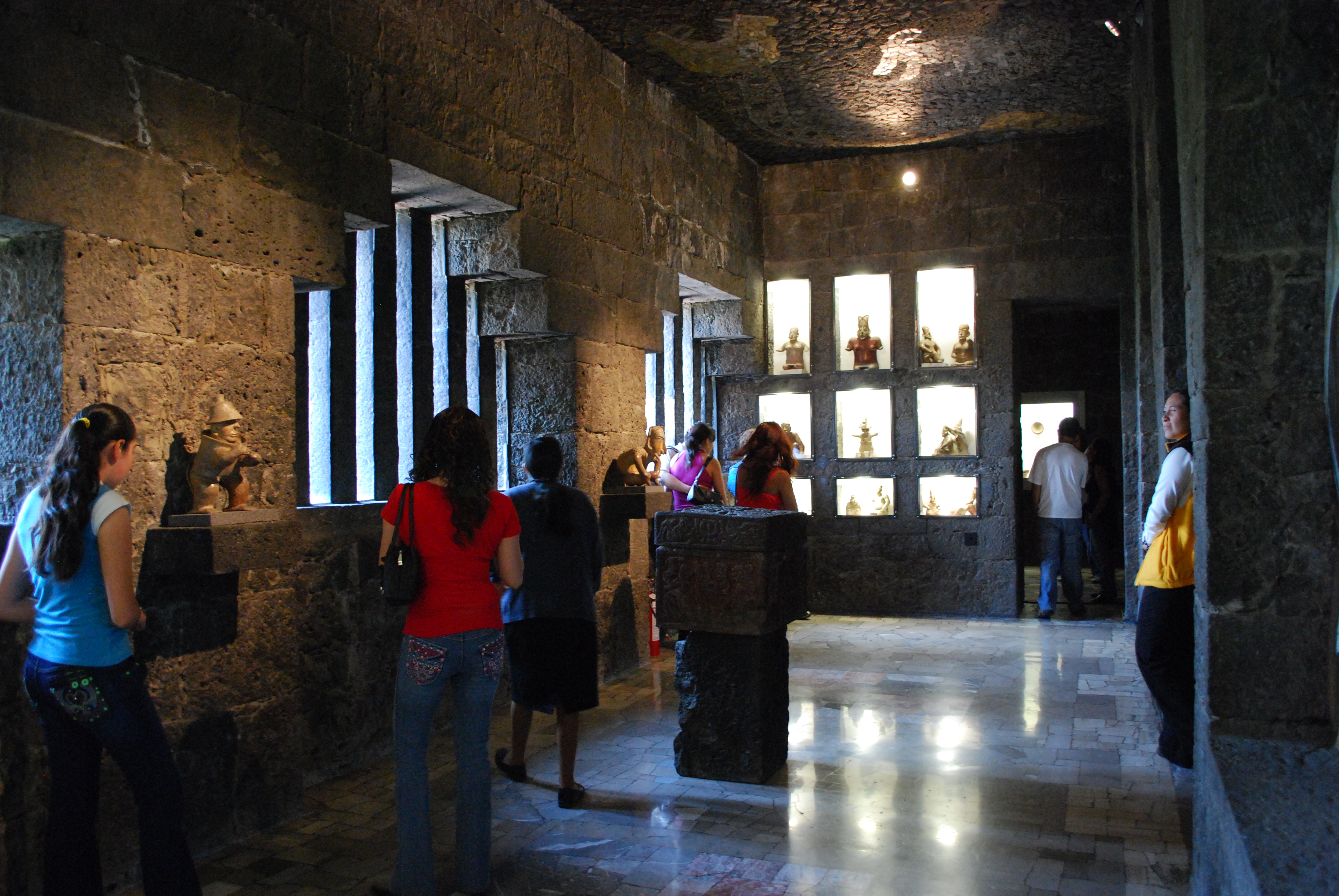
Construction began in 1942 on a lava field in San Pablo Tepetlapa, created roughly 2,000 years ago by the eruption of the Xitle volcano. Rivera and architect Juan O'Gorman extracted the building material from the site itself - dark volcanic stone, carved and stacked into walls that slope inward like a Mesoamerican temple. The design blends Mayan, Toltec, and what Rivera called "Traditional Rivera" elements: serpentine pilasters, rhomboid doorways, windows of amber-colored onyx that glow translucent from the inside while appearing opaque from the street. The ground floor, representing the Underworld in Mesoamerican cosmology, receives almost no natural light. The middle floor - the earthly realm - opens to daylight through enormous windows flanked by carved stone serpent heads. Rivera ran out of money before the project was complete. Frida Kahlo wrote to a government official in 1943, describing her husband's sadness at being unable to finish. With financial support from patron Dolores Olmedo, construction finally concluded in 1963. The museum opened on September 18, 1964, seven years after Rivera's death.
Thirty-Nine Thousand Voices
Of the estimated 39,000 pre-Columbian pieces in the collection, only about 2,000 are on permanent display - a selection curated originally by the poet Carlos Pellicer at Rivera's personal request. The rest are stored in a building called the Bodega de Colecciones. What visitors see is arranged not by archaeological period or region in the conventional museum sense, but as Rivera intended: grouped to evoke scenes of daily and ritual life. Pellicer described the effect as "truly amazing" - niches and alcoves populated by ceramic figures and stone sculptures that seem to inhabit the dark volcanic rooms rather than merely occupy them. The four corners of the building are dedicated to elemental deities of the Mexica worldview: Chicomecoatl for earth, Ehecatl Quetzalcoatl for wind, Tlaloc for water, and Huehueteotl for fire. On the second floor, sixteen preparatory sketches for Rivera's murals hang in a space called the Study, offering a rare glimpse of the artist's compositional process before paint met wall.
The Lava Garden
Rivera's vision extended well beyond the museum building. The Anahuacalli sits on sixty thousand square meters of land, much of it preserved as an ecological reserve protecting the flora and fauna unique to the Pedregal lava field. This landscape - twisted rock formations colonized by cacti, orchids, Begonia del Pedregal, and medicinal herbs found nowhere else in the city - can be viewed panoramically from the museum's roof terrace. Rivera drafted specifications to protect the lava formations during construction, insisting that the volcanic terrain was inseparable from the building's beauty. He envisioned the surrounding land as a City of Arts: plazas for workshops, forums for theater and dance, permanent galleries. Not all of it was realized in his lifetime, but the ecological reserve endures as one of Mexico City's most unusual green spaces - a pocket of pre-urban wilderness inside a metropolis of twenty million people.
From the Air
Located at 19.345N, 99.145W in the San Pablo Tepetlapa neighborhood of Coyoacan, southern Mexico City. The dark volcanic-stone pyramid sits amid a lava field that contrasts visibly with surrounding urban development. The Pedregal lava field and the nearby Ciudad Universitaria (UNAM campus) are useful visual references. Approximately 10 minutes south of the Frida Kahlo Museum. Nearest major airport: Mexico City International Airport (MMMX/MEX), about 20 km northeast. Toluca International Airport (MMTO/TLC) is 60 km west. Best viewed at 3,000-5,000 feet. The volcanic landscape of the Pedregal is distinguishable from altitude as a darker, rougher terrain patch amid the urban grid.