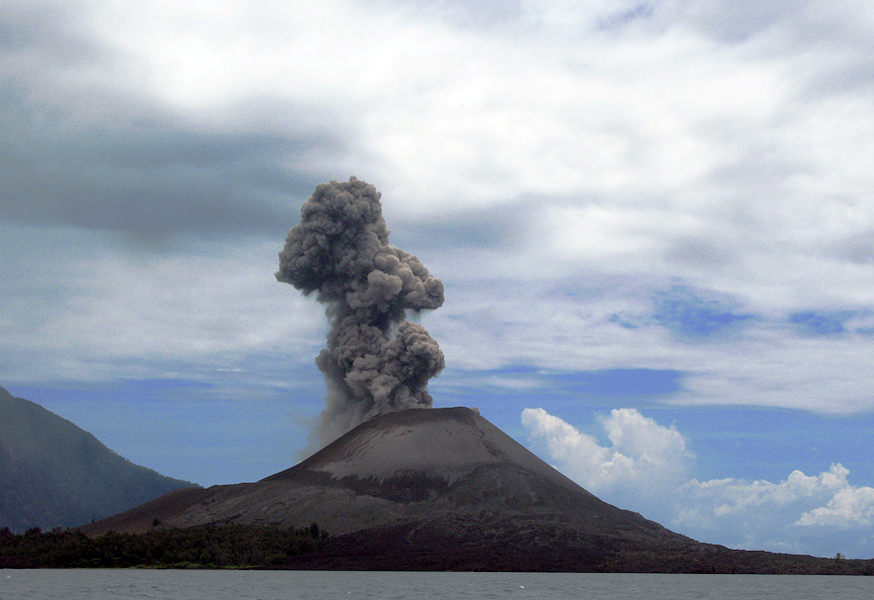
Anak Krakatau: The Child That Keeps Growing
In 1883, the volcanic island of Krakatoa exploded with the force of 200 megatons of TNT, collapsing into the sea and killing 36,000 people. For 44 years, only water remained where the island had stood. Then, in 1927, a new cone broke the surface - Anak Krakatau, 'Child of Krakatoa.' The child has been growing ever since, rising at an average of 5 meters per year, erupting frequently, and in 2018 partially collapsing to cause a deadly tsunami. Anak Krakatau is living proof that even the most catastrophic destruction is temporary - the volcano that destroyed itself is rebuilding, one eruption at a time.
The Parent
Krakatoa before 1883 was a volcanic island rising 450 meters above the Sunda Strait between Java and Sumatra. When it erupted on August 27, 1883, the explosion was heard 3,000 miles away. Two-thirds of the island collapsed into the emptied magma chamber. Tsunamis up to 120 feet high killed tens of thousands.
The explosion left a submarine caldera - a water-filled crater where the island had been. The rim of the caldera formed a few small islands: Rakata, Sertung, and Panjang. The volcanic system had exhausted itself spectacularly. But the magma chamber was refilling.
The Birth
In 1927, fishermen reported steaming water in the caldera. Submarine eruptions had begun. On August 11, 1930, a new island emerged above the waves - Anak Krakatau was born. The child was unstable at first, washed away by waves multiple times before establishing itself permanently.
The new island grew rapidly. Eruptions added material constantly. By the 1950s, Anak Krakatau was a permanent feature, complete with vegetation colonizing its slopes between eruptions. The volcano was rebuilding itself in the same spot where its parent had self-destructed.
The Growth
Anak Krakatau grew at an average rate of 5 meters per year in height and 7 meters in width. By 2018, it had risen to about 340 meters above sea level - not yet matching its parent's height, but growing steadily. The island was constantly reshaped by eruptions, sometimes more frequently than weekly.
The volcano became a popular tourist destination for visitors willing to brave the boat trip from Java. The constantly smoking cone, occasional explosions, and knowledge that one stood on the site of history's most famous eruption made it irresistible to volcanic tourists.
The Collapse
On December 22, 2018, Anak Krakatau demonstrated that it had inherited its parent's destructive potential. Part of the cone collapsed into the sea during an eruption, triggering a tsunami that struck the coasts of Java and Sumatra without warning. Over 400 people died.
The collapse reduced the island's height from 340 meters to about 110 meters. Two-thirds of its volume slid into the sea. The parallel to 1883 was chilling - the child had partially repeated its parent's behavior, though on a smaller scale. The 2018 collapse was a reminder that Anak Krakatau remains active and dangerous.
The Future
Anak Krakatau continues to erupt and grow. Since the 2018 collapse, the cone has been rebuilding. Eventually - in decades or centuries - the child may reach the parent's size. Eventually, another catastrophic eruption may occur. The volcanic system follows its own timeline.
Scientists monitor Anak Krakatau constantly. Seismographs track tremors. Satellites measure the cone's growth. After 1883 and 2018, no one underestimates the volcano's potential. Anak Krakatau remains what it has been since its birth: a living reminder that the earth is never finished, never static, always building and destroying. The child of Krakatoa is still growing.
From the Air
Anak Krakatau (6.10S, 105.42E) lies in the Sunda Strait between Java and Sumatra. Jakarta Soekarno-Hatta (WIII) is 150km northeast. The active cone is clearly visible from the air, often with steam or ash plumes. The surrounding caldera rim islands (Rakata, Sertung, Panjang) are visible. The strait is heavily trafficked shipping lanes. Weather is tropical - hot and humid with monsoon rains.