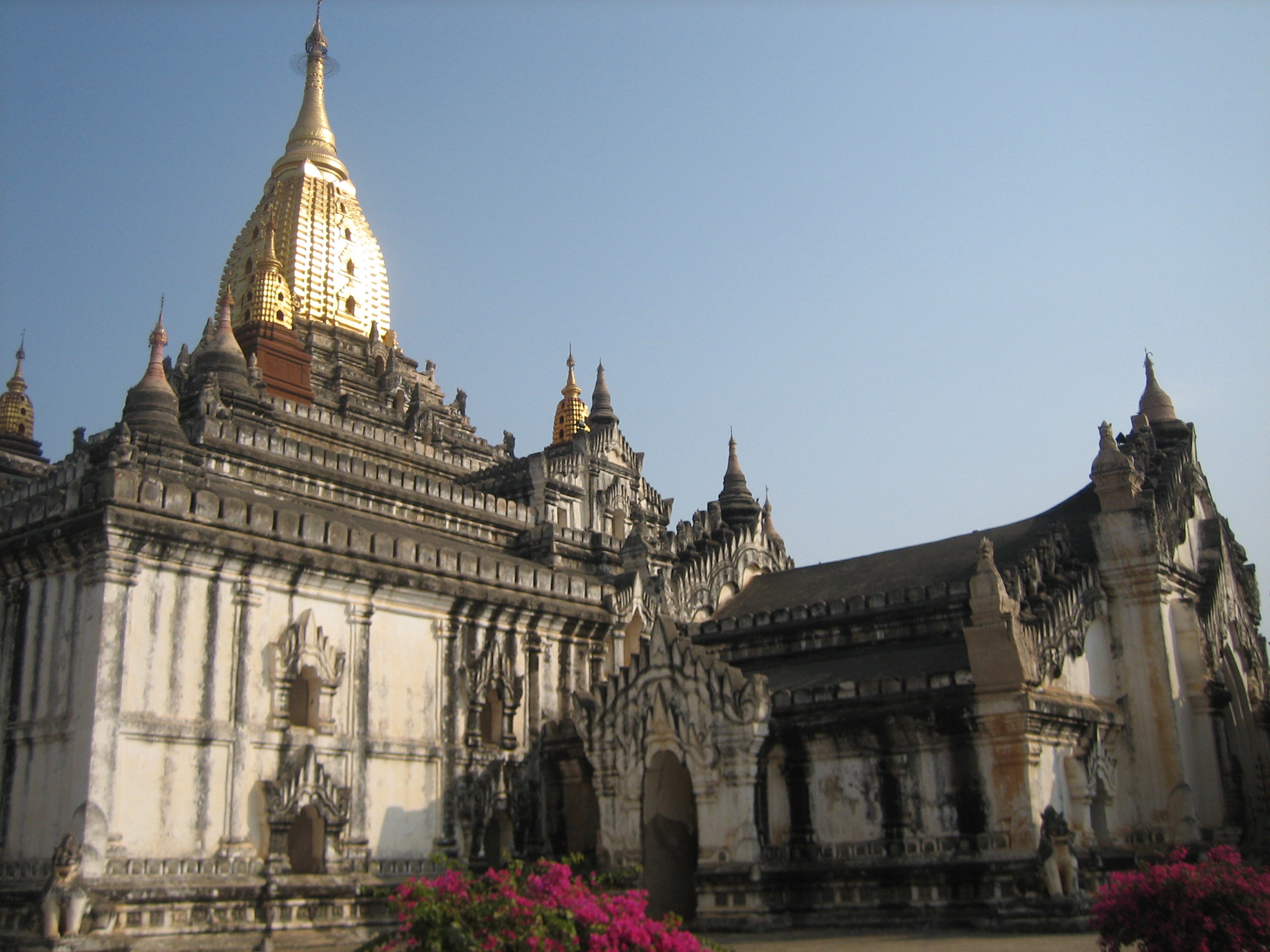
Ananda Temple
Stand close to the south-facing Buddha inside the Ananda Temple and it wears an expression of sorrow. Step back twenty paces and the same face shifts into something like joy. This optical trick, built into solid teak nine centuries ago, captures something essential about the Ananda: it is a place designed to change depending on how you approach it. Completed in 1105 AD during the reign of King Kyansittha of the Pagan Dynasty, the temple has been called the "Westminster Abbey of Burma," a title that gets at its spiritual importance if not quite its architectural strangeness. Rising 51 meters above the Bagan plain, it fuses Mon and Indian building traditions into something that belongs to neither and both.
A Legend Sealed in Silence
The temple's origin story is as dark as its architecture is luminous. According to tradition, eight monks approached King Kyansittha seeking alms and described the Nandamula Cave temple in the Himalayas, where they had meditated. Using what the legend calls meditative psychic skills, they conjured such vivid images of the sacred site that the king commissioned them to build something comparable on the Bagan plain, a temple that would stay cool even under the central Myanmar sun. The monks obliged. When they finished, Kyansittha had them killed, ensuring that no one could replicate the design elsewhere. Whether the legend is historical fact or cautionary myth, it speaks to the value placed on the Ananda's uniqueness. Nothing quite like it exists anywhere else in Bagan, and the builders of this temple left no other.
Four Faces, Four Ages
At the heart of the temple, a central cube houses four standing Buddha statues, each 9.5 meters tall above an eight-foot throne, each facing a cardinal direction. They represent four Buddhas: Kakusandha facing north, Konagamana facing east, Kassapa facing south, and Gautama facing west. Together they are called the "Buddhas of the modern age," conveying omnipresence through space and time. The north- and south-facing images are original, carved from solid teak in the Bagan style and displaying the dhammachakka mudra, the hand position symbolizing the Buddha's first sermon. The east and west images are later replacements in the Konbaung style, the originals having been destroyed by fire. The east-facing Konagamana holds a small sphere between thumb and middle finger, said to represent dhamma as a cure for suffering. This mudra appears nowhere else in traditional Buddhist sculpture. At the feet of the west-facing Gautama, lacquer statues depict King Kyansittha kneeling in prayer beside Shin Arahan, the Mon monk who converted the king to Theravada Buddhism.
Stories Written in Clay and Stone
The Ananda is less a single temple than an encyclopedia rendered in architecture. Its walls and terraces carry 554 glazed terra-cotta tiles depicting jataka tales, the stories of Buddha's previous lives sourced from Mon texts. At the base, from south to west, 552 images show Mara's warriors marching to attack the Buddha. Around the corner, from west to north, the same warriors lie vanquished. Higher up, 537 plaques each illustrate a specific jataka story, while the fifth terrace alone holds 547 plaques from the Vessantara Jataka. Camels appear among the images, hinting at the influence of overland trade routes on this riverbank kingdom. In the outer corridors, 1,500 stone sculptures line the vaulted passages. Eighty episodes from the Buddha's life are carved from single rocks averaging 3.5 feet tall, including the scene of Prince Siddhartha peeping through a tapestry for a last look at his sleeping wife Yasodhara and newborn son Rahula before leaving the palace forever.
Shaken, Gilded, Enduring
The 1975 Bagan earthquake damaged the Ananda along with hundreds of other monuments across the plain. But the temple's masonry, which scholars have described as showing "an astonishing degree of perfection," survived largely intact. Restoration followed, and the temple has been well maintained through regular whitewashing and painting of its walls. In 1990, on the occasion of the temple's 900th anniversary, the spires were gilded, giving the Ananda the golden crown it wears today. The Indian government has assisted with ongoing restoration work. Nearby stands Ananda Okkyaung, a brick monastery built in 1137, its walls still bearing eighteenth-century paintings. The Tharabha Gate, the only surviving entrance of the ancient walled city of Pagan built by King Pyinbya in 849 AD, sits to the northwest. Stucco engravings of guardian spirits still cling to its surface. Every year during the month of Pyatho, from December to January, a week-long pagoda festival draws thousands of villagers who camp around the temple while a thousand monks chant scriptures continuously for 72 hours.
From the Air
Located at 21.17N, 94.87E on the Bagan plain in central Myanmar's Mandalay Region. The temple's gilded spire rises 51 meters and is visible from altitude among the thousands of temples dotting the flat plain along the Irrawaddy River. Nearest airport is Nyaung U Airport (VYNU), the gateway to Bagan, with flights to Yangon (80 minutes), Mandalay (30 minutes), and Heho (40 minutes). The Bagan archaeological zone covers approximately 8,000 hectares. Best viewed in early morning or late afternoon light when the temples cast long shadows across the plain.