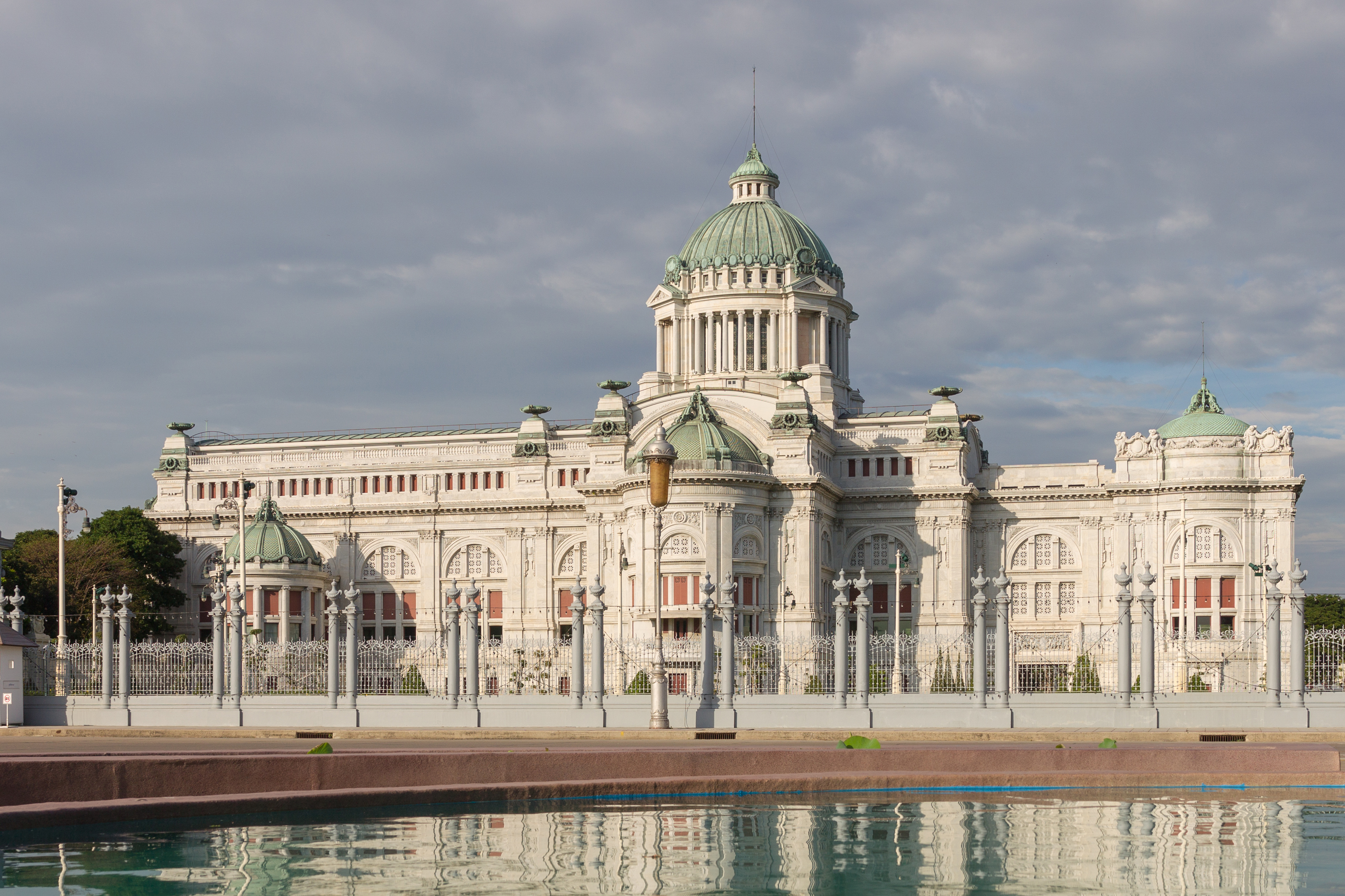
Ananta Samakhom Throne Hall
Carrara marble has no business being in Bangkok. The white stone quarried from Tuscan mountainsides belongs to Michelangelo and Roman emperors, not to the humid floodplains of the Chao Phraya River. Yet here it stands, shaped into a domed neoclassical palace that King Chulalongkorn commissioned in 1908 as the grandest reception hall his kingdom had ever seen. He named it Ananta Samakhom -- the place of immense gathering -- borrowing the name from a throne hall his father had built and then ordering that older structure demolished. The gesture was unmistakable: this would be the throne hall to surpass all others.
Italian Hands, Thai Ambition
Chulalongkorn, Rama V, laid the foundation stone on 11 November 1908, the 40th anniversary of his first coronation. The design brief called for Italian Renaissance and neoclassical grandeur, and the king initially hired the Prussian architect C. Sandreczki. But the project soon passed to two Italians, Mario Tamagno and Annibale Rigotti, with engineering by Carlo Allegri and G.E. Gollo. The sculptor Vittorio Novi and his nephew Rudolfo Nolli handled the ornamental work. Marble arrived by ship from Carrara. Construction consumed eight years, and Chulalongkorn never saw it finished -- he died in 1910, five years before the hall was completed during the reign of his son Vajiravudh, Rama VI. The new king used it for royal ceremonies and to display the European art collection he had assembled on two trips abroad.
A Dynasty in Paint and Dome
The hall rises two stories to a central dome 49.5 meters high, ringed by six smaller domes. Every ceiling and curved wall surface carries frescoes by the Italian artists Galileo Chini and Carlo Riguli, each dome telling a chapter of the Chakri dynasty. Look north and you see Rama I leading his armies home from victory over the Khmer, then ascending the throne as the dynasty's founder. The eastern dome celebrates Rama II and Rama III, whose passion for the arts filled Bangkok with royal temples. To the south, Rama V abolishes slavery -- the reformer king depicted in the very building he imagined. The western dome places Rama IV, King Mongkut, among priests of different faiths, honoring his advocacy of religious tolerance. In the central hall, art nouveau flourishes mix with royal monograms and the Garuda emblem, while European women hold flower garlands on the balcony murals -- an improbable decorative choice that speaks to the era's fascination with blending East and West.
Four Days That Changed Everything
On 24 June 1932, the Khana Ratsadon -- the People's Party -- launched the revolution that would end absolute monarchy in Siam. For four days, the plotters made this marble throne hall their headquarters, holding princes and royal ministers hostage inside walls painted with the very dynasty they aimed to constrain. The irony was architectural: a building designed to glorify royal power became the staging ground for its limitation. After the coup succeeded, Siam's first parliament, the National People's Assembly, convened inside the hall on 28 June 1932. For the next four decades, legislators debated the nation's future beneath frescoes of conquering kings. The throne hall served as the seat of the legislative branch until 1974, when a new Parliament House opened to the north and the building was returned to the royal court.
Between Palace and Public
Today the Ananta Samakhom Throne Hall occupies an unusual position in Bangkok's ceremonial landscape. It sits within the Dusit Palace compound, fronted by the Royal Plaza and the equestrian statue of King Chulalongkorn -- the man who set its construction in motion. The most visible ceremony held here is the state opening of parliament, when the king delivers a speech from the throne to open the legislative session of the National Assembly. Until October 2017, the hall was open to the public as a museum housing the Arts of the Kingdom exhibition, which showcased handicrafts sponsored by the Queen Sirikit Institute. That exhibition closed indefinitely, leaving the interior accessible only during state occasions. The marble facade still catches the Bangkok light, looking precisely as improbable as the day it arrived from Italy.
From the Air
Located at 13.7716N, 100.5131E in Bangkok's Dusit district. The white dome and neoclassical facade are visible from altitude against the green of surrounding palace grounds. Best viewed at 2,000-3,000 feet. The Royal Plaza and equestrian statue are visible in front. Nearest airport: Don Mueang (VTBD) approximately 15 nm north. Suvarnabhumi (VTBS) approximately 17 nm east-southeast.