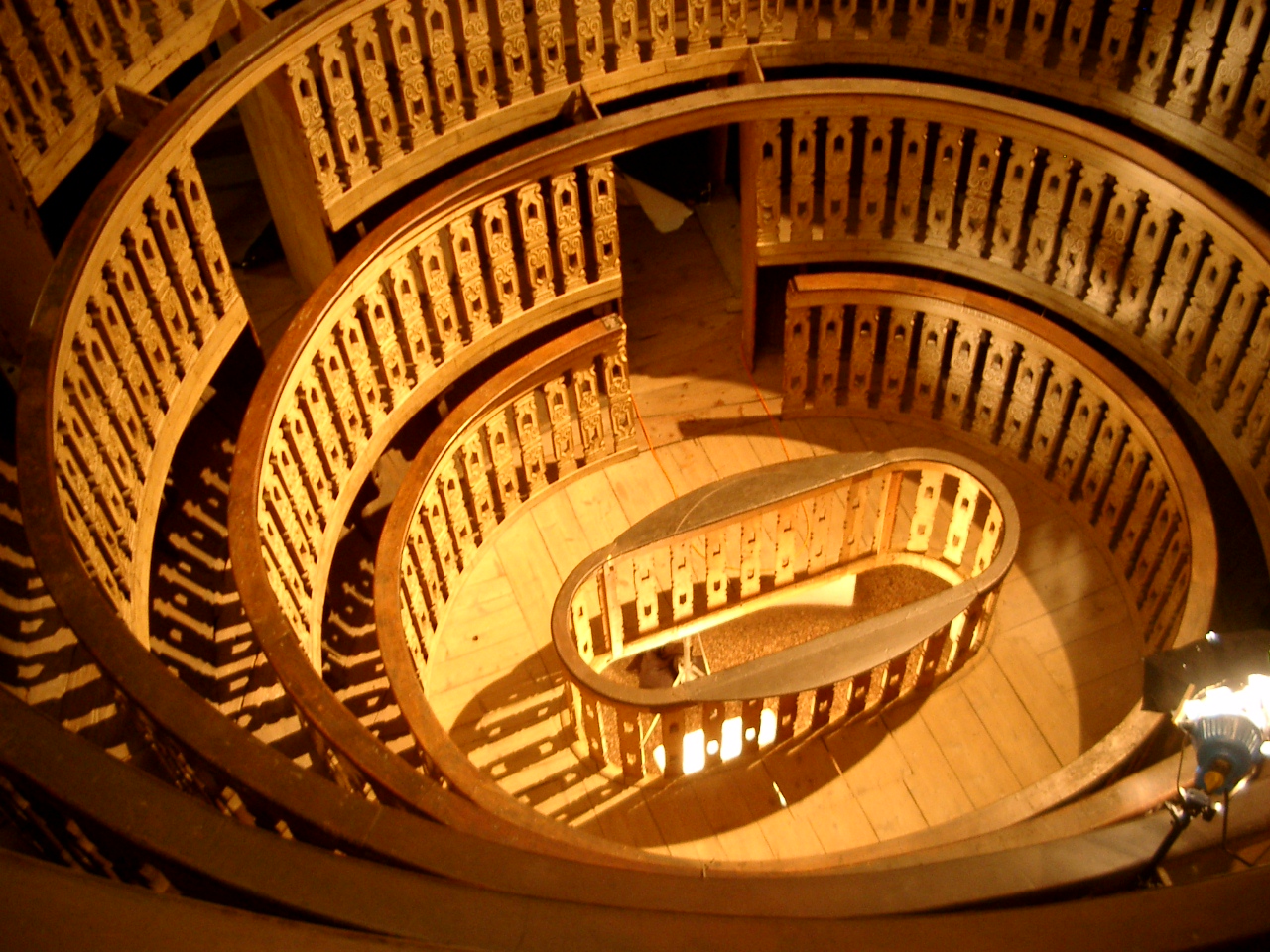
Anatomical Theatre of Padua
The room is shaped like a funnel -- an inverted cone inside a cylinder, six concentric rings of standing galleries spiraling downward toward a dissection table at the bottom. There are no seats. Students stood pressed against wooden railings, peering down into the body below. When the Anatomical Theatre of Padua opened in 1595, it was the first permanent structure in the world built for this purpose, and its design encoded a revolutionary idea: that understanding the human body required looking at it directly, not reading about it in ancient texts. Every anatomical theatre built in European universities during the 17th century would follow the Paduan model.
Three Centuries of Cutting
Padua's relationship with dissection stretches back to the 13th century, when Pietro d'Abano performed the first recorded autopsy in the city. Called from Paris to teach medicine, philosophy, and astrology, d'Abano had studied in Constantinople and translated Galen's works from Greek to Latin, spreading the Padua Studium's reputation throughout Italy. A local legend from the same era tells of St. Anthony discovering an avaricious man's heart in a basket -- the heart described with the clinical precision of direct observation, suggesting that Paduans were already comfortable looking inside corpses. By the 15th century, the university had three chairs of medicine: theoretical, practical, and surgical. In 1404, Galeazzo di Santa Sofia carried a practice he had learned in Padua to Vienna, performing what is considered the first solemn public dissection in Europe. The tradition was established long before anyone built a permanent room for it.
Vesalius and the Revolution of Seeing
The figure who transformed Padua's dissection tradition into a scientific revolution was Andreas Vesalius, a Flemish anatomist who arrived in 1537. Vesalius did not just describe anatomy -- he introduced the demonstrative method, insisting that students watch him cut, handle organs, trace the paths of vessels. His De humani corporis fabrica, published in 1543 with illustrations drawn by a student of Titian, was as much art as science: detailed depictions of dissected bodies posed in landscapes, muscles and tendons rendered with the precision of Renaissance painting. Vesalius performed his dissections on the bodies of executed criminals, and sometimes on monkeys and dogs, in a temporary wooden theatre that was assembled and dismantled for each session. The permanence of the 1595 theatre represented the final step: anatomy was no longer an occasional spectacle but a continuous discipline, deserving its own architecture.
The Architecture of Attention
Girolamo Fabrici d'Acquapendente, who held the chair of surgery and anatomy for fifty years, inaugurated the permanent theatre in 1595, designed according to plans by Paolo Sarpi and Dario Varotari. The funnel shape was not merely practical but symbolic. Its seven concentric rings have been connected to the seven heavens of the Empyrean, or the seven circles of Hell in Dante's Divine Comedy -- as if the descent into the body mirrored a descent into deeper knowledge. The professor stood below the students, working beside them rather than lecturing from above. Students could not take notes; they could only watch. In this arrangement, the traditional hierarchy of the lecture hall was inverted. Knowledge flowed upward from the opened body, not downward from the authority of a book. By 1739, the visitor Charles de Brosses would describe the space as resembling a well -- cramped, intimate, uncomfortably close to the work being done.
Survival and Transformation
The theatre remained in active use until 1872, when the medical school moved to the former convent of St. Mattia. Over the centuries, renovations addressed persistent practical problems -- in 1822, a skylight was added because the surrounding staircases blocked the windows; in 1845, the university president complained that the smell of stored corpses made the air unbreathable and that sunlight through the skylight turned the room into an oven. The roof was rebuilt without its skylight after the move, and the space entered a long period of uncertainty about its future. In the 20th century, architect Gio Ponti redesigned the interior, giving the building its present appearance while preserving the original funnel form. Today the Anatomical Theatre sits inside the Palazzo del Bo, the historic seat of the University of Padua, as both a monument to the history of medicine and a reminder of how the simple act of looking -- really looking -- at the human body changed what we know about ourselves.
From the Air
Located at 45.41N, 11.88E in central Padua, Veneto, Italy. The Palazzo del Bo, housing the theatre, is part of the University of Padua campus in the city center, near the Piazza delle Erbe. Nearby airports include Padua (LIPU) and Venice Marco Polo (LIPZ). The city's layout is defined by the Bacchiglione River and its medieval walls, visible from altitude in clear conditions.