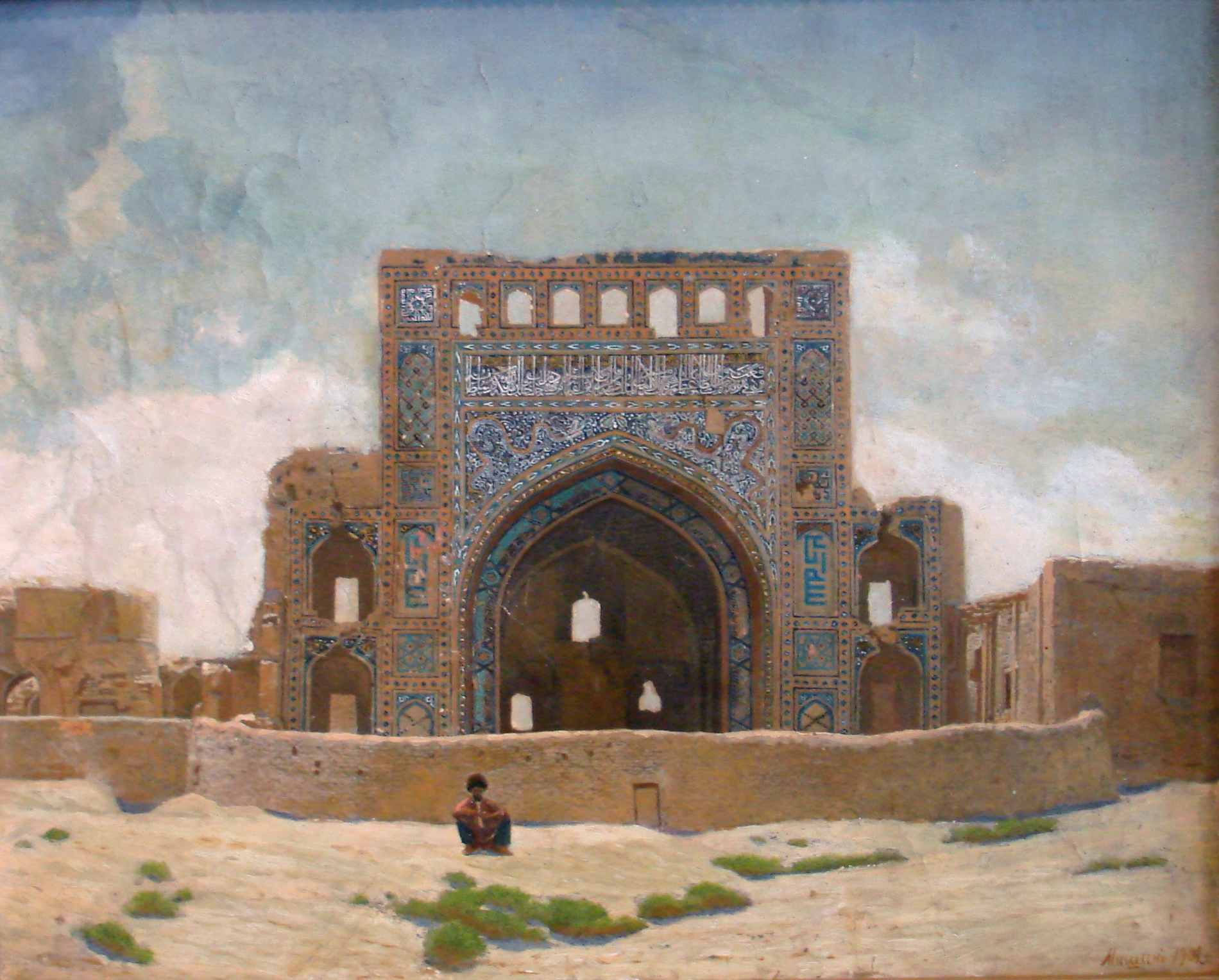
Anau, Turkmenistan
In 1866, a Russian general began digging into the mounds south of Ashgabat, convinced they held treasure. He found no gold. What the mounds actually contained was far more valuable: the remains of a farming community that had been growing barley and wheat in these foothills for more than seven thousand years. Anau -- the name comes from the Persian for "new water" -- sits just 8 kilometers south of Turkmenistan's capital, in the foothills of the Kopet Dag mountains. It served as the capital of Ahal Province until December 2022. But its real significance lies underground, in layers of ash, grain, pottery, and collapsed mudbrick that record one of Central Asia's oldest continuous human settlements.
Digging into Deep Time
The serious excavation began in 1904, when American geologist Raphael Pumpelly led an expedition funded by the Carnegie Institution of Washington. Pumpelly brought William Morris Davis as a geographer, Hubert Schmidt as an archaeologist, and Wilhelm Dorpfeld -- famous for his work at Troy -- to supervise the dig. They employed systematic stratigraphic methods, sinking shafts and galleries more than 45 feet deep into the North Mound and over 52 feet into the South Mound. What they uncovered was a prehistoric settlement stretching back to approximately 5500 BC. Pumpelly returned in 1908 for a second excavation. Decades later, in 1993, archaeologist Fredrik Hiebert led a new campaign that refined the chronology and brought modern analytical techniques to bear on the ancient deposits.
Barley, Wheat, and the Birth of Farming
The grain tells the story. Between 85 and 90 percent of the cereal remains found at ancient Anau were barley, with bread wheat making up most of the rest. The presence of plump, well-developed grains of six-row barley suggests that small-scale irrigation may have been practiced as early as the Chalcolithic period, roughly 4500 BC. Charcoal was abundant in layers dating from 4500 to 1000 BC, evidence of cooking fires, craft production, and the slow rhythms of daily life sustained across millennia. The painted pottery recovered from Anau's lowest levels shows stylistic connections to Susa I in southwestern Iran, hinting at trade networks or shared cultural traditions spanning hundreds of kilometers.
Two Mounds, Two Eras
Anau's archaeology divides neatly into two chapters. The northern settlement dates from roughly 5500 to 3000 BC -- a span of 2,500 years during which the Chalcolithic Anau culture developed its distinctive pottery, farming techniques, and village life. Around 3000 BC, habitation shifted southward. This southern site was occupied from 3000 to 1000 BC, through the Bronze Age and into the early Iron Age. Compartmented bronze seals found at the site -- depicting eagles, monkeys, and goddesses -- date to roughly 2200-1800 BC and now reside in the Museum of Fine Arts in Boston, tangible links between a Central Asian foothill village and the wider ancient world.
Ancient Roots, Modern Recognition
Anau received official city status on February 3, 2008, a bureaucratic milestone for a place that has been continuously settled for seven and a half millennia. In 2024, the city was designated "Cultural Capital of the Turkic World" by TURKSOY, the international organization for Turkic culture. The honor acknowledged what the mounds have always argued: that this stretch of foothill, watered by streams flowing down from the Kopet Dag, has been a cradle of civilization in Central Asia since long before the Silk Road, long before written history, and long before anyone thought to call it a city at all.
From the Air
Located at 37.90N, 58.50E, approximately 8 km south of central Ashgabat in the foothills of the Kopet Dag mountains. The archaeological mounds are visible as low, rounded hills in the landscape but are not prominent from high altitude. Ashgabat International Airport (ICAO: UTAA) lies roughly 15 km to the northwest. The Kopet Dag range rises sharply to the south, marking the border with Iran. Best viewed at lower altitudes on approach to or departure from Ashgabat, where the transition from flat plain to foothills is apparent.