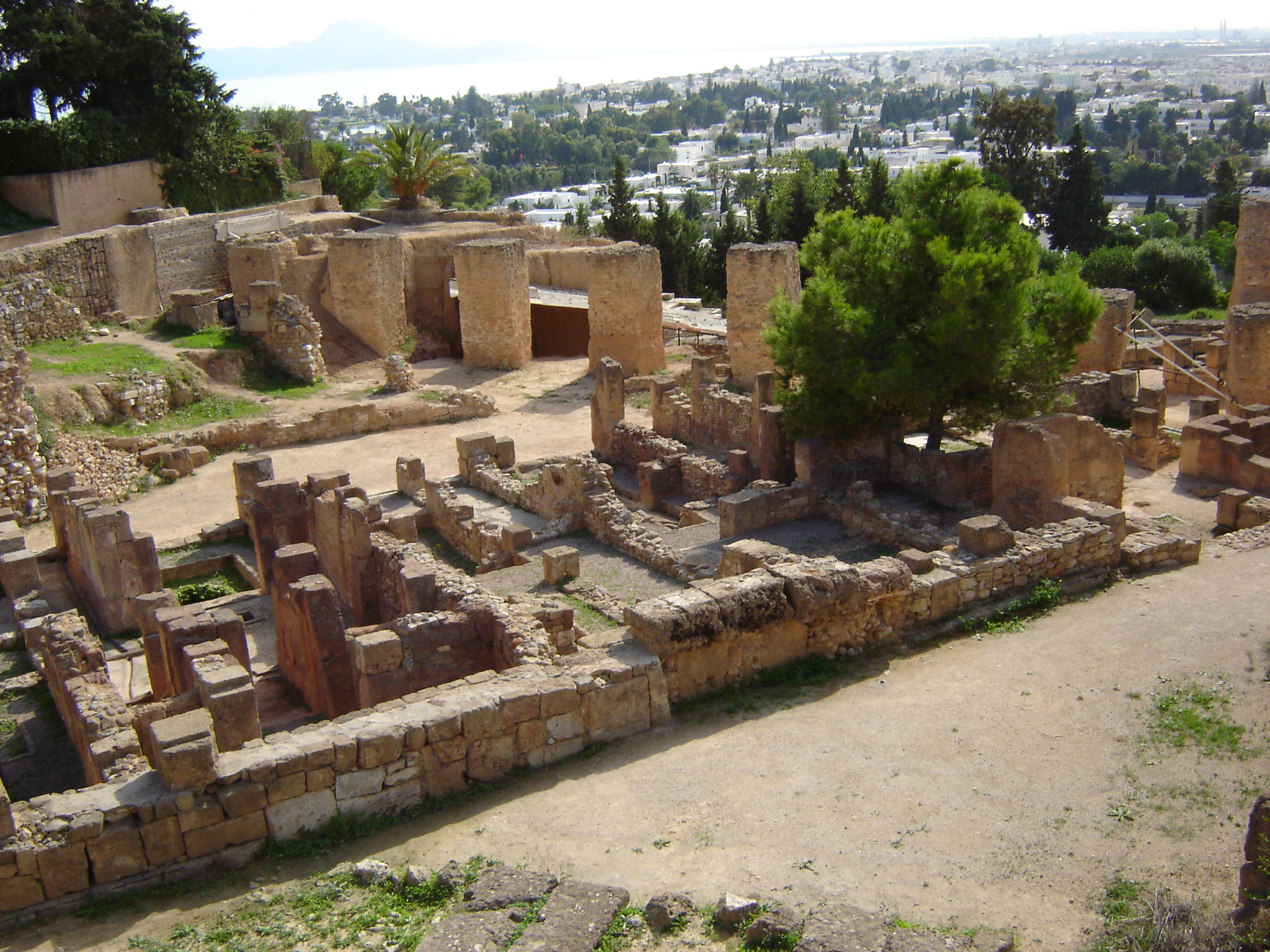
Ancient Carthage
The founding story doubles as a riddle. When Queen Dido fled her murderous brother in Tyre and landed on the North African coast, the local Berber chief offered her as much land as an ox hide could cover. She cut the hide into strips so thin they encircled an entire hill. That hill -- Byrsa, from the Phoenician word for "citadel" -- became the heart of Carthage, a city whose very name, Qart Hadasht, simply means "New City." From that clever beginning in 814 BC, Carthage would grow into the largest and wealthiest metropolis in the western Mediterranean, controlling trade routes from the Strait of Gibraltar to the coast of Sicily.
Merchants Who Built an Empire
Unlike Rome, which conquered territory through armies, Carthage built its dominion through commerce. Phoenician in origin and maritime in temperament, the city sat at the junction of the Mediterranean's two basins, commanding trade between East and West. By the fourth century BC, it controlled the coastline from Morocco to western Libya, held Sardinia, Malta, the Balearic Islands, and the western half of Sicily, and maintained colonies across southern Spain. Its empire was less a unified state than a web of treaties, tributary arrangements, and trading posts -- closer to the Athenian Delian League than to the Roman Republic. Carthaginian merchants dealt in everything from Iberian silver and tin to African ivory and grain, and their commercial fleet was the largest in the ancient world.
The Sicilian Crucible
For two centuries before Rome became a factor, Carthage's primary rival was Syracuse. Sicily -- large, fertile, and positioned at the center of all Mediterranean shipping -- was the prize both coveted. The conflicts produced staggering battles: in 480 BC, King Hamilcar led a Carthaginian force described by Herodotus as 300,000 strong (certainly exaggerated, but enormous regardless) against the tyrant Gelo at Himera. The Carthaginians lost decisively, and Hamilcar died -- either killed in battle or, by some accounts, throwing himself onto a funeral pyre in shame. The defeat prompted political reforms at home, replacing monarchy with an oligarchic republic. For the next century and a half, Carthage and Syracuse traded sieges and truces across Sicily, with plague repeatedly devastating Carthaginian expeditions at the worst possible moments.
Hannibal's Gamble
The Punic Wars with Rome lasted from 264 to 146 BC and decided the fate of the western world. The First Punic War cost Carthage Sicily and its naval supremacy. The Second Punic War produced history's most audacious military campaign: Hannibal Barca's crossing of the Alps with war elephants in 218 BC, followed by his annihilation of Roman armies at Trebia, Lake Trasimene, and Cannae, where an estimated 60,000 Romans died in a single afternoon. For over a decade, Hannibal campaigned in Italy, winning battle after battle but never taking Rome itself. The Romans, with their vast reserves of manpower, absorbed losses that would have destroyed any other state, then carried the war to Africa. At Zama in 202 BC, Scipio Africanus defeated Hannibal on Carthaginian soil. The peace terms stripped Carthage of its navy and its empire.
Delenda Est
Carthage might have survived as a diminished but wealthy trading city. By the mid-second century BC, it had paid off its war indemnity and was prospering again -- which was precisely the problem. The Roman senator Cato the Elder ended every speech in the Senate, regardless of topic, with the same phrase: Carthago delenda est -- "Carthage must be destroyed." In 149 BC, Rome manufactured a pretext and launched the Third Punic War. Despite their reduced military, the Carthaginians mounted a fierce three-year defense, repelling Roman assaults at Lake Tunis and even destroying much of the Roman fleet with fire ships. It was not enough. In 146 BC, Scipio Aemilianus breached the walls, and the city was systematically razed. Tens of thousands were killed or enslaved. The site was cursed and left desolate.
Afterlife of a Civilization
A century after its destruction, Julius Caesar ordered Carthage rebuilt. Under Augustus, the new Roman Carthage became the second-largest city in the western empire, with half a million inhabitants. But Punic culture did not simply vanish. The language persisted for centuries -- two Roman emperors of the third century AD, Septimius Severus and his son Caracalla, spoke Latin with Punic accents. Latin itself absorbed Carthaginian words: mala Punica for pomegranate, pavimentum Punicum for terracotta mosaic. The Romans even adopted the Carthaginian threshing board. Yet Roman hostility endured too. The phrase Punica fides -- "Punic faith" -- remained a common expression for treachery, a final insult from the victors who had erased a civilization but could not erase its memory.
From the Air
The site of ancient Carthage lies at 36.85°N, 10.32°E on a peninsula jutting into the Gulf of Tunis, clearly visible from altitude. The hill of Byrsa, the Punic ports (two lagoons -- one circular, one rectangular), and the Baths of Antoninus are identifiable landmarks. Tunis-Carthage International Airport (DTTA) is located just 3 km to the southwest. Best viewed at 3,000-6,000 feet to appreciate the peninsula geography and the relationship between the ancient harbor lagoons and the modern coastline.