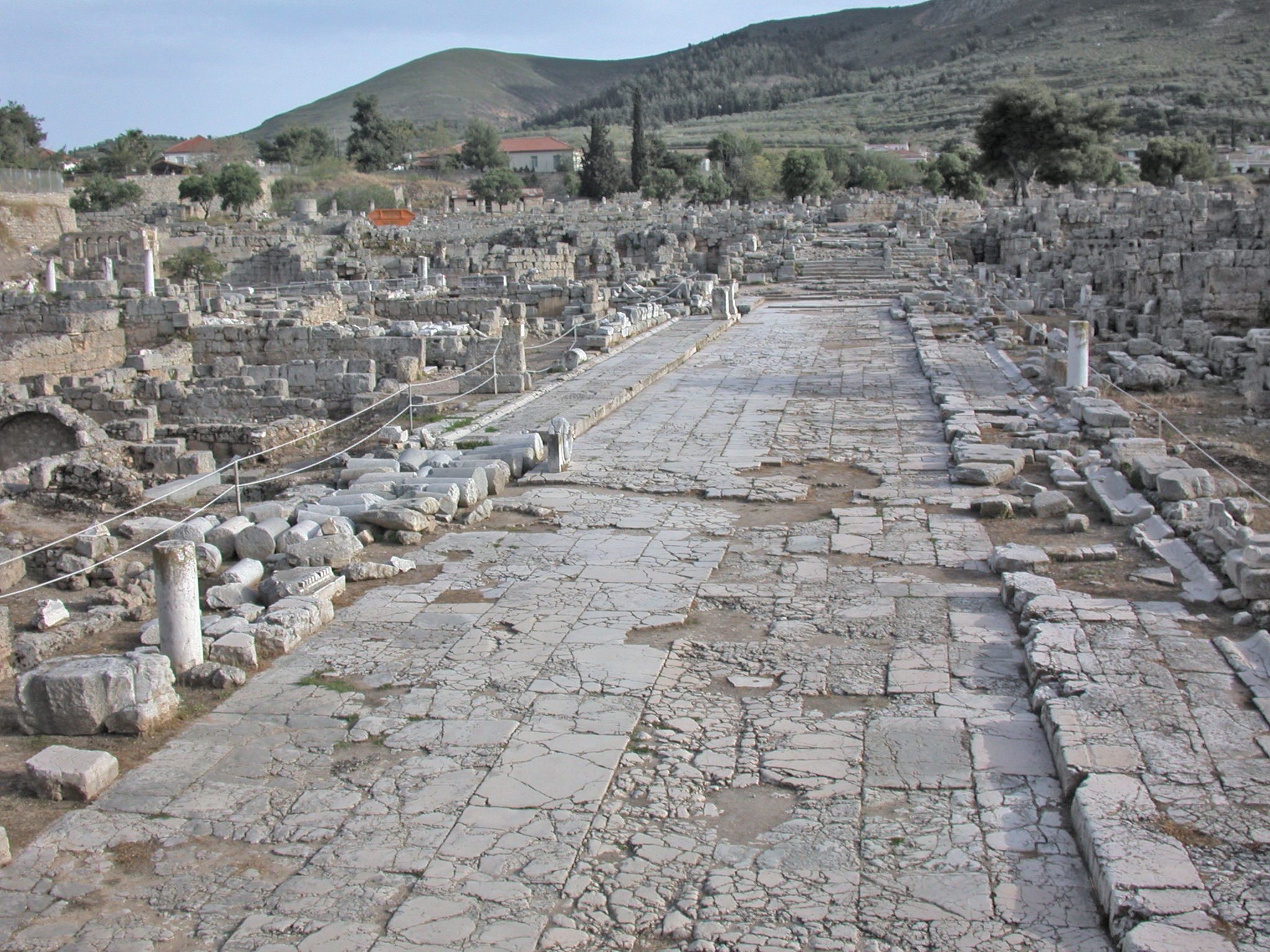
Ancient Corinth
Horace put it this way in Latin: non licet omnibus adire Corinthum, not everyone can afford to go to Corinth. The city sat on the narrow Isthmus of Corinth, the four-mile pinch of land where every cargo and every traveler crossing between the Peloponnese and mainland Greece had to pay a toll. Corinth grew rich from that geography, then richer from the trireme it invented, then richer still from temple economies that included roughly a thousand hetairai serving the goddess Aphrodite. By 400 BC, the city had a population of 90,000 people. In 146 BC, the Roman general Lucius Mummius destroyed it utterly. A century later, Julius Caesar refounded it. The story is older than that.
The Bacchiad Aristocracy and the Tyrant Cypselus
By the eighth century BC, an aristocratic clan called the Bacchiadae ran Corinth, perhaps a couple hundred adult males who took power from the last king Telestes around 747 BC and ruled by annually electing a single magistrate. Under them, Corinth became the most advanced city in Greece and founded major colonies at Corcyra in 733 BC and Syracuse the same year. Then came the prophecy. Herodotus reports that the Bacchiadae heard from the Delphic oracle that the son of a man named Eëtion would overthrow their dynasty. Eëtion's wife Labda gave birth to a baby named Cypselus, and the men sent to kill the infant could not bring themselves to do it; the baby smiled at each of them. Labda hid him in a chest. Cypselus grew up, used his position as polemarch to expel the Bacchiadae in 657 BC, and ruled Corinth as tyrant for thirty years. He needed no bodyguard. He died of old age.
Periander and the Diolkos
Cypselus's son Periander succeeded him in 627 BC and ruled for forty years. He was counted among the Seven Wise Men of Greece, struck the city's first coins, and tried to dig a canal through the Isthmus to connect the Aegean and the Ionian Sea. He gave up. The technology of the sixth century BC could not move that much rock. Instead he built the Diolkos, a paved overland ramp where ships could be hauled across the Isthmus on rollers, charging tolls for the service. The Diolkos worked. Some of the limestone paving still survives. Periander's reign was prosperous, but personally tragic. He killed his wife Melissa in a rage. His son Lycophron, learning what had happened, refused to speak to his father and was exiled to Corcyra. When Periander tried to bring him home, the Corcyreans, terrified of having Periander rule them, killed Lycophron instead.
The Three Orders and the Trireme
In the classical period, Corinth's rivalry with Athens and Thebes was the rivalry of equals. Until the mid-sixth century BC, Corinth dominated the Greek pottery trade with its black-figure ceramics. Corinthian architects gave the world the third order of classical architecture, the elaborate Corinthian column with its acanthus-leaf capital, while the Doric expressed Spartan severity and the Ionic an Athenian middle path. Thucydides credits the Corinthians with the trireme, the three-banked warship that became the standard naval vessel of the Mediterranean for nearly a thousand years. During the Persian Wars, Corinth contributed 400 hoplites to defend Thermopylae and 40 warships at Salamis under the admiral Adeimantos. At Plataea, 5,000 Corinthian hoplites fought in their distinctive helmets. Herodotus, who is generally said to have disliked the city, conceded that the Corinthians were considered the second-best fighters of all the Greeks, after the Athenians.
The Roman Year Zero
In 146 BC, after a long political dispute over the Achaean League, Rome sent the consul Lucius Mummius against Corinth. The army sacked the city, killed many of its men, sold the women and children into slavery, and demolished the buildings. The empty site sat almost vacant for a century. In 44 BC, just before his assassination, Julius Caesar refounded Corinth as a Roman colony, and the city quickly became the provincial capital of Achaea. The new Corinth filled with Roman citizens, freed people, and Greek-speaking immigrants from the eastern Mediterranean. Around AD 50, Paul the Apostle arrived, stayed eighteen months, and wrote letters back to the community he had founded that became the First and Second Epistles to the Corinthians. Systematic excavations of the site have continued under the American School of Classical Studies at Athens since 1896. The seven standing columns of the Temple of Apollo, built around 540 BC, survived both the Roman destruction and most of what came after.
From the Air
Ancient Corinth ruins at 37.9061°N, 22.8783°E, on the south side of the Isthmus of Corinth, about 80 km west of Athens. Acrocorinth, the city's massive limestone acropolis, rises 575 m above the ruins to the south. Visual altitudes 3,000-5,000 ft. The Corinth Canal, finally cut in 1893, slices the Isthmus 6 km north of the ruins. Athens International (LGAV) lies 47 nm east. Coastal weather is reliably clear; afternoon thermals build over the Peloponnesian highlands.