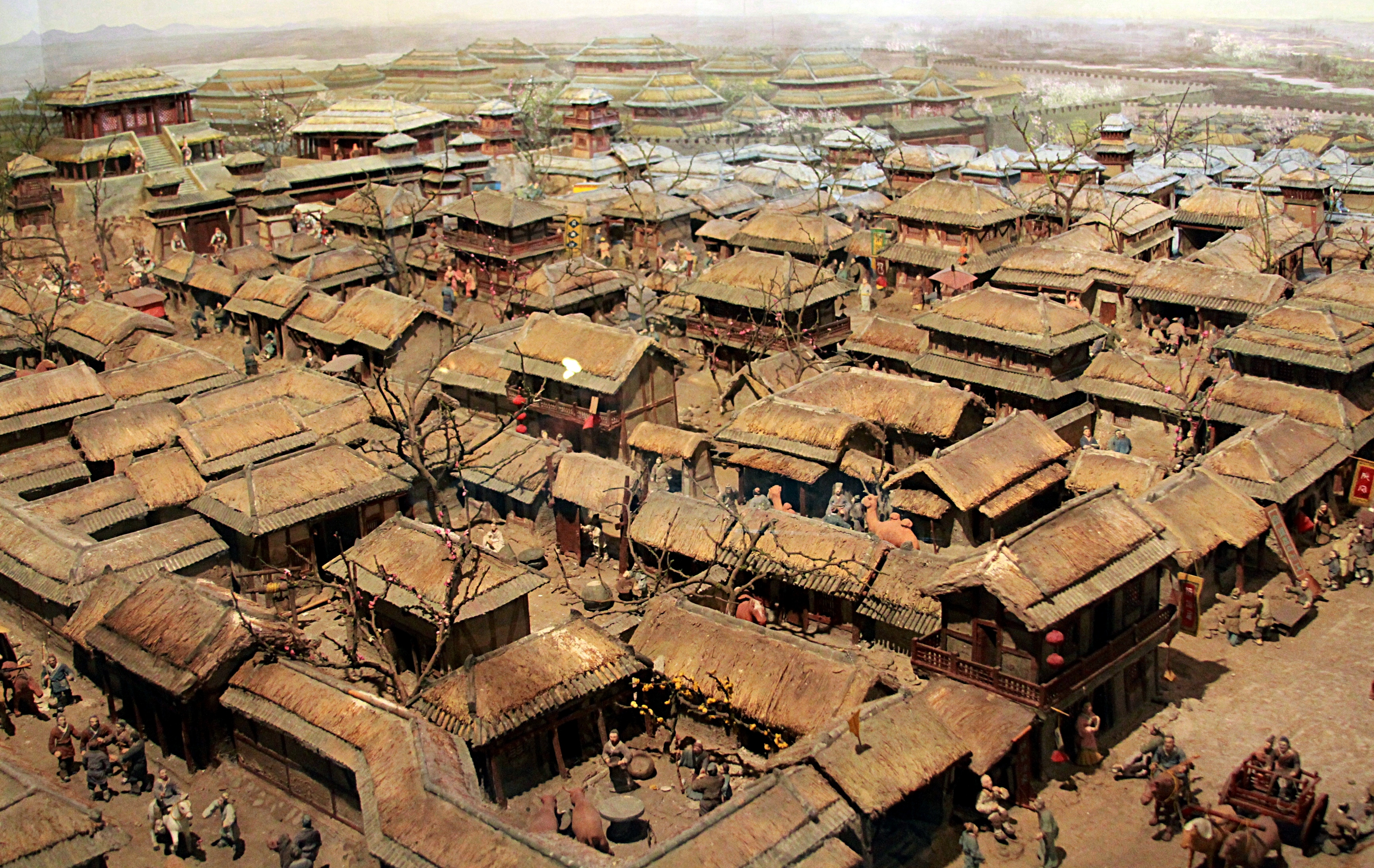
Ancient Linzi
Six hundred horses, arranged in two neat rows. That is what archaeologists found in the burial pits near the tomb of Duke Jing of Qi, outside the walls of ancient Linzi. The sheer scale of the sacrifice -- horses that would have represented enormous wealth in the 5th century BC -- tells you something about the city they surrounded. Linzi, capital of the Qi state, was one of the largest and richest cities in China during the Spring and Autumn period, a metropolis of 70,000 households according to the Records of the Grand Historian, built between two rivers in what is now Shandong Province.
A City Between Rivers
Linzi was engineered to impress. Built between the Zi River to the east and the old course of the Xi River to the west, the city covered approximately 668 square kilometers -- vast by the standards of any ancient civilization. A 14-kilometer wall of rammed earth enclosed the outer city, with walls reaching a maximum base width of 43 meters. The inner city walls were even more massive, up to 60 meters wide at the base. Seven broad avenues, some 20 meters wide and over 4 kilometers long, formed a rough grid pattern. The city had a sewer and water supply system -- infrastructure that many European cities would not match for another two millennia. A rammed-earth platform in the inner city, known as the Duke Huan platform, still rises 14 meters above the ground, measuring 86 meters on a side.
Where Philosophy Was Paid For
Between roughly 315 and 285 BC, the kings of Qi sponsored the Jixia Academy in Linzi -- the earliest and largest center of learning in Chinese history up to that point. The academy was an extraordinary experiment in state-funded intellectual life. Chosen scholars received a handsome stipend from the government in return for advising the king on governance, ritual, and philosophy. The roster of Jixia scholars reads like a who's who of Chinese thought: Mencius, whose ideas about benevolent government would shape Confucianism for centuries; Xun Zi, who taught both Han Fei (the theorist of legalism) and Li Si (the prime minister who helped unify China); and Shen Dao, an early proponent of governance by law. The academy may have taken its name from the Ji gate nearby, but its influence radiated far beyond any city wall.
The Last City to Fall
Linzi's importance can be measured by the fact that it was the last major capital conquered by Qin Shi Huang -- the man who would become China's first emperor. In 221 BC, the Qin army occupied Linzi, and with its fall, the Qi state ceased to exist. The unification of China was complete. King Ying Zheng of Qin declared himself emperor shortly afterward, beginning the imperial system that would endure, in various forms, for over two thousand years. The city itself continued to be inhabited, but it never regained its former significance. The ruins were first excavated by Japanese archaeologists in 1926 and again by Chinese archaeologists in 1964.
What the Horses Tell Us
More than 100 tumuli surround the ruins of Linzi, some as far as 10 kilometers from the old city walls. Many were looted in antiquity, their contents scattered or destroyed. But the horse sacrifice pits near Duke Jing's tomb survived intact, and they speak to a culture of lavish aristocratic burial that valued horses as symbols of military power and personal prestige. Six hundred animals, killed and carefully arranged in rows -- not piled or discarded but placed with ritual precision. Whether you see this as a testament to the Qi state's wealth or as evidence of its cruelty depends on how you read the ancient world. Either way, the horses endure as the most visceral artifact of Linzi's greatness: a city so rich it could bury its status symbols six hundred at a time.
From the Air
Ancient Linzi is located at approximately 36.890N, 118.338E in modern Linzi District, Shandong Province. The site is inland, about 200 km west of Qingdao. The archaeological area is within the urban footprint of modern Zibo. Nearest airports: ZSJN (Jinan Yaoqiang International Airport) and ZSQD (Qingdao Jiaodong International Airport). The rammed-earth platforms and tumuli may be visible from low altitude.