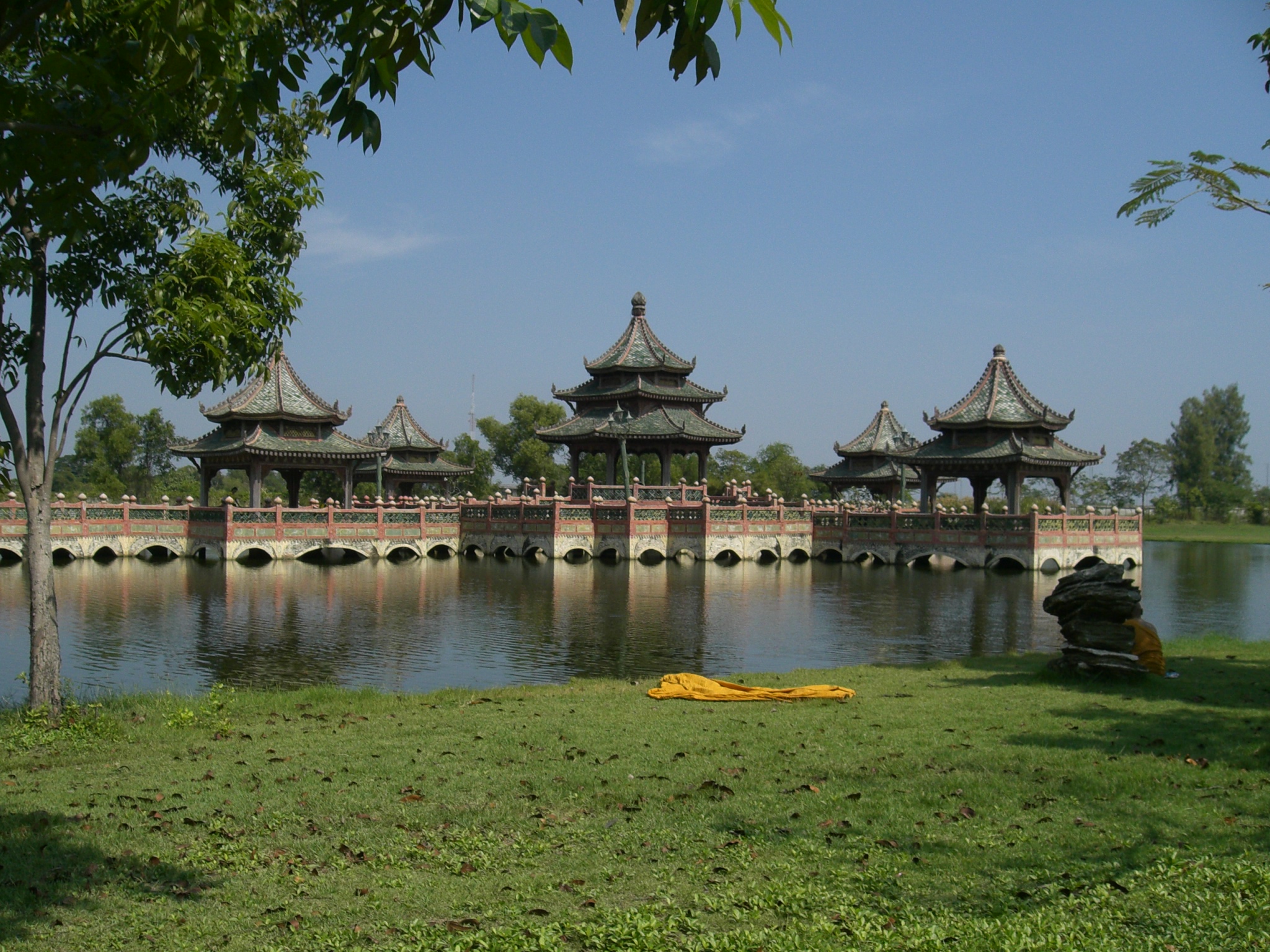
Ancient Siam
It was supposed to be a golf course. Lek Viriyaphan, a Thai businessman with a lifelong passion for art, originally planned to build a course in the shape of Thailand's map, dotting the fairways with miniature replicas of the kingdom's most important monuments. Then he started researching those monuments and discovered how many of the originals had crumbled into neglect. The golf course became something else entirely: a 320-hectare open-air museum in Samut Prakan province, south of Bangkok, where 116 structures representing centuries of Thai architecture stand in their approximate geographic positions on a plot of land shaped like the country itself. Walk from south to north across Ancient Siam and you cross Thailand.
A Country in Miniature
The scale of the concept is staggering. Ancient Siam -- also known as Muang Boran, or Ancient City -- is often called the world's largest outdoor museum. The park's layout mirrors the shape of the Thai kingdom, with each replica positioned to correspond roughly with the real monument's location. The Grand Palace of Ayutthaya, destroyed during the Burmese invasion of 1767 and never rebuilt, stands in the central region of the park. The Phimai Sanctuary, a Khmer-era temple complex in Nakhon Ratchasima, occupies the northeast. Phra Viharn, the cliffside temple on the Cambodian border, sits near the eastern edge. Some structures are full-scale reproductions of existing sites. Others are scaled-down versions. Still others are creative interpretations -- not replicas of specific buildings but designs inspired by historical architectural traditions. The National Museum provided experts to ensure historical accuracy in the reconstructions, giving the park a scholarly foundation beneath its spectacle.
The Collector's Obsession
Lek Viriyaphan did not stop at Ancient Siam. The same impulse that converted a golf course into a museum drove him to build the Sanctuary of Truth in Pattaya -- an entirely wooden temple constructed without nails -- and the Erawan Museum in Samut Prakan, topped by a three-headed elephant standing 29 meters tall. He worked on all three projects simultaneously until his death on November 17, 2000. Ancient Siam was his first and largest creation, and it attracted remarkable attention. King Bhumibol Adulyadej and Queen Sirikit visited the park in 1971, bringing all of their royal children. The following year, on February 11, 1972, they returned with Queen Elizabeth II and the Duke of Edinburgh. The royal party toured the reconstructed monuments by vehicle, a British queen and a Thai king driving through a miniature kingdom together.
Eleven Centuries on Foot
The park's structures span Thai architectural history from the prehistoric era through the Rattanakosin period -- roughly eleven centuries of building tradition arranged chronologically. The earliest influences visible are Dvaravati, the Mon Buddhist culture that flourished in central Thailand from the 6th to the 11th centuries. Srivijaya, the maritime empire based in Sumatra that influenced southern Thailand, is represented alongside Angkor-period Khmer structures that shaped the northeast. The Lanna kingdom of the north, the Sukhothai period that produced some of Thailand's most refined Buddhist art, and the Ayutthaya era that dominated the kingdom for over four centuries all have dedicated sections. The Rattanakosin period -- the current dynasty's era, beginning in 1782 -- completes the chronological arc. Walking through the park, the architectural vocabulary shifts noticeably: from the heavy stone prangs of Khmer influence to the elongated curves of Sukhothai stupas to the ornate gilding of the Bangkok period.
Preservation Through Reproduction
Ancient Siam raises a question that conservation purists have debated since its founding: does a replica preserve heritage or diminish it? Lek Viriyaphan's answer was pragmatic. Many of the originals were in ruins, neglected by government agencies with limited budgets and competing priorities. The Grand Palace of Ayutthaya existed only in archaeological fragments and historical descriptions. By reconstructing it in full, Ancient Siam gave visitors a physical encounter with a building that fire and war had erased from the landscape centuries ago. The park has also served unexpected roles in Thai public life. In 2006, the television show America's Next Top Model used the Pavilion of the Saint as a runway for its Season 6 finale -- the largest model platform in the show's history, set against the backdrop of the reconstructed Sanphet castle. Lek Viriyaphan built Ancient Siam to educate younger generations about their heritage. He could not have predicted all the forms that education would take.
From the Air
Ancient Siam sits at 13.5458N, 100.6281E in Samut Prakan province, south of Bangkok near the coast of the Gulf of Thailand. From the air, the park's distinctive Thailand-shaped outline is clearly visible, covering 320 hectares of flat coastal land. The green parkland stands out against the surrounding urban and industrial development. Best viewed at 3,000-5,000 feet AGL to appreciate the country-shaped layout. The nearest major airport is Suvarnabhumi (VTBS), approximately 15 km to the northeast. The Samut Prakan Crocodile Farm is adjacent to the park. The Gulf of Thailand coastline lies just to the south, providing good visual reference.