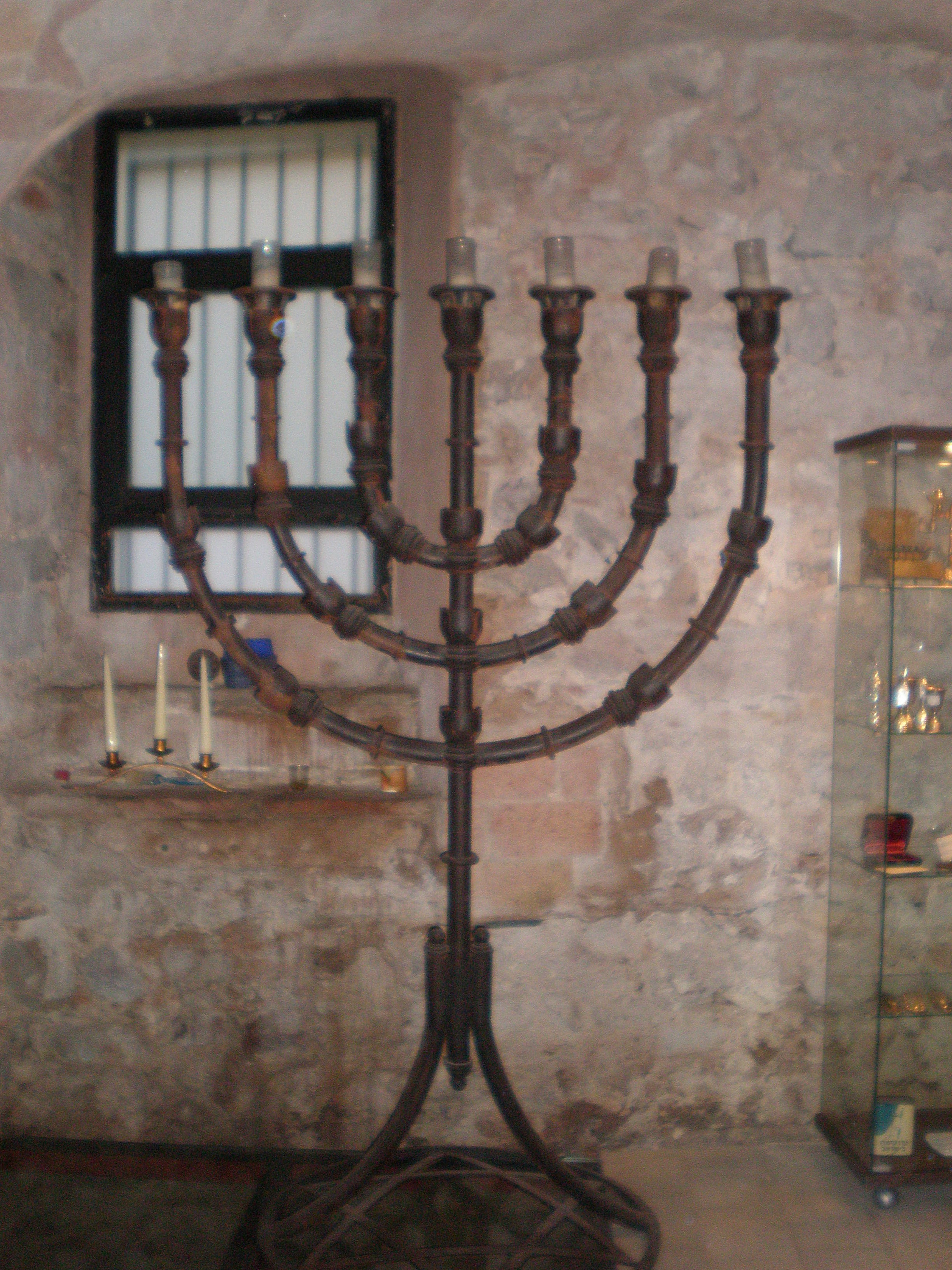
Ancient Synagogue of Barcelona
Follow a tax collector's footsteps. In 1987, the historian Jaume Riera y Sans was studying a thirteenth-century document that described the route a royal tax collector took through Barcelona's Jewish quarter -- the Call -- collecting levies from synagogue to synagogue. The route ended at the Sinagoga Major, the main synagogue. Riera traced that route onto a modern map and arrived at an unremarkable building on Carrer de Marlet, in the tangle of medieval lanes behind the cathedral. The building had been a warehouse, a shop, various things. Nobody remembered it had once been a synagogue.
Older Than Memory
Dating to as early as the 3rd century, the Ancient Synagogue of Barcelona has been described as the oldest in Spain and one of the oldest in Europe. Medieval Barcelona had several synagogues, but the Sinagoga Major was the most important. King James I of Aragon visited it in 1263 at the conclusion of the Barcelona Disputation -- a formal theological debate between the Dominican friar Pablo Cristiani and the rabbi Nachmanides that remains one of the most famous interfaith encounters of the Middle Ages. Shlomo ben Aderet, the most influential leader of Spanish Jewry in his era, served as rabbi of the Sinagoga Major for fifty years during the late 13th century. The building's orientation toward Jerusalem and its two windows conform to Jewish religious law, details that would prove critical in its eventual identification.
The Massacre and the Forgetting
In 1391, anti-Jewish riots swept across the Iberian Peninsula. In Barcelona, the Jewish community of the Call was massacred. Survivors faced forced conversion or exile. The synagogue, stripped of its purpose, was converted to other uses. Over the following centuries, additional stories were built on top of the original structure. The building changed hands, changed functions, and changed beyond recognition. Its identity as a place of Jewish worship was completely forgotten -- buried not underground but in plain sight, hidden by the accumulated weight of six hundred years of indifference. The Call itself became just another neighborhood of narrow streets and aging buildings, its Jewish history erased from public memory.
A Detective Story in Stone
Riera's archival research led Miguel Iaffa to examine the building's exterior. What Iaffa found confirmed the hypothesis: the structure's orientation faced Jerusalem, and it retained two windows consistent with halakhic requirements for a synagogue. When the owner put the building up for sale in 1995, Iaffa purchased it. The Call Association of Barcelona, which he led, undertook the painstaking work of restoration, peeling back centuries of alterations to reveal the original structure beneath. In 2002, the Sinagoga Major reopened -- this time as a synagogue and Jewish museum, the first Jewish worship in the building in over six hundred years. By 2005, it was drawing 20,000 visitors annually.
A Living Inheritance
The Ancient Synagogue is not a museum piece frozen in time. It hosts B'nei Mitzvah ceremonies and weddings -- in 2003, a couple from Montreal held the first wedding in the synagogue in six centuries. In 2006, a New York attorney donated a 500-year-old sefer Torah to the collection. The building sits in what is now one of Barcelona's most fashionable neighborhoods, the Gothic Quarter, where tourists browse boutiques in buildings that once housed the largest Jewish community in Catalonia. The synagogue's story is ultimately one of recovery -- not just of a building, but of an identity that persecution tried to erase and time nearly finished the job. That a tax collector's route, written down seven centuries ago, led to its rediscovery gives the story the quality of a parable about what survives when everything else is lost.
From the Air
Located at 41.38N, 2.18E in Barcelona's Gothic Quarter (Barri Gotic), within the medieval street grid of the Ciutat Vella. The synagogue is on Carrer de Marlet, a narrow lane near Barcelona Cathedral. Barcelona-El Prat Airport (LEBL) is 12 km southwest. The site is invisible from altitude -- it sits within the dense medieval core -- but the Gothic Quarter is identifiable as the oldest section of the city between La Rambla and Via Laietana.