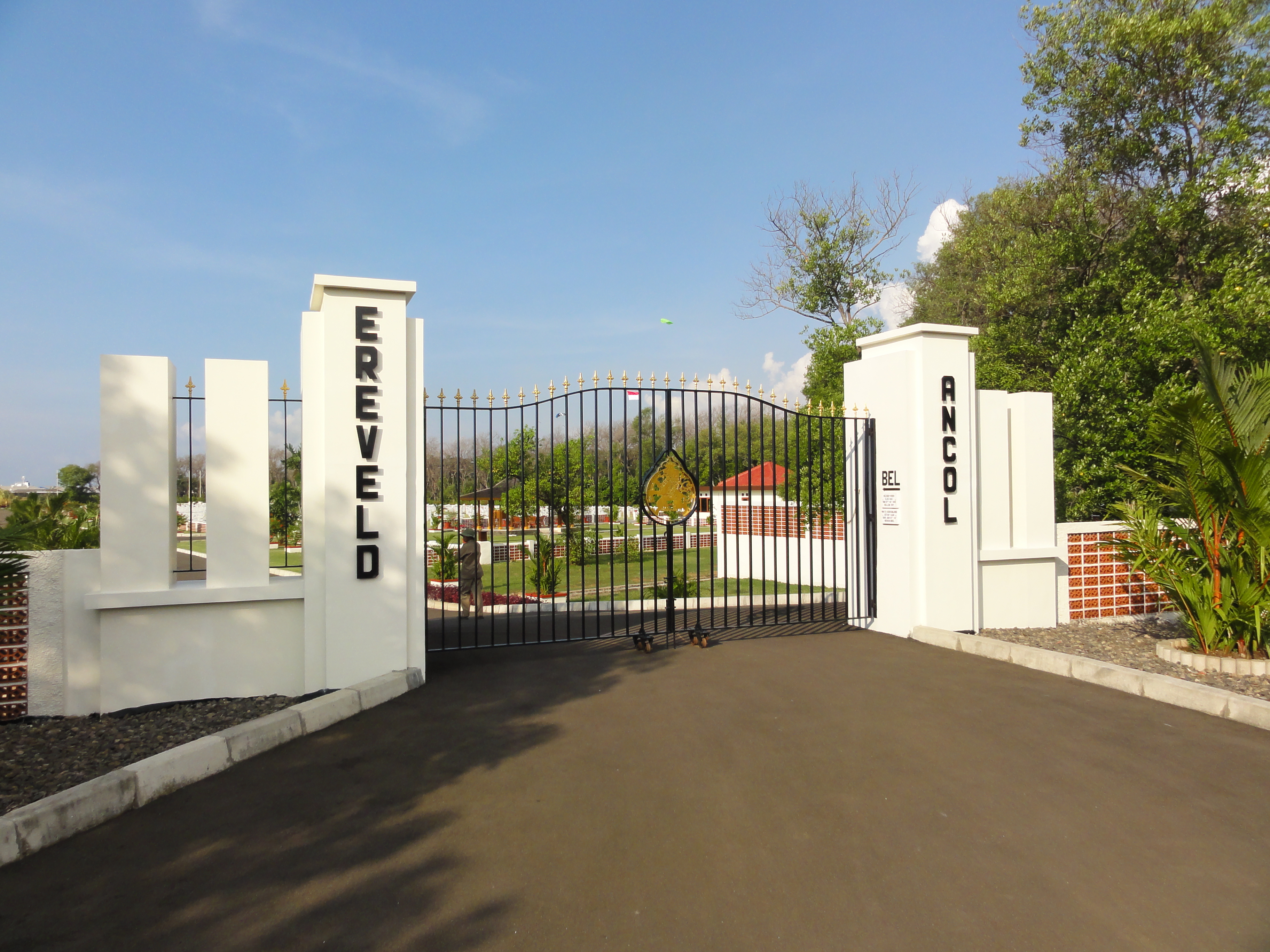
Ancol War Cemetery
The inscription on the crude cement gravestone said only two words in Japanese: "cemetery - deceased." When Dutch investigators first reached the swampy site at Ancol in June 1946, that anonymous marker and a wooden cross were all that remained of the execution ground where the Kempeitai, Japan's feared military police, had killed hundreds of resistance fighters during the occupation of the Dutch East Indies. Beneath the neglected earth lay the bodies of soldiers, civilians, and scholars who had defied the occupiers - their identities unknown, their fates unrecorded, their graves unmarked. What happened next transformed this killing field into a place of solemn remembrance.
The Killing Ground
Ancol - spelled Antjol before Indonesia's 1972 orthography reform - was a swampy, isolated stretch of Jakarta's northern coast. Its remoteness made it ideal for the purposes of the Kempeitai, who used it as both a field of execution and a mass grave during the Japanese occupation from 1942 to 1945. The victims came from across the resistance movement: military officers, reserve soldiers, academics, and civilians who had refused to submit to occupation. Among them was Professor Achmad Mochtar, a distinguished scientist who died in 1945. Officers like Colonel G.F.V. Godenson and Captain L.A. Vellenga perished alongside lieutenants barely in their twenties. More than 2,000 people were buried at Ancol, including 1,328 confirmed members of the resistance against Japanese occupation.
Unearthing the Truth
After Japan's surrender on 15 August 1945, a temporary British military administration took charge of the Dutch East Indies. The Dutch Temporaire Krijgsraad launched investigations into Japanese war crimes across the Indonesian archipelago, but it took months before anyone looked at Ancol. When graves registration personnel from the Royal Netherlands Army finally arrived in June 1946, they found the site neglected and overgrown. The investigation served a dual purpose: documenting the dead and building cases for war crimes trials. In preparation for prosecuting the staff of the Kempeitai headquarters in Batavia, some of the accused were brought from prison to Ancol and interrogated at the very site of their crimes. A temporary wooden monument replaced the Japanese gravestone, bearing a Dutch inscription that translated to "Their spirit has conquered, 1942-1945."
A Grand and Emotional Tribute
On 14 September 1946, Ancol War Cemetery was formally inaugurated - the first war cemetery in the southwest Pacific constructed by the Royal Netherlands Army Graves Service. The ceremony was grand and deeply emotional. The Dutch flag was draped over the monument while gravestones were decorated with palm branches, rose petals scattered across every grave. Civilians from multiple nations and soldiers alike lined up around the monument in tribute. The dignitaries who attended reflected the international weight of the occasion: Lieutenant Governor-General H.J. van Mook, Lieutenant General S. Spoor, Vice Admiral A.S. Pinke, and British General E.C. Mansergh, then Commander-in-Chief of Allied Forces in the Netherlands East Indies. Consular representatives from the United States, France, and China stood among the mourners, acknowledging losses that crossed borders.
Quiet Ground in a Restless City
Today Ancol War Cemetery is one of two Dutch war cemeteries in Jakarta, the other being Menteng Pulo War Cemetery in the Tebet district. The cemetery sits in Ancol, a northern neighborhood of the Indonesian capital that has since grown into a busy urban area anchored by the Ancol Dreamland entertainment complex nearby. The contrast is striking - amusement parks and waterfront development surround a site where the executed were once buried in anonymous mass graves. The Netherlands War Graves Foundation maintains the cemetery, ensuring that the rows of headstones and the grounds remain dignified. Each grave represents a life cut short by occupation: young lieutenants in their twenties, seasoned colonels, reserve officers, employees of trading syndicates, and those caught up in the Hilgers affair. For their descendants and for the Dutch community, Ancol remains a place of pilgrimage - proof that even in a swamp chosen for its remoteness, memory refused to be buried.
From the Air
Located at 6.12S, 106.85E in northern Jakarta, near the coast. The cemetery is in the Ancol district, close to the Ancol Dreamland waterfront area. Nearest major airport is Soekarno-Hatta International (WIII), approximately 20 km to the west. Halim Perdanakusuma Airport (WIHH) lies to the southeast. Best viewed at low altitude; the cemetery is a small green rectangle amid dense urban development along Jakarta's northern waterfront.