Ancon Hill
When Panama regained control of this 199-meter hill in 1977, the government's first act was not to build on it, develop it, or rename it. It was to fly a flag. The massive Panamanian flag that now billows at the summit of Cerro Ancon is visible across the capital, a statement written in fabric and wind. For more than seven decades, this green knob of jungle rising from the center of Panama City belonged to the United States -- the administrative heart of the Canal Zone, crowned with military bunkers and the governor's residence. Its return was not a footnote in a treaty. It was the treaty's emotional core.
The Pirate's Lookout
Ancon Hill entered recorded Western history through violence. In 1671, the privateer Henry Morgan landed on the Pacific coast of Panama with destruction on his mind. Before sacking Panama City -- then known as Panama Viejo -- his scouts climbed Ancon Hill to survey the defenses below. What they saw helped Morgan plan an assault that would burn the city to the ground. The new Panama City, rebuilt a few kilometers southwest on a rocky peninsula, grew up in the shadow of the same hill Morgan's men had used as a vantage point. The irony was not lost on later generations: the hill that had helped destroy old Panama watched over the new one like a silent guardian, its jungle slopes indifferent to the centuries of change at its feet.
Jungle Island in a Concrete Sea
From the air, Ancon Hill looks like a mistake -- a dense green mound surrounded by the glass and concrete of a modern capital. Because it was restricted military land for so long, the hill was never developed, and its tropical forest survived while the city grew around it. Today that accident of geopolitics is a biological refuge. Sloths hang in the canopy. White-nosed coatis forage along the trails. Geoffroy's tamarins, a small monkey species endemic to Panama and Colombia, leap between branches just minutes from downtown traffic. Nine-banded armadillos shuffle through the underbrush, and deer occasionally appear on the upper slopes. The hill's protected status -- it now serves as a nature reserve -- preserves this unlikely pocket of wilderness. A 30-minute hike along a paved one-way road leads to the summit, passing broadcast towers and the remnants of a very different era.
Command and Control
The lower slopes of Ancon Hill once housed Gorgas Hospital, named for the army surgeon William Crawford Gorgas, whose campaigns against yellow fever and malaria made the Panama Canal possible. Higher up sat the residence of the Governor of the Canal Zone, and higher still was Quarry Heights, headquarters of the United States Southern Command. The name Quarry Heights was literal: a massive rock quarry had carved away one side of the hill, leaving a visible cliff face that still scars the landscape. An abandoned underground bunker, once manned by Southern Command, remains inside the hill -- sealed, inaccessible, a Cold War relic buried beneath tropical vegetation. The hill was, in short, the nerve center of American power in Central America, wrapped in jungle camouflage.
A Name, a Poem, a Ship
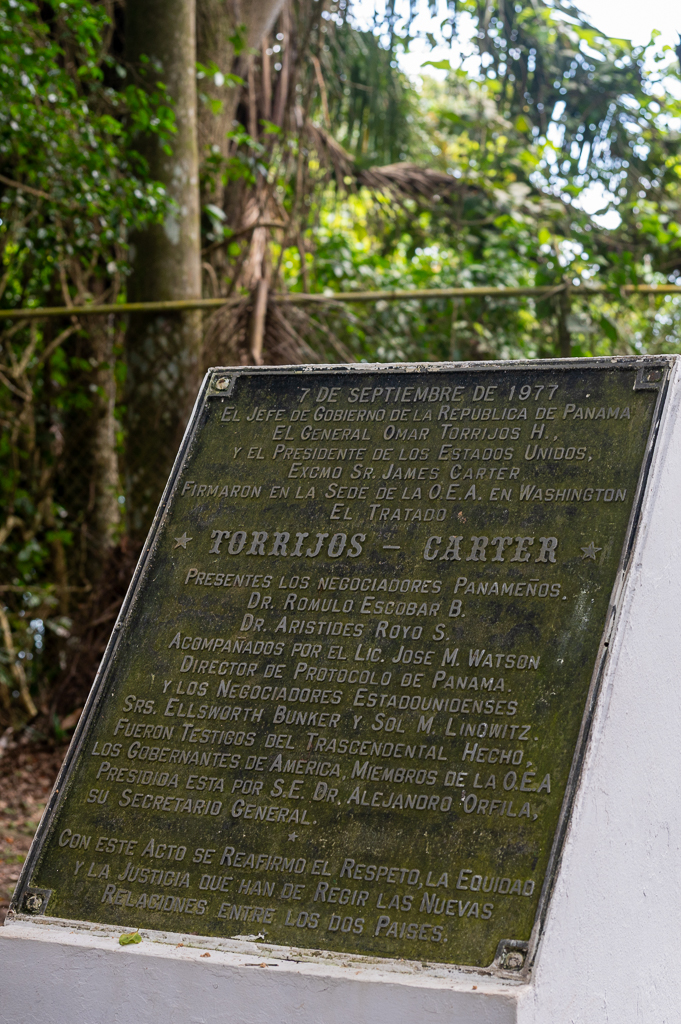
Ancon Hill has threaded itself through Panamanian identity in unexpected ways. In 1906, the poet Amelia Denis de Icaza wrote a poem mourning the hill's annexation into the Canal Zone, turning a geographic feature into a national symbol of lost sovereignty. The hill's name echoed further: the SS Ancon, the first ship to officially transit the Panama Canal in 1914, took its name from the hill and its surrounding township. Even the Panamanian environmental organization ANCON -- the Asociacion Nacional para la Conservacion de la Naturaleza -- adopted the hill's name as its acronym. When the Torrijos-Carter Treaties returned the hill to Panama in 1977, the flag-raising ceremony at the summit was broadcast across the nation. The hill that had been taken for a canal became the symbol of what the canal could not take: a country's sense of itself.
From the Air
Located at 8.957N, 79.549W, Ancon Hill is the most prominent terrain feature in Panama City at 199 meters (653 feet). It is unmistakable from the air -- a densely forested green dome surrounded by urban development on all sides, with two broadcast towers at the summit and a large Panamanian flag visible from distance. The exposed quarry cliff face on one side provides an additional visual reference. Nearest airport is Marcos A. Gelabert International (MPMG/PAC) at Albrook, immediately southwest of the hill. Tocumen International (MPTO) is 18 km east. Maintain altitude above 1,000 feet AGL when overflying.