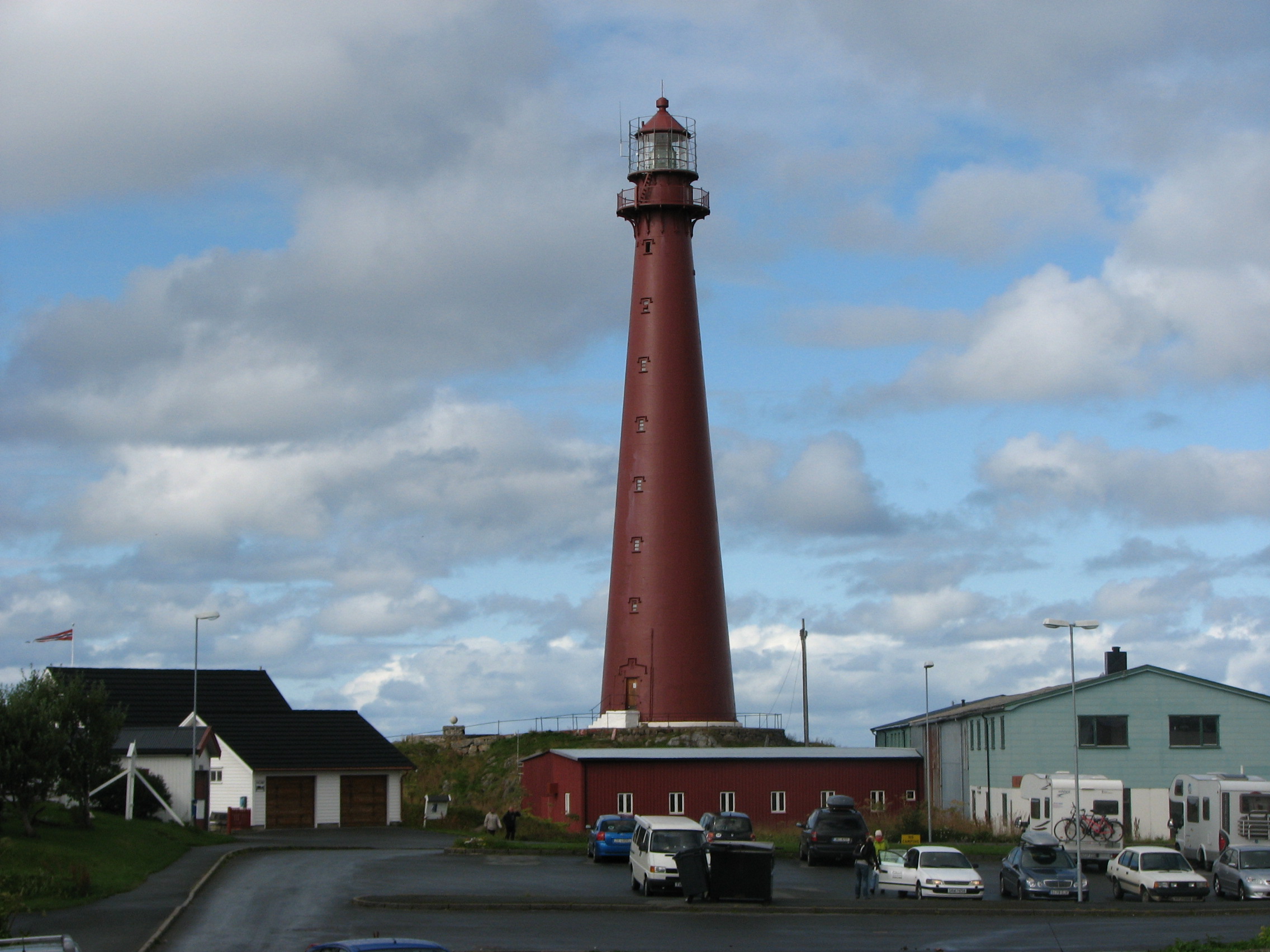
Andenes Lighthouse
Every year on 26 April, the Andenes Lighthouse goes dark. Not because it has failed or been decommissioned, but because the sun will not set again for months. At 69 degrees north, on the outermost tip of Andoya island in the Vesteralen archipelago, the midnight sun renders a lighthouse redundant from late April through early August. When the light returns on 10 August, the Arctic darkness has begun its slow annual reclamation, and the 40-meter red tower resumes the work it has done since 1859: throwing a white flash across the Norwegian Sea every thirty seconds, visible for eighteen nautical miles.
Iron Against the North Atlantic
The lighthouse was established in 1859, during a period when Norway was systematically lighting its enormous and dangerous coastline. The country's western seaboard -- more than 25,000 kilometers of mainland coast and islands -- was among the most treacherous in the world for mariners, a maze of fjords, skerries, and open-ocean exposure where storms rolled in from the North Atlantic with little warning. Andenes sits at a particularly exposed point, the northern tip of an island chain that catches the full force of weather systems moving east from the Norwegian Sea. The tower is built of cast iron, round in cross-section, and painted the deep red that marks it against both snow and summer green. At 40 meters, it was tall enough to lift its light above the spray and fog that clung to the shoreline, and sturdy enough to endure winds that regularly exceed gale force.
A Light That Follows the Seasons
Most lighthouses operate year-round. Andenes does not, and the reason is pure astronomy. North of the Arctic Circle, the sun remains above the horizon continuously during the summer months -- the famous midnight sun that draws tourists to northern Norway. During this period, no artificial navigation light is needed because there is no darkness to penetrate. The Andenes light burns from 10 August through 26 April, a schedule dictated not by bureaucratic convention but by the tilt of the Earth's axis. This seasonal rhythm gives the lighthouse a character unlike its counterparts further south. It is a working instrument with a built-in rest period, a beacon that defers to the sun when the sun refuses to yield the sky.
Automation and Afterlife
For more than a century, lighthouse keepers maintained the Andenes light -- trimming wicks, polishing lenses, recording weather, and enduring the isolation that came with living at the tip of a windswept island above the Arctic Circle. Automation arrived in 1978, eliminating the keeper's role and converting the lighthouse to remote operation. The tower might have faded into obscurity, as many automated lighthouses do. Instead, it found a second life. In 1999, Andenes Lighthouse was listed as a protected cultural heritage site, recognizing its architectural and historical significance. The nearby Andoy Museum took over management and began offering guided tours during the summer season. The result is that Andenes has become the best-known and most-visited lighthouse in Norway's Arctic region -- a monument to the maritime heritage of a coastline where the sea has always been both livelihood and threat.
The View from the Top
Visitors who climb the tower's interior staircase emerge onto a platform with a view that stretches across the Norwegian Sea to the northwest and along the spine of Andoya to the south. On clear days, the ocean extends to a sharp, unbroken horizon -- the next landmass in that direction is Svalbard, nearly a thousand kilometers away. Below, the village of Andenes clusters around its fishing harbor, a community that has depended on the sea for centuries. Whale-watching boats depart from the harbor in summer, chasing sperm whales that feed in the deep waters off the continental shelf. The lighthouse presides over all of it: the village, the harbor, the whale boats, and the endless ocean. It is a simple structure with a simple purpose, but standing at its base -- a red iron column against the Arctic sky -- you feel the full weight of what it means to mark the edge of land where Norway runs out of ground and the North Atlantic begins.
From the Air
Located at 69.32N, 16.12E at the northern tip of Andoya island in the Vesteralen archipelago, Nordland county, Norway. The 40-meter red cast-iron tower is a prominent visual landmark from the air, standing at the edge of the village of Andenes. Andenes Airport (ENAN) is immediately adjacent, less than 1 nm to the south. The lighthouse sits on exposed coastline facing the Norwegian Sea. Approach from the northeast for the best view of the tower against the ocean backdrop. Weather is highly variable; strong winds and low visibility are common, especially outside summer months.