Anderlecht
Erasmus came here to write. Jacques Brel grew up here, the singer who would later make the cardboard-box factory of his family the subject of a song, and somewhere on the working-class streets of postwar Anderlecht he became the man who could turn a bourgeois life into a four-minute act of escape. Saint Guy — the Poor Man of Anderlecht — lay in his crypt under the Collegiate Church for a millennium of pilgrims. RSC Anderlecht, the football club whose purple-and-white scarves still hang from windows on match day, has won the Belgian top division 34 times, more than any other team in the country. Anderlecht is one of the 19 municipalities of the Brussels-Capital Region — 17.91 square kilometres in the southwest, 126,581 people in 2024, legally bilingual French and Dutch — and it has been many things at once for so long that to call it a single neighbourhood would be to miss the point.
From Village to Brussels
Anderlecht spent most of its history as a village outside the walls. In 1393, the Duchess of Brabant, Joanna, formally folded it into Brussels by charter; around the same time the Romanesque crypt of Saint Guy was crowned with a new Brabantine Gothic church above it. In 1521, the Dutch humanist Erasmus of Rotterdam stayed for a few months in the canons' house next to that church, the building that today is preserved as the Erasmus House museum with its medicinal and philosophical gardens. The 17th and 18th centuries dragged Anderlecht into the long wars between the Low Countries and France: from the high ground of Scheut, in the north of the municipality, French batteries lobbed the 1695 bombardment of Brussels — together with the resulting fire, the most destructive single event in Brussels' history. On 13 November 1792, just after the Battle of Jemappes, General Dumouriez and the French Revolutionary army routed the Austrians here, and the French promptly disbanded the canons and declared Anderlecht an independent municipality. At century's end, the place still counted only about 2,000 souls.
The Canal Made the City
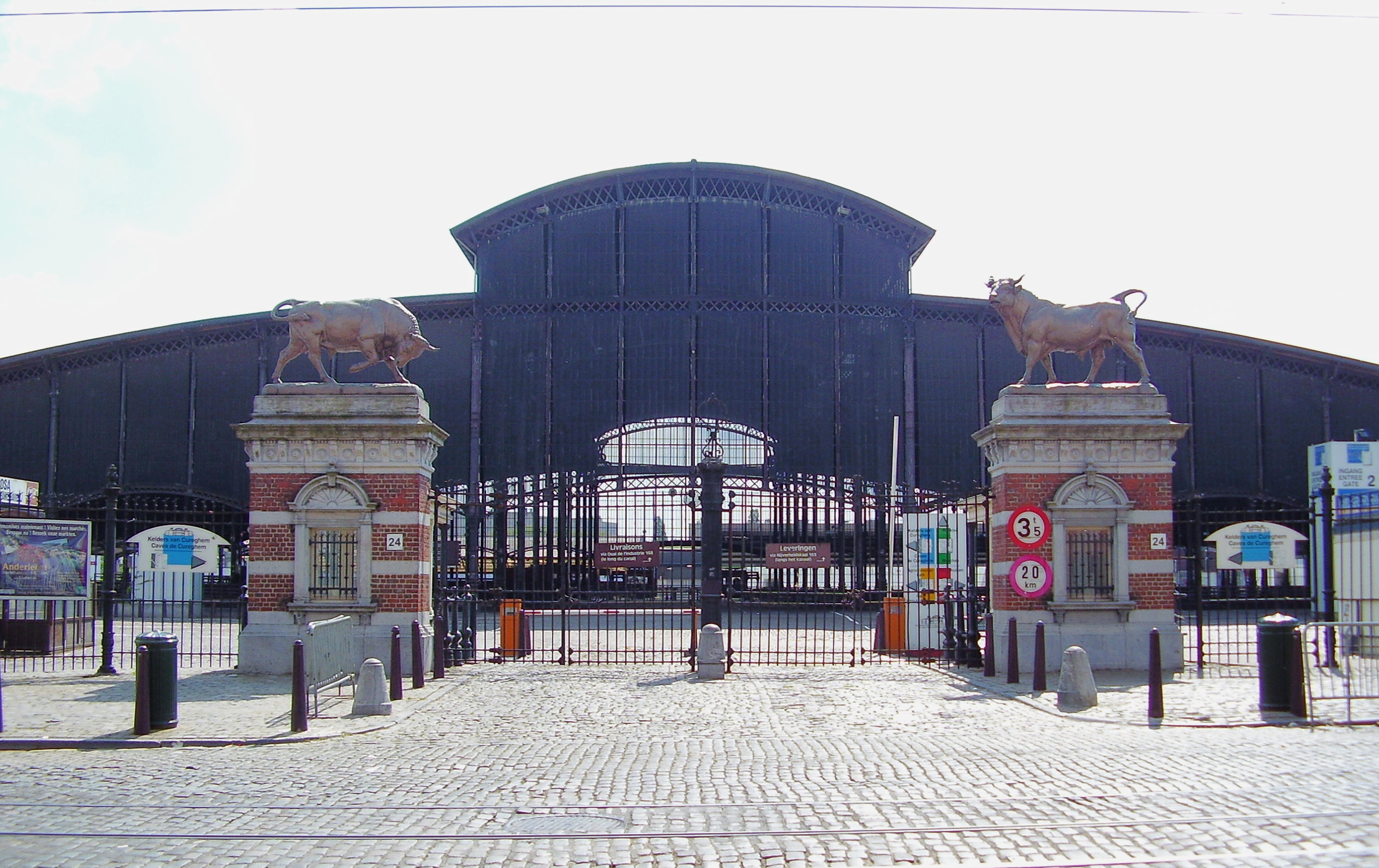
Then came the Industrial Revolution and a multiplier on everything. Between 1830 and 1890 the population of Anderlecht grew tenfold; it doubled again between 1890 and 1910. The Brussels-Charleroi Canal cut through the western half of the municipality and became the spine of industrial Anderlecht: along the canal and the Chaussée de Mons rose Cureghem, today still one of the largest and most densely populated districts of the commune, and an Anderlecht-specific Brussels word — the Royal School of Veterinary Medicine moved to Liège in 1991, but Belgians still say *Cureghem* when they mean the vet school. The Abattoirs of Anderlecht on rue Ropsy Chaudron remain the main slaughterhouse in Brussels, employing about 1,500 people, and the Great Hall now doubles as a covered food and flea market. To house the workers, new garden cities went up at the start of the 20th century — La Roue, Moortebeek, Bon Air — modest picturesque rows of small houses that still feel like the architectural conscience of an early-1900s working class. After 1945, modernist housing projects like Scherdemael, Peterbos, Marius Renard, and Aurore filled in the green spaces.
Erasmus, Brel, and a Pope
Few municipalities of Brussels can match Anderlecht's roll call. Saint Guy, the 11th-century farmhand-turned-pilgrim known as the Poor Man of Anderlecht, is the patron saint; his tomb is in the crypt of the Collegiate Church of St. Peter and St. Guido, one of the oldest in Belgium, dating in part to the 10th century. Adrian VI, pope from 1522 to 1523 and the last non-Italian pope until John Paul II, served as a canon at the Anderlecht chapter. Erasmus stayed in 1521 and the house he stayed in is now a museum. Jacques Brel, born 1929 and dead 1978, lived from 1942 to 1951 at 7, rue Jacques Manne and worked from 1946 to 1953 at the family cardboard-box factory at 18, rue Verheyden; a Brussels metro station bears his name. Toots Thielemans, the jazz harmonica virtuoso, was an Anderlecht boy. So were the comic-book artists William Vance and Zidrou, the cyclist Philippe Thys (a three-time winner of the Tour de France), the chanson singer Régine, and the poet Maurice Carême. Princess Elisabeth, the Duchess of Brabant and heir to the Belgian throne, was born here in 2001.
Purple and White
On a match day in the Meir district, the streets around Astrid Park fill with scarves of the same colour. RSC Anderlecht plays its home matches in the Constant Vanden Stock Stadium — named for the entrepreneur, footballer, and Belgium national team coach who shaped the modern club — and it remains, by a wide margin, the most successful Belgian football team in domestic and European competition, with 34 Belgian top-flight titles. The stadium sits inside a residential neighbourhood that was planned in the years just before the First World War: broad avenues, villas, and row houses in Art Deco, a coherent inter-war ensemble that holds up surprisingly well today. There is more here than the football: the synagogue of Anderlecht, an Art Deco building completed in 1933; the National Memorial to the Jewish Martyrs of Belgium, commemorating the 24,600 Belgian Jews murdered in the Holocaust; the National Museum of the Resistance; the Cantillon Brewery, an actual working brewery that doubles as a *gueuze* museum; and, somewhere on Boulevard Sylvain Dupuis near the Westland Shopping Center, a statue of Jean-Claude Van Damme that the municipality has, with the right blend of pride and self-deprecation, allowed to remain.
From the Air
Anderlecht sits at 50.8392 N, 4.3297 E, in the southwestern Brussels-Capital Region. From altitude, look for the Brussels-Charleroi Canal slicing diagonally through the municipality from northeast to southwest — the canal is the easiest landmark for finding the commune, with Cureghem hugging the eastern bank and the Abattoirs (a long, glass-roofed Great Hall) on rue Ropsy Chaudron. The Constant Vanden Stock Stadium (Lotto Park) is visible inside Astrid Park, southeast of the canal. Recommended viewing altitude 1,500-3,000 ft AGL. Brussels (EBBR) is 12 km east-northeast. Heavy controlled airspace — Brussels CTR and TMA; coordinate with EBBR approach.