Andersonville Prison
"Can this be hell?" The words came from Sergeant Robert H. Kellogg of the 16th Connecticut Volunteers as he stepped through the stockade gates on May 2, 1864. Before him stood what had once been men -- walking skeletons covered in filth, crammed into a space barely larger than a small farm field. In the center of the pen, a swamp of human waste sent up a stench so thick it could be tasted. This was Camp Sumter, better known as Andersonville, a Confederate prisoner-of-war camp carved from the pine woods of southwestern Georgia. In the fourteen months it operated, from February 1864 to April 1865, Andersonville would become the deadliest ground of the entire Civil War -- a place where nearly 13,000 men died not from bullets, but from scurvy, dysentery, and the slow agony of starvation.
A Pen of Pine and Misery
The prison rose from the red Georgia clay as a rectangular stockade of rough-hewn logs, originally enclosing about sixteen acres. By the summer of 1864, it had been enlarged, but the expansion could not keep pace with the flood of prisoners. At its peak, 45,000 Union soldiers were held in a space that allotted each man roughly five feet by six feet of earth -- barely enough to lie down. The only water source was a sluggish creek that also served as the camp's latrine, a stream perpetually fouled with the waste of thousands of sick and dying men. A light fence erected inside the stockade wall marked the "dead line" -- step across it or even brush against it, and sentries in elevated platforms called "pigeon roosts" would shoot without warning. It is possible, though not proven, that the modern word "deadline" traces its origins to this grim boundary.
Dying by Degrees
Food was the cruelest scarcity. By 1864, the Confederacy itself was starving, and prisoners received even less than their guards: poorly milled cornflour, often impossible to cook because the men had no utensils and were allowed almost no firewood from the surrounding forest. Scurvy ravaged the camp as prisoners went months without fresh fruit or vegetables. The Confederate Surgeon General dispatched Dr. Joseph Jones to investigate the staggering death toll; Jones vomited twice during his single-hour tour and concluded that "scorbutic dysentery" -- bloody diarrhea caused by vitamin C deficiency -- was the primary killer. Historian Rosemary Drisdelle later argued in 2010 that unrecognized hookworm disease was also a major cause of death. Clothing fell to pieces and was stripped from the newly dead. "Before one was fairly cold his clothes would be appropriated and divided," prisoner John McElroy recalled, "and I have seen many sharp fights between contesting claimants."
Order Among the Damned
Without law enforcement or any system of protection, Andersonville became something close to a primitive society. A gang calling themselves the Raiders terrorized fellow inmates with clubs, stealing food, money, and clothing -- killing those who resisted. In response, a prisoner named Peter "Big Pete" Aubrey organized the Regulators, who hunted down the Raiders, tried them before a jury of newly arrived prisoners, and meted out punishment: running the gauntlet, stocks, ball and chain, and in six cases, hanging. Survival depended on social bonds. Research has shown that prisoners with strong networks -- friends from the same regiment, hometown, or ethnic group -- had significantly higher survival rates. These connections provided shared food, shelter, moral support, and protection in a place where every man was desperate.
The Secret List
Young Union prisoner Dorence Atwater was assigned to record the names and numbers of the dead for Confederate authorities. Suspecting that the federal government would never see the official tally, Atwater sat beside commandant Henry Wirz and secretly copied every entry onto his own concealed list. When released, he smuggled the roll through Confederate lines in his bag. The list was eventually published by the New York Tribune after Horace Greeley learned that federal officials had refused it. Meanwhile, Wirz himself faced a military tribunal for war crimes. He argued that he had pleaded with Confederate authorities for more supplies and had tried to improve conditions. The court was unmoved. On November 10, 1865, Wirz was hanged -- one of only three men executed for war crimes after the Civil War, and the only Confederate official among them.
Sacred Ground
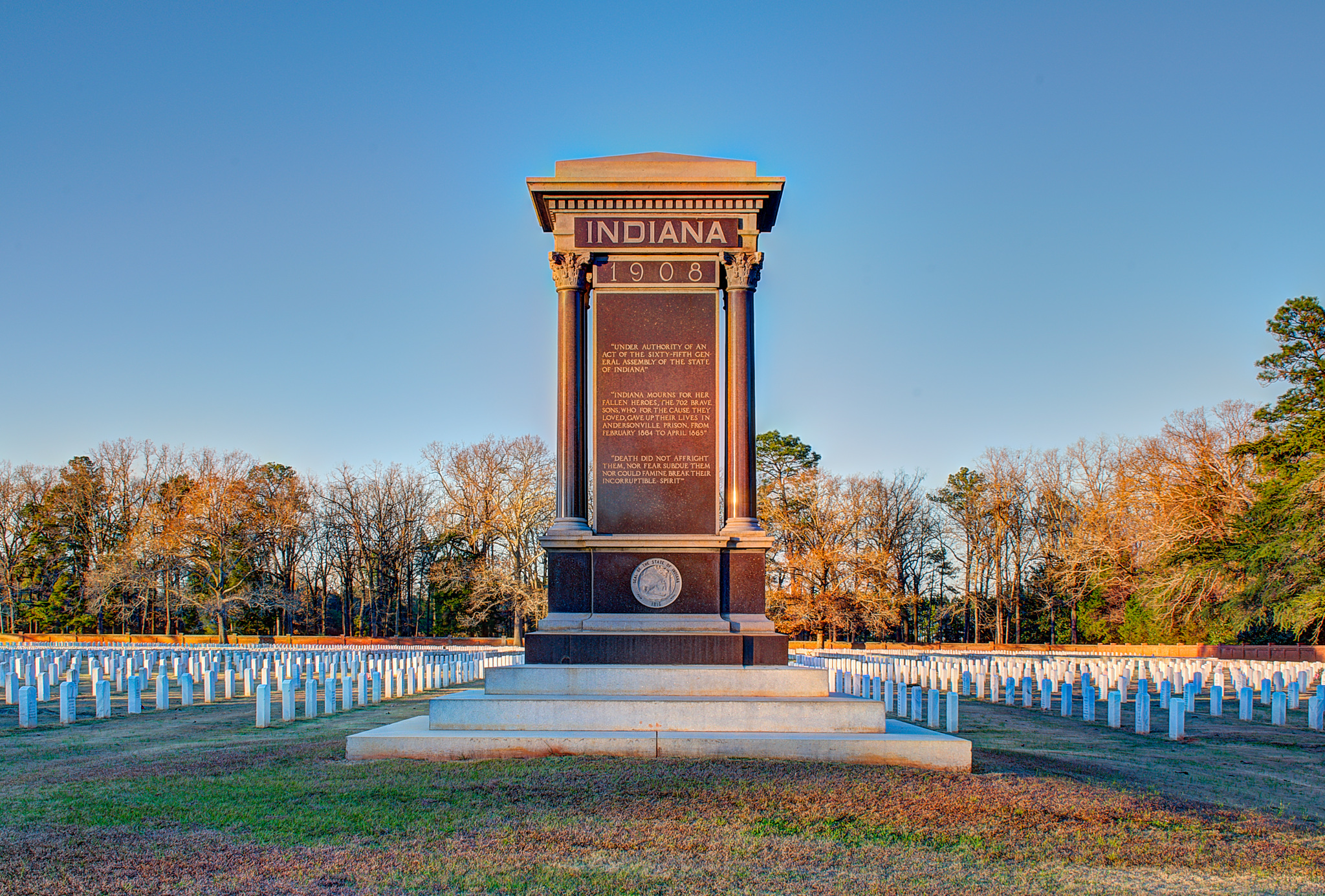
Today the site is the Andersonville National Historic Site, home to the Andersonville National Cemetery and the National Prisoner of War Museum. The cemetery holds 13,714 graves, 921 of them marked "unknown." Double rows of white posts trace the outline of Camp Sumter across the Georgia landscape, and two reconstructed sections of stockade wall stand at the north gate and northeast corner. In 1890, the Grand Army of the Republic purchased the grounds, later passing them to the Woman's Relief Corps, who planted Bermuda grass root by root, set out pecan orchards, and established a rose garden with bushes sent from nearly every state in the Union. Monuments from more than a dozen states now stand among the graves. What was once the deadliest patch of ground in the Civil War has become one of its most reflective -- a place where the cost of war is measured not in battles won, but in lives slowly and needlessly lost.
From the Air
Andersonville National Historic Site sits in the flat agricultural landscape of southwestern Macon County, Georgia, at 32.19N, 84.13W. From the air, the rectangular outline of the former stockade is visible as a cleared field marked by white posts and monuments. The National Cemetery is adjacent, its rows of headstones forming a distinctive pattern. The small town of Andersonville lies just west. Nearest airports: Middle Georgia Regional (KMCN) approximately 35nm northeast, Jimmy Carter Regional (KABY) approximately 20nm south-southwest. The terrain is flat pine and farmland, best viewed at 2,000-3,000 feet AGL.