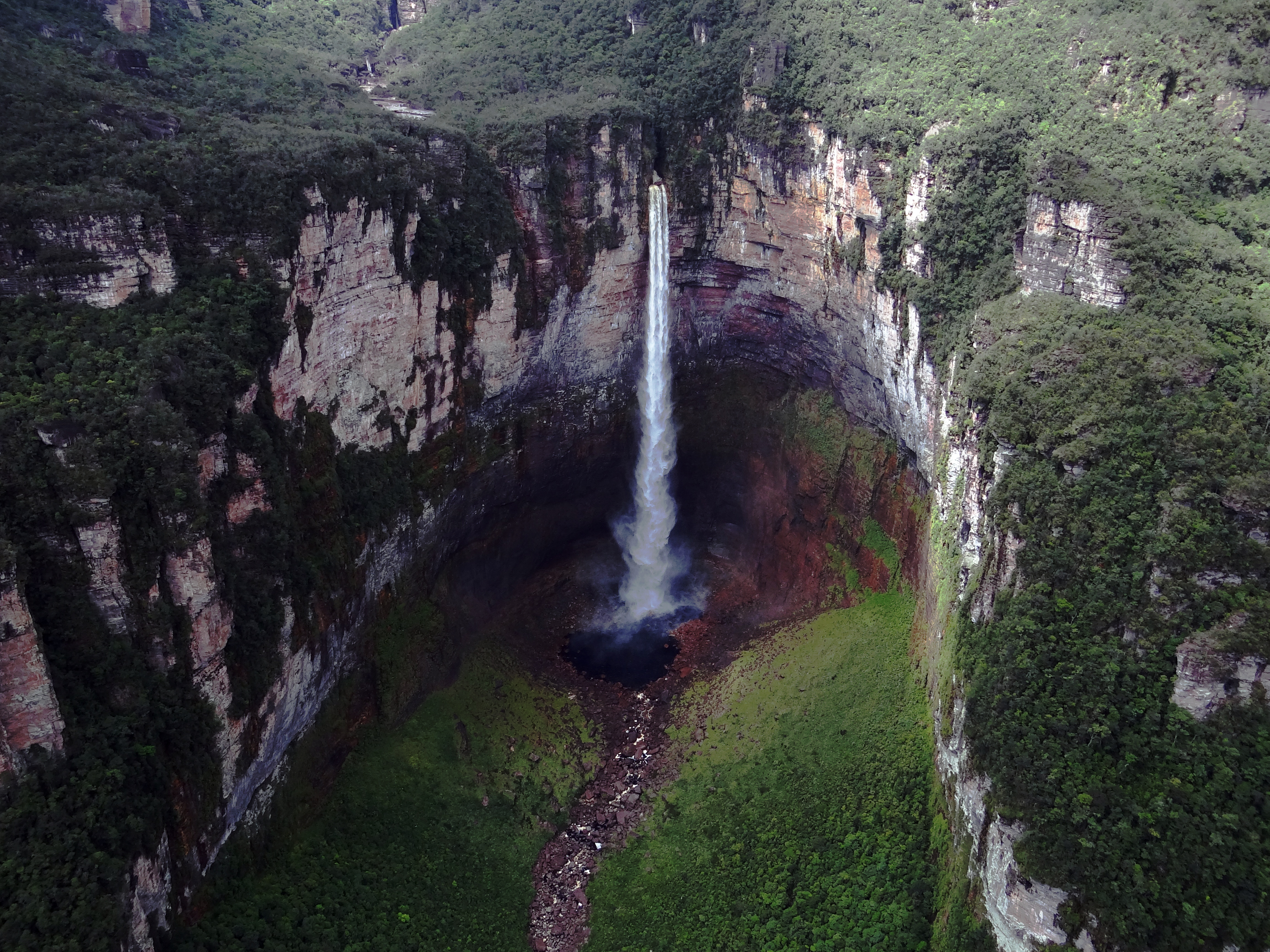
Angel Falls
Water falls for nearly a full kilometer here. It leaves the edge of Auyan-tepui and enters the air as a river, but long before it reaches the jungle floor, it has atomized into mist, a column of white vapor rising against a cliff of red-brown sandstone two billion years old. Angel Falls drops 979 meters in southeastern Venezuela -- the world's tallest uninterrupted waterfall, nineteen times the height of Niagara, and so remote that it remained unknown to the outside world until a gold-hunting aviator stumbled across it from the cockpit of a small plane.
The Pilot Who Gave It a Name
On November 16, 1933, American bush pilot Jimmie Angel was following directions from Spanish explorer Felix Cardona, searching for a valuable ore bed in the Venezuelan highlands. What he found instead was a waterfall of impossible height pouring from the flanks of Auyan-tepui. Four years later, Angel returned with his wife Marie and two companions, attempting to land his Flamingo monoplane El Rio Caroni on the tepuy's summit. The wheels sank into marshy ground, stranding them all. It took eleven days to hike down the gradually sloping backside of the mountain. News of their ordeal spread widely, and the waterfall was named in his honor -- Salto Angel appearing on Venezuelan government maps for the first time in December 1939. Angel's plane stayed on the summit for 33 years before a helicopter finally lifted it out. Today it sits, restored, outside the airport in Ciudad Bolivar.
A Place the Pemon Avoided
The Pemon people, indigenous to the Gran Sabana region, called the waterfall Korepakupai Vena -- 'big fall' -- though Auyan-tepui itself, meaning 'House of the Gods,' was considered dangerous and largely unvisited. There is no convincing evidence that the Pemon had named the individual streams on the mountain. In 2009, President Hugo Chavez announced his intention to rename the falls Kerepakupai-Meru, arguing that Venezuela's most famous landmark should carry an indigenous name. 'This is ours, long before Angel ever arrived there,' he said. He later stepped back, saying he would not decree the change but was defending the use of the Pemon name. The debate captured a tension that runs through much of South American geography: whose names stick to the land, and why.
Explorers, Climbers, and Jumpers
The Latvian explorer Aleksandrs Laime became the first recorded European to reach the base of the falls alone in 1946. He later climbed to the upper side via the back slope in the late 1950s and even located Angel's abandoned plane, eighteen years after the crash. On Latvian independence day in 1955, Laime proposed naming the stream after the Gauja River in Latvia, a name that was registered in Venezuela's National Cartographic Institution. The first ascent of the cliff face itself came on January 13, 1971, when a four-man team led by American mountaineer George Bogel, an electrical engineer from Pittsburgh, completed a nine-and-a-half-day climb. In November 1983, Max Botto of Venezuela and Jerry Bird of the United States became the first to BASE jump from the falls, Bird deploying his parachute later and landing first despite leaping second.
Paradise Falls and the Silver Screen
Angel Falls inspired the fictional Paradise Falls in Pixar's 2009 animated film Up, where a widower flies his house on balloons to a South American tepuy. The waterfall has appeared in films ranging from What Dreams May Come with Robin Williams to the 2015 Point Break remake, where actors appear to free-climb the adjacent rock face. Lowell Thomas included it among the Seven Wonders of the World in his 1956 documentary of the same name. Even the 1990 horror film Arachnophobia was partly set here. The falls have become one of those rare natural landmarks whose image is more widely recognized than their actual location -- many people who could sketch their shape could not find them on a map.
Getting There Is the Journey
Reaching Angel Falls remains a complicated affair. The waterfall sits in dense jungle within Canaima National Park, a UNESCO World Heritage Site. Visitors fly to Canaima camp from Ciudad Bolivar or Puerto Ordaz, then travel upriver by motorized canoe with Pemon guides. River trips generally run from June to December, when water levels are high enough for navigation. During the dry season, the river route closes, and the falls themselves narrow to a slender thread -- spectacular in a different way, revealing the full geology of the cliff face. From the air, the falls are visible as a white streak against Auyan-tepui's dark flanks, but the ground-level approach through rainforest and river rapids gives the waterfall its true scale.
From the Air
Located at 5.97N, 62.54W on the northwest face of Auyan-tepui. The falls are visible from considerable distance as a white streak against the dark cliff face of the tepuy. Best viewed from the west or northwest at 3,000-8,000 feet AGL. Auyan-tepui's flat summit (667 km2) is an unmistakable landmark. Nearest airports: Canaima (SVCN) to the northwest, Ciudad Bolivar (SVCB) to the north. Expect turbulence and convective weather near the tepuy, especially in afternoon hours. During the wet season (June-November), the falls are at maximum flow and surrounding waterfalls also become visible.