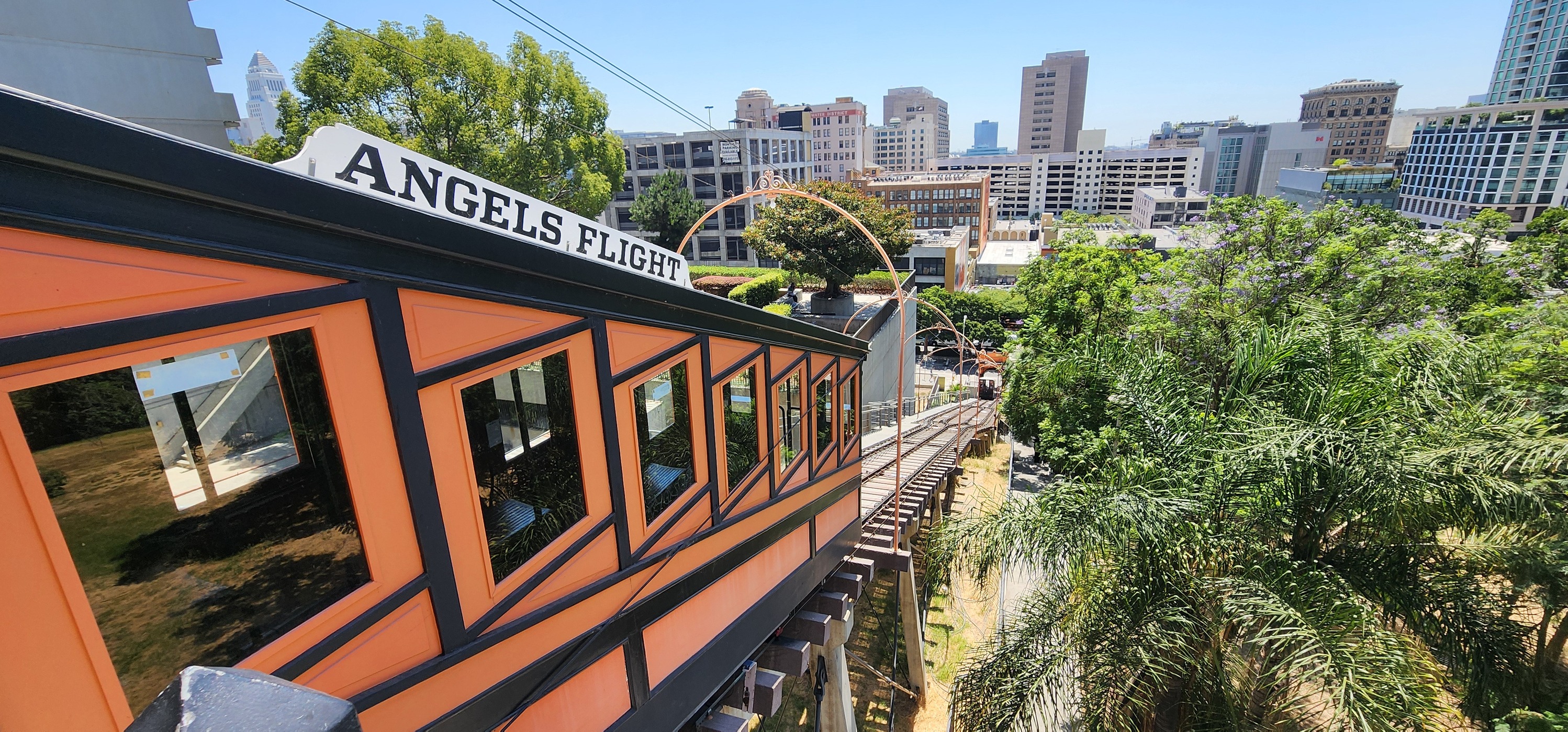
Angels Flight
The cars are named Sinai and Olivet, which tells you something about the ambitions of the man who built them. J.W. Eddy opened Angels Flight on December 31, 1901, to carry residents of Bunker Hill up and down a 33 percent grade to the shops and offices below. The railway ran for 68 years. Then the city tore apart Bunker Hill, scattered the community that lived there, and put Angels Flight in storage for 27 years while Los Angeles became something different. The cars came back. They have been coming back ever since.
The Hill That Was
Bunker Hill was not always a district of glass towers and concert halls. Through the first half of the 20th century, it was a dense residential neighborhood of Victorian mansions that had slowly descended into rooming houses and tenements — the kind of place where writers set their noir novels because it felt, to them, authentically precarious. Angels Flight served that community, running its two counterweighted cars up and down the 298-foot incline for a penny a ride, accumulating more than 100 million passengers over its lifetime. Los Angeles Historical-Cultural Monument No. 4 was created specifically for the railway.
The Clearance of Bunker Hill
In 1955, the city of Los Angeles declared Bunker Hill a blighted area and authorized its redevelopment. What followed was the longest urban renewal project in Los Angeles history, one that displaced approximately 22,000 people — elderly residents, immigrant families, people with no obvious place to go. The Victorian houses came down. The rooming houses came down. The community came down. Angels Flight shut on May 18, 1969, its eastern terminal demolished, its cars packed into storage. The redeveloped Bunker Hill that emerged over the following decades — with its museums and parking structures and financial towers — had no obvious use for a 298-foot funicular.
The Returns
The cars were stored for free by the city for 27 years. When Angels Flight reopened on February 24, 1996, it had been relocated half a block south of its original position to fit the new Bunker Hill streetscape. The revival lasted five years. In February 2001, a mechanical failure sent car Sinai careening down the track; one passenger died and seven were injured. The railway closed again for nine years of safety reviews, modifications, and bureaucratic process. It reopened in 2010, closed briefly in 2013 after an operator reportedly used a tree branch to bypass the brake system, reopened, closed, and reopened again. Its most recent opening was August 31, 2017.
The Shortest Railway in the World
The title is one of the railway's reliable promotional claims: at 298 feet, Angels Flight is shorter than almost any other operating funicular. What the title doesn't capture is the particular quality of riding it — the way the city opens up as Olivet (or Sinai) pulls you up the grade, the view of the downtown towers on one side and the Grand Central Market below on the other, the sense that you are moving through a city that has layered its histories on top of each other, the Victorian era buried beneath the 1970s buried beneath the present. The ride takes about 90 seconds. It has appeared in more than a hundred films.
From the Air
Angels Flight sits at 34.0513°N, 118.2502°W in downtown Los Angeles on the western slope of Bunker Hill. The railway is visible from low-altitude passes over downtown LA, where the cluster of high-rise buildings marks the Bunker Hill district. Grand Central Market and the historic Broadway corridor lie just below the railway's lower terminal. Nearest airports: Burbank Bob Hope (KBUR) 11 miles northeast, Hawthorne (KHHR) 9 miles southwest, Los Angeles International (KLAX) 13 miles southwest.