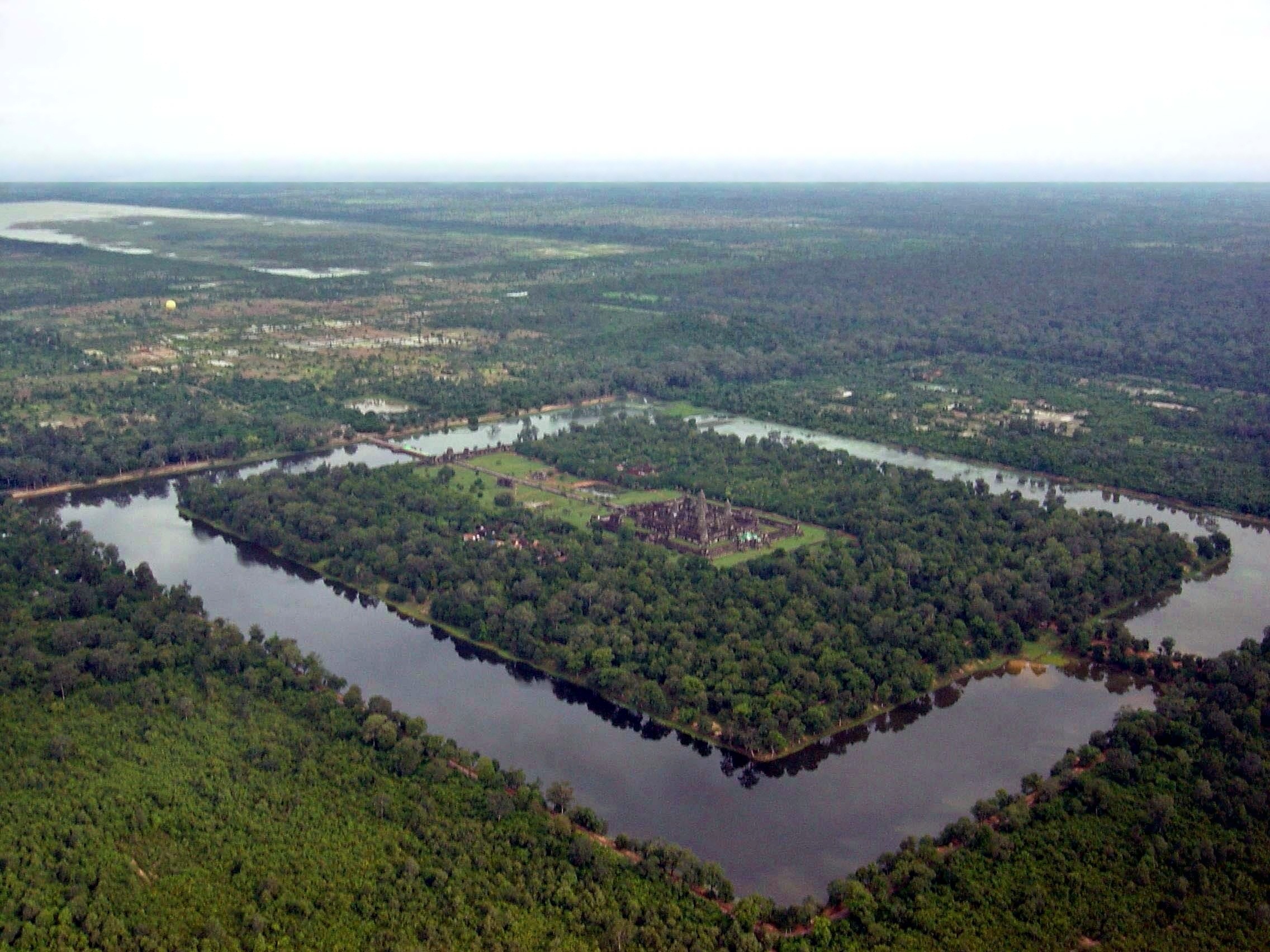
Angkor Wat
The temple faces west. Nearly every other Khmer monument of its era opens to the east, greeting the rising sun, but Angkor Wat turns its back on dawn and looks toward sunset -- toward death, toward Vishnu's cardinal direction, toward the afterlife its builder believed he would enter as a god. That single architectural choice, made nine centuries ago by King Suryavarman II, has kept scholars arguing ever since. Was this a mausoleum disguised as a temple, or a temple that simply broke convention? The bas-reliefs inside proceed counterclockwise, reversing the normal Hindu order -- the same reversal performed at Brahminic funerals. Whatever Suryavarman intended, what he achieved is beyond dispute: the largest religious structure on Earth, covering 162 hectares, surrounded by a moat wide enough to be mistaken for a lake, with five lotus-bud towers rising above the Cambodian plain like stone prayers.
A Mountain Built by Hand
Angkor Wat is a physical model of Hindu cosmology rendered in sandstone. The central quincunx of towers represents the five peaks of Mount Meru, mythological home of the gods. The encircling walls stand in for the mountain ranges at the edge of the world, and the 190-meter-wide moat represents the cosmic ocean beyond. Three concentric galleries rise in tiers toward the center, each level more restricted than the last -- commoners entered only the lowest gallery, while the innermost sanctuary was reserved for the king and his priests. The main tower aligns with the morning sun on the spring equinox. Construction began around 1113 and continued for roughly 37 years, employing thousands of laborers who quarried sandstone from Phnom Kulen, some 50 kilometers to the north, and floated the blocks down rivers and across the vast Tonle Sap lake.
Stone Dancers and Epic Wars
More than 1,800 apsaras -- celestial dancing figures -- adorn the walls, each carved with distinct facial features, jewelry, and hairstyles. No two are identical. The outer gallery's bas-reliefs stretch over 600 meters, depicting scenes from the Ramayana and Mahabharata alongside historical narratives of Suryavarman's military campaigns. One panel shows the famous Churning of the Sea of Milk, in which gods and demons pull a serpent wrapped around a mountain to churn the cosmic ocean and produce the elixir of immortality. The carving is so precise that individual soldiers can be identified by their unit based on hairstyle and weaponry. When afternoon sunlight enters the western galleries at a low angle, these flat reliefs seem to ripple with motion -- an effect the original architects almost certainly planned.
From Vishnu to Buddha
Suryavarman II dedicated Angkor Wat to Vishnu, breaking with the Shaivite tradition of his predecessors. But by the late 13th century, Theravada Buddhism had become the dominant faith across the Khmer world, and the temple quietly changed hands between religions. Buddhist statues replaced Hindu ones. Monks in saffron robes took up residence where Brahmin priests had once performed rituals. This religious transition, rather than destroying the temple, may have saved it. While nearly every other structure at Angkor was abandoned after the capital fell to Ayutthaya invaders in 1431, Angkor Wat remained an active Buddhist shrine. Monks maintained the temple, pilgrims continued to visit, and the jungle -- which swallowed neighboring Ta Prohm and the Bayon -- never fully reclaimed Angkor Wat. It is one of the few ancient monuments in Southeast Asia that has been in continuous religious use since its construction.
Rediscovery and Restoration
European travelers first encountered Angkor Wat in the 16th century, but it was the French naturalist Henri Mouhot whose 1860 descriptions sparked Western fascination. He called it grander than anything left by Greece or Rome, though local Cambodians had never lost track of it. French-led restoration efforts began in the early 20th century, interrupted by decades of civil war. Khmer Rouge soldiers camped within the temple during the 1970s, burning its remaining wooden structures for firewood, and a firefight between Khmer Rouge and Vietnamese forces left bullet scars on the bas-reliefs. Art thieves in the late 1980s inflicted further damage, lopping off sculptures to sell on the black market. Today, teams from France, India, Japan, and China work on conservation projects. The German Apsara Conservation Project found that around 20 percent of the reliefs were in poor condition, degraded by natural erosion and microbial biofilms eating into the sandstone.
A Living Symbol
Angkor Wat appears on Cambodia's national flag -- the only building depicted on any national flag in the world. From just 7,650 visitors in 1993, tourism surged to over 2.6 million foreign arrivals by 2018, bringing both revenue and strain. Ropes now guide visitors past the most fragile bas-reliefs, and wooden steps protect worn floors. Yet despite the crowds, the temple retains its capacity to stun. In the hour before dawn, when mist rises from the moat and the towers are silhouettes against a lightening sky, Angkor Wat still feels less like a ruin and more like what Suryavarman built it to be: a bridge between the human world and something vast beyond it.
From the Air
Located at 13.41°N, 103.87°E in Siem Reap Province, northern Cambodia. The temple complex and its rectangular moat are clearly visible from altitude, appearing as a geometric form amid dense forest. The West Baray reservoir (8km x 2km) lies to the northwest. Siem Reap-Angkor International Airport (VDSR/REP) is approximately 7km to the south. Best viewed in clear conditions during the dry season (November-February) when the moat reflects the towers. Approach from the west to appreciate the temple's unusual westward orientation.