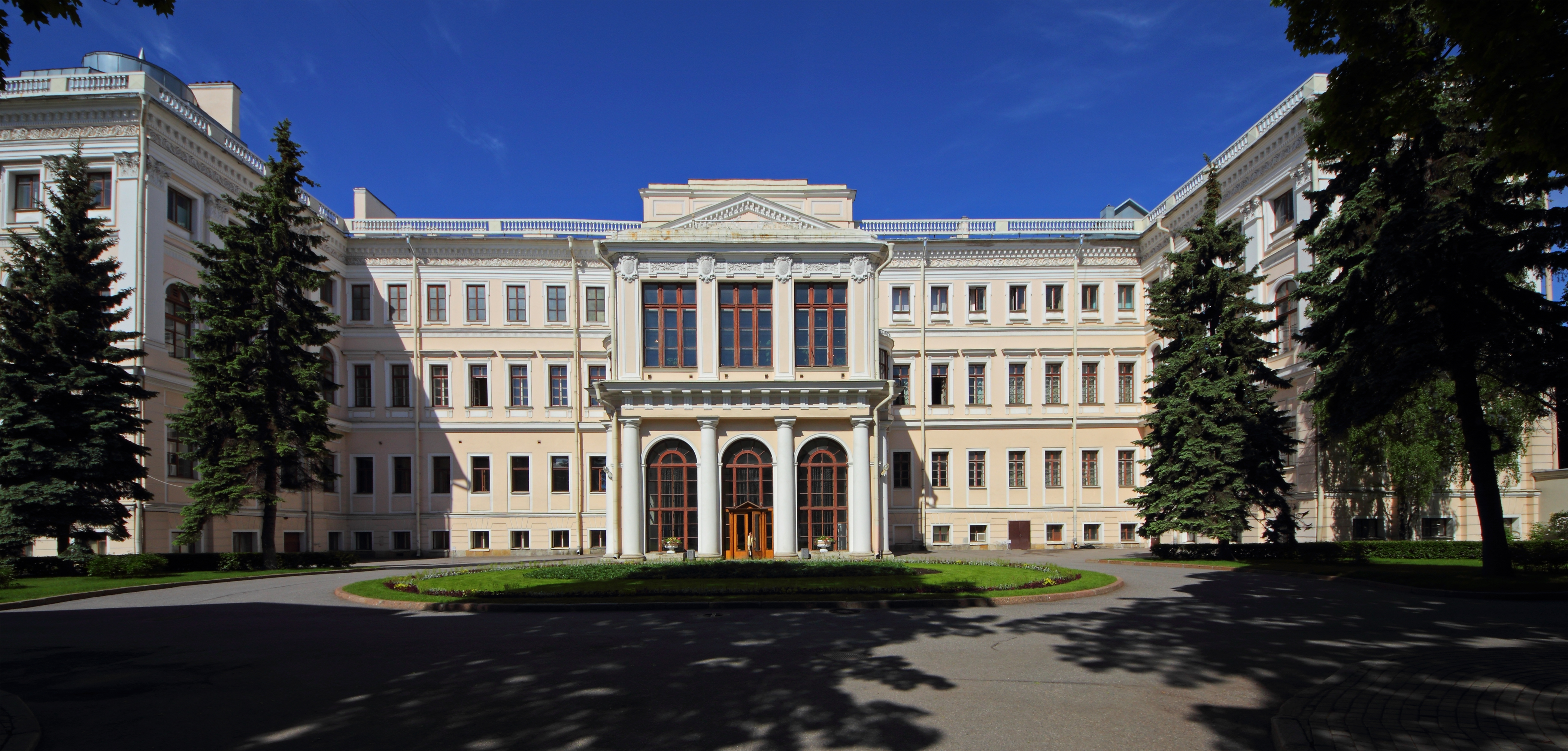
Anichkov Palace
Walk along Nevsky Prospekt in Saint Petersburg, cross the Anichkov Bridge with its four bronze horse-tamers, and on the left you reach a long Baroque palace stretched along the Fontanka river. Empress Elizabeth gave it to her favorite. Catherine the Great gave it to her favorite. Alexander I gave it to his sister. Alexander III made it his Saint Petersburg residence and refused to live anywhere else. Today the building serves more children than any tsar ever housed: about 10,000 of them, every week, take after-school classes inside the rooms where Romanovs once threw weddings.
An Empress's Gift
Construction began in 1741 on a plot that had once belonged to Antonio de Vieira, a Portuguese-born Russian official whose family had fallen out of favor. The empress was Elizabeth Petrovna, daughter of Peter the Great, recently arrived on the throne. The architect is contested - some attribute the design to Bartolomeo Rastrelli, who would later build the Winter Palace and the Catherine Palace; others to Mikhail Zemtsov. What everyone agrees on is the result: thirteen years of construction, finished in 1754, in dazzling Russian Baroque, with a main facade originally turned toward the Fontanka river and connected to it by a small canal so that boats could pull up to the steps. When the work was done, Elizabeth handed the palace to Count Aleksey Razumovsky, a Ukrainian Cossack singer she had met in the imperial chapel choir, raised to the highest ranks of the empire, and (most historians now believe) secretly married. The gift was the kind of thing eighteenth-century empresses gave.
Potemkin Moves In
Razumovsky died in 1771; the palace reverted to the crown. Five years later Catherine the Great gave it to her own favorite - Prince Grigory Potemkin, the one-eyed soldier-administrator who organized the conquest of Crimea, founded several southern Russian cities, and may also have been Catherine's secret husband. Potemkin commissioned the architect Ivan Starov to remodel the building in the newly fashionable Neoclassical style. The Baroque exuberance was restrained. An English garden architect named William Hould laid out the surrounding park. When Potemkin died in 1791, mid-journey on the steppe, the palace returned again to the crown and was adapted into the offices of Her Imperial Majesty's Cabinet - the financial administration of the imperial family. In the 1800s, under Alexander I, Giacomo Quarenghi added a strict neoclassical colonnade along Nevsky Prospekt for the Cabinet. Many critics felt - and still feel - that Quarenghi's severe wing does not sit well next to Rastrelli's earlier exuberance.
Wedding Presents
In 1817 Alexander I bestowed the palace on his sister, Grand Duchess Elena Pavlovna, as a wedding gift. She married into the German house of Mecklenburg-Schwerin and largely used the palace as a Saint Petersburg residence between trips abroad. After her, the palace passed into the possession of various heirs to the throne. Following his marriage in 1866, the future Tsar Alexander III and his Danish wife Maria Feodorovna - the same Maria who would later become a frequent visitor at the Alexander Palace - made the Anichkov their Saint Petersburg residence. Their children, including the future Nicholas II, spent their early childhood years in these rooms. When Alexander III became tsar in 1881, after his father Alexander II was assassinated by a bomb on a Saint Petersburg street, he refused to move into the Winter Palace. He found the Winter Palace too exposed, too associated with his father's assassination. The Anichkov, smaller and easier to guard, became the imperial family's preferred Saint Petersburg residence for the entire reign. The Winter Palace was used for state ceremonies; the family lived here.
Last Wedding, First Revolution
On 22 February 1914, the palace hosted what would be one of the last great social events of the Romanov dynasty: the wedding of Princess Irina Alexandrovna - Nicholas II's niece - to Prince Felix Yusupov, heir to one of the great fortunes of the empire. Two and a half years later, Felix Yusupov would help organize the murder of Grigori Rasputin in the cellar of his Moika Palace nearby. By then the Anichkov was no longer a wedding venue. Maria Feodorovna, Alexander III's widow and the dowager empress, had retained the right of residence at the Anichkov until the February Revolution of 1917, although by that point she had moved to Kiev to be closer to her younger son. After the revolution, the new Provisional Government's Ministry of Provisions moved into the palace. After the October Revolution, the Bolshevik government nationalized the building and turned it into the Saint Petersburg City Museum.
The Children's Palace
In 1937 the Soviet government converted the palace into a Young Pioneer Palace - a cultural and educational center for children, modeled on the imperial-scale facilities the new system wanted to provide for the working class. Renamed several times over the decades, the institution is now formally the Saint Petersburg City Palace of Youth Creativity. It is the largest such center in Russia. More than ten thousand children, from kindergartners to high school students, attend roughly a hundred different programs here every week: orchestras, drama clubs, science circles, dance ensembles, chess teams, robotics workshops, ecological societies, model rocketry, traditional crafts. Some of the rooms - the great halls Rastrelli built and Potemkin's people redecorated - are open to the public on selected days as a small museum. Most of the time, the building is full of children. They walk past the gilt mirrors and the Carlo Rossi-era plasterwork to their music lessons. The palace that Elizabeth built for her secret husband is now a place where someone's daughter learns to play the cello. There are worse afterlives for an imperial residence.
From the Air
Coordinates 59.933°N, 30.340°E. The palace stands at the intersection of Nevsky Prospekt and the Fontanka River in central Saint Petersburg, immediately east of the Anichkov Bridge with its bronze horse-tamer sculptures. Recognizable as a long pale-yellow Baroque facade along the Fontanka. Best viewed at 1,500-2,500 feet AGL. Nearest airport is Saint Petersburg Pulkovo (ULLI), about 16 km south.